
THE AGENCY OF IMAGES IN SIMULATED AND STATISTICAL PHOTOREALISM
LA AGENCIA DE LAS IMÁGENES EN EL FOTORREALISMO SIMULADO Y ESTADÍSTICO
Jens Schröter
University of Bonn
DOI: 10.33732/ASRI.987
.........................................
Recibido: (29 05 2026)
Aceptado: (22 07 2026)
.........................................
Cómo citar este artículo
Schröter, Jens. (2026). The Agency of Images in Simulated and Statistical Photorealism. ASRI. Arte y Sociedad. Revista de investigación en Arte y Humanidades Digitales, (31), e987.
Recuperado a partir de https://doi.org/10.33732/ASRI.987
Abstract
This article compares two distinct regimes of photorealistic image production, photorealism by simulation and photorealism by statistics, and reads their contrast through the question of image agency, a problem that has recently become central to critical studies of AI. From a media-archaeological perspective indebted to Foucault and Parikka, and drawing on sources from computer graphics research as well as an interview with AI artist Roope Rainisto, the study reconstructs the technical, historical, and economic conditions underlying each approach. Simulation, rooted in the flight simulators of the 1960s and now dominant in film, architecture, and advertising, is based on models: a virtual camera mathematically photographs a virtual space of objects, so that the resulting image is predictable, explainable, and traceable to a network of human decisions. Generative AI, by contrast, is data-driven: a prompt assembles pixels from an opaque latent space, producing images whose surface appears photographic while their details remain unpredictable. The article argues that these two modes of image production invite radically different attributions of agency, between images understood as indices of human labour and as seemingly autonomous entities.
Keywords
Agency of images, media archaeology, photorealism, computer graphics, generative AI.
Resumen
Este artículo compara dos regímenes distintos de producción de imágenes fotorrealistas, el fotorrealismo por simulación y el fotorrealismo por estadística, y lee su contraste a través de la cuestión de la agencia de las imágenes, un problema situado recientemente en el centro de los estudios críticos sobre IA. Desde una perspectiva de la arqueología de los medios deudora de Foucault y Parikka, y basándose tanto en fuentes primarias procedentes de la investigación en computación gráfica como en una entrevista con el artista de IA Roope Rainisto, el estudio reconstruye las condiciones técnicas, históricas y económicas que subyacen a cada enfoque. La simulación, heredera de los simuladores de vuelo de la década de 1960 y hoy dominante en el cine, la arquitectura y la publicidad, se basa en modelos: una cámara virtual fotografía matemáticamente un espacio virtual de objetos, de modo que la imagen resulta predecible, explicable y rastreable hasta una red de decisiones humanas. La IA generativa, en cambio, se rige por los datos: un prompt ensambla píxeles desde un espacio latente opaco, produciendo imágenes cuya superficie parece fotográfica pero cuyos detalles permanecen imprevisibles. El artículo sostiene que ambos modos de producción invitan a atribuciones de agencia radicalmente diferentes, entre imágenes entendidas como índices de trabajo humano o como entidades aparentemente autónomas.
Palabras clave
Agencia de las imágenes, arqueología de los medios, fotorrealismo, gráficos por computadora, IA generativa.
Introduction
Although image-generation systems based on machine learning —DALL·E or Midjourney among them— currently attract a remarkable amount of attention, photorealistic computer graphics are by far the more consequential field of technologies and practices for producing photo-like images (on what it means for an image to “look like a photo,” see Schröter, 2025). That field rests on modelling and simulation rather than on the statistics underlying AI imagery, and it looks back on a far longer history that began with flight simulation. As Gooch and Gooch (2001, p. 1) put it, photorealism has driven computer graphics for decades, and the quality of a computed image has habitually been judged by how nearly it approaches a photograph; their formulation, written in 2001, points back to origins that are by now roughly six decades old. From the 1970s onward the field gained steadily in importance, not least in cinema, where it became a central ingredient of the special effects that much entertainment film depends on. Photorealistic computer graphics are still indispensable today across architecture —where buildings can be shown before they exist— as well as science, advertising and many further domains (see Kramer, 2018); a whole service industry has grown up around photorealistic rendering1. One decisive advantage of rendering, at least until now, has been that it permits the deliberate, planned construction of images that look photographic. AI images behave differently: because they are produced by stochastic procedures, an identical prompt yields a different picture on every run, which makes such images – as yet – unsuitable for a great many applications.
These observations already point to the concern of this article. I want to set photorealism by simulation against photorealism by statistics, and to read that contrast through a question that recent debates in critical AI studies have placed at the centre of attention: the agency of images. Pictures are increasingly described not as passive carriers of human intention but as entities that act —that mobilise viewers, reorganise perception and intervene in automated decision-making. The discourse around generative AI (GenAI) sharpens this question, because the aesthetic and photorealistic quality of AI-generated pictures is regularly presented as evidence of the supposed creative and cognitive powers of the underlying systems. My claim is that the two photorealisms invite the attribution of agency in markedly different ways, and that comparing them therefore tells us something about how, and why, images and image-generating systems come to be addressed as agents at all. The article proceeds as follows. I first describe the production of photorealistic images by simulation, then briefly consider what the “photographic” in photorealism actually denotes. A section on photorealism by statistical rendering follows. The two approaches are then compared, with particular attention to the agency they appear to exercise, before a short conclusion returns to the question of agency.
Methodology
The comparison undertaken here proceeds from a media-archaeological perspective. Media archaeology designates a family of historical approaches to media that foreground the technical history of media and the history of knowledge that made a given technology possible; the label “archaeology” itself is borrowed from Michel Foucault (Parikka, 2012, p. 5; Schröter, 2023b). Following Parikka (2012), media archaeology treats media cultures as sedimented and layered, “a fold of time and materiality where the past might be suddenly discovered anew” (p. 3), and it excavates the past to understand the contingent character of the present rather than to compile linear histories of progress.
The first commitment is on the question of conditions of existence. In Parikka’s (2012) reconstruction, the basic operation of media archaeology, in a gesture indebted to Foucault, is “digging into the background reasons why a certain object, statement, discourse or, for instance in our case, media apparatus or use habit is able to be born” (p. 6). Applied to photorealistic imagery, this means: it is treated as an outcome whose technical, scientific, institutional and economic conditions can be reconstructed. The second commitment is the emphasis on discontinuity and contingency. As Schröter (2023b) argues, a media-archaeological account stresses the discontinuity in the development of a given digital medium as well as the contingency of every actual digital medium —“Jedes digitale Medium könnte anders sein als es ist” [“Every digital medium could be other than it is”] (p. 4)— and through the historical reconstruction of the knowledge and power conditions of a medium’s emergence it can make the political implications of technical design visible at the level of that design itself.
Concretely, the study draws on the source types that media archaeology privileges. Alongside the secondary literature of media and computer-graphics studies, it relies on primary sources written by the engineers and scientists who developed the relevant techniques —papers from computer-graphics conferences and journals, in which earlier stages of a technology are reported and from whose references further sources can be traced. The comparison of the two photorealisms is then organised around the discontinuity that separates a model-driven, “object-oriented” lineage from a data-driven, “media-oriented” one, with particular attention to the moments at which something new appears. Because media archaeology is, in Parikka’s (2012) phrase, less a history than a cartography —a mapping of future potentials as much as of pasts— the method also licenses the article’s closing turn to the question of the agency of images: reconstructing how each technique makes the network of human and technical decisions behind an image visible or invisible.
A note on terminology: The notion of the “agency of images” is especially discussed by Gell (1998) and Bredekamp (2018). It is often associated with the power of idols to move humans and make them act (Gell, 1998, pp. 133–137). This is obviously not the topic here. But agency in the sense of making-act does play a role in the types of images discussed here. As will be discussed in more detail at the end of this paper, simulated images are more like instruments; their agency produces (mostly) predictable behaviour (at least that’s the idea). Images based on GenAI are more unpredictable and are therefore interesting for art because they can produce inspiration.
Photorealism by simulation
In a simulation, the real process at issue has to be rendered in mathematical terms so that algorithms can subsequently reproduce it inside the computer (Neunzert, 1995, p. 44). Drawing on measurement data of every kind and on mathematically formulated regularities about how a process behaves, one constructs mathematical models that describe that process approximately. “Realism” —the correspondence between the mathematical model and the structure of an actual phenomenon— is thus the very point at which computer simulation sets in. A simulation builds models of objects or processes, and these can be characterised as virtual objects or processes.
The virtual object of a simulation is therefore a mathematically formalised structure of a “real” object, detached from matter and represented in the computer to whatever degree of approximation the purpose at hand requires. In a flight simulation —a virtual flight— the prospective flight situation must be anticipated as realistically as possible so that pilots can prepare adequately; yet the simulation must not be too realistic either, since a flight simulator in which one could actually die would serve no purpose. Setting aside the interactive behaviour of the simulated aircraft, this realism concerns the character of the display through which pilots see and hear the “landscape” they are supposedly flying over and the “adversaries” they are supposedly engaging. Newell and Blinn (1977) state the matter plainly when they recall that techniques for producing photograph-like images of modelled three-dimensional scenes emerged in the mid-1960s, driven initially by flight simulation, where the illusion of reality matters (p. 444). Here, a kind of agency of the image can be described: the image and its photorealism have the purpose of training pilots to act in the right way. Discussions sometimes blur whether the realism of the image means its approximation to “natural vision” —as the flight-simulation context might suggest— or its approximation to the conventions of the photographic image. Because photography appears to be so fundamental a category for describing perception, “realistic” most often means that the generated image follows the habits of viewing that photographs and films have shaped (Meyer et al., 1986; Nakamae & Tadamura, 1995).
The photo-like character is itself a simulation, in the sense that selected properties of photography and film are measured empirically and the resulting data serve as the basis for the computer models. The photographic dimension of photorealism is thus by no means merely rhetorical —it is not that the superficial signs or the “look” of photography are simply imitated, as happens in the artistic current of photorealistic painting, which arose at roughly the same moment as the first photorealistic experiments of computer-graphics artists. Rather, the properties of the photographic and cinematographic apparatus are themselves simulated, which means that a virtual camera is a real camera and not a mere imitation or fiction; depending on the data available, it can be brought ever closer to its material model, if a realistic camera model is in fact the aim —though the model can equally be altered deliberately. This virtual camera then virtually photographs a virtual field of objects, an “object-space” illuminated by a virtual light source (Schröter, 2003). At bottom these are all mathematical structures interacting through mathematical operations.
What is photographic in photorealism?
Virtual photographs or films are expected to honour the basic visual features of chemical photography2, of which at least three can be named, photograms aside.
The first is the abundance of unintended detail that constitutes —to borrow a phrase from Roland Barthes (1968)— the “effet de réel.” Many early renderings were judged insufficiently realistic precisely because they looked too “clean,” displaying too few scratches, stains and similar blemishes on the surfaces of the depicted objects (Newell & Blinn, 1977, pp. 445–446). To this belong the effects produced by camera optics, and above all the organisation of the image according to central perspective: computer-generated images may in principle obey any projection whatever, but if they aim at photorealism, they adopt the perspectival order handed down by photography and film.
The second is that research into photorealistic computer graphics strives to simulate not only perspectival projection but the specific behaviour of cameras —the empirically measurable distortions and focusing effects of lenses and shutters (Schröter, 2025), gradations of sharpness, and the shutter-speed-dependent motion blur that smears fast-moving objects. The simulation of motion blur refers, ex negativo, to the sharp instantaneity of most photographic images (Potmesil & Chakravarty, 1982).
The third concerns the properties of the photographic emulsion itself —for instance the grain that becomes visible in enlargements or in highly light-sensitive film— which photorealistic computer graphics seeks to model virtually whenever that is desired (Geigel & Musgrave, 1997).
Beyond these three basics, if unevenly encountered, features, photographic images can of course look extremely varied, quite apart from the countless styles of artistic photography and film. Yet the notion that guides many computer-graphics artists when they set out to make “photorealistic” pictures seems to reduce, in the end, to a standard, average photograph3. It bears noting, however, that the descent of computer-graphic realism from flight simulation meant that early procedures were developed for generating objects such as trees or clouds, so that the realism of a computed image long remained, in Manovich’s phrase, “partial and weighted” (1995, p. 59).
As the case of flight simulation already indicates, the convergence of computer-generated imagery toward standardised photographic and cinematographic pictures has institutional and economic conditions. From the late 1970s on, research into realistic computer graphics was pursued less and less by the military and increasingly by the film industry. For many military uses —and, in the end, for flight simulation itself— photorealistic graphics are unsuitable, because they supply too much information; complexity-reduced displays are therefore often preferred. But where computer-generated images are to be inserted into a film or a print advertisement as a special effect, and unless their artificiality is motivated by the narrative, they must blend indistinguishably into the photographic-filmic context4.
A range of software packages exists for rendering photorealistic images, each combining different algorithmic procedures for different aspects of the picture5. Sometimes inventive empirical approximations, workarounds and simplifications that are simply “good enough” —close enough either to the real world or to photographic images of it— are used; at other times meticulously precise simulations of the physics of light are preferred (Watt, 1996, p. 157). Which algorithms are chosen depends not only on explicit or implicit ideals of realism but very often on economic questions of computing resources and available time (Schröter, 2025). There is, in short, no single way to render photorealistic images (see Figure 1)6.
Figure 1: Gilles Tran, Image d’objets transparents montrant les capacités du logiciel POV-Ray, rendered with POV-Ray 3.6 using radiosity. The glasses, ashtray and pitcher were modelled in Rhino, the dice in Cinema 4D.

Source: Wikimedia Commons (July 2026), https://commons.wikimedia.org/wiki/File:Raytraced_image_of_several_glass_objects.png or http://www.oyonale.com/modeles.php?lang=en&page=40, Public Domain, free to use.

Photorealism by statistics
This section turns to the arrival of GenAI in the production of photorealistic images. Across the 2010s, and especially the 2020s, several important advances occurred in the field later named GenAI. The technologies now familiar to us were made possible by the broad availability of data through the internet and social media, by powerful graphics cards, and by vast quantities of invisible micro-labour such as the labelling of training datasets. The range of architectures cannot be set out here in any detail (see Pehcevski, 2024). What matters for the present purpose is the difference between the way images are produced in simulation and the way they are produced in GenAI.
The contrast between the potentials of simulation and of artificial intelligence —their differing uses, but also their joint use in hybrid systems— is at present widely discussed in scientific and industrial settings. The basic difference is this: simulation is computationally demanding but requires comparatively little data. It is model- and knowledge-driven, and therefore transparent and explainable; it is clear which description of the modelled phenomenon is in play, and the constituent elements are precisely defined in mathematical terms, even where their interactions produce emergent results. It is precisely for this reason that simulation is so often used to anticipate how a modelled entity or system will behave in the future or under altered conditions.
Artificial intelligence —today chiefly machine learning— is computationally somewhat less demanding, but it depends centrally on enormous datasets for training the network. It is data-driven: the system learns from the data7, bottom-up, as it were. The internal structures of the model that emerge in this process are not transparent (but see Offert & Dhaliwal, 2024). This approach is valuable wherever a great deal of data is available, but the underlying regularities remain obscure. Because it cannot easily be reconstructed how a particular output arises from a trained network, the results are frequently unexpected. It is this opacity that has recently fuelled the demand for AI systems to be made explainable8.
Returning to photorealistic images, the difference between those generated by simulation and those generated by GenAI mirrors the general difference between model-driven simulation and data-driven GenAI. In simulation, as described above, a virtual camera that projects clearly defined virtual objects in object-space into image-space is specified mathematically —that is, the image that will later appear is itself defined in advance. In that sense the image is “explainable”; its emergence is precisely predictable and controllable. With GenAI the process runs otherwise: a linguistic prompt instructs the system to generate an image from a position in the "latent space" learned from the training data; a complex, opaque, high-dimensional and non-linear mathematical structure (Somaini, 2025; on the aesthetics of AI images see also Wilde & Thon, 2025). GenAI produces an image that looks photographic not by virtually simulating the photographic process but by arranging pixels so as to maximise the probability that the resulting picture will look like a photo. The system learns, so to speak, what a photo looks like —just as it can learn what a cat looks like— from the surface appearance of the millions of photographic images in its training set (Meyer, 2025), photo-specific glitches included. Large language models now steer the diffusion models used to generate the picture, though the field is changing so quickly that other technologies may soon take over. One can, for instance, enter detailed instructions to ensure that the generated image looks photographic, specifying the type of lens or film to be evoked9.
Simulation versus statistics
I now want to set image generation by simulation against image generation by statistics, and to ask in each case how the procedure bears on the agency we are inclined to ascribe to images.
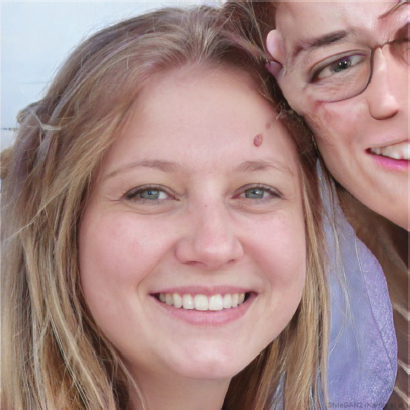
First, both routes to an image produce glitches of their own. In simulation, objects often appear too polished to read as genuinely photorealistic (see Figure 1); in AI-generated pictures, although photorealistic faces seem comparatively easy to produce, one frequently encounters disturbing local inconsistencies (see Figures 2 and 3).
Figure 2: Photorealistic image of persons created with GenAI.
Source: https://thispersondoesnotexist.com (July 2026). Images are free to use.
Figure 3: Photorealistic image of persons created with GenAI.

Source: https://thispersondoesnotexist.com (July 2026). Images are free to use.
These divergences follow from the divergent modes of image generation. Simulation is model-driven; GenAI is data-driven and statistical. In simulation every detail has to be specified, so certain levels of detail are sometimes simply omitted because they would cost too much time and computing power —which can yield images that lack local incident and look “clean,” “sterile” or “cartoonish” (at least where photorealism is the goal; see again Figure 1, with its faint air of being “too clean”). In GenAI the neural network has “seen” very many of photographs of human faces, so it can produce, with high probability, a face that looks as if it had been photographed10. But because the process is statistical and “hallucinations” cannot be eliminated (Xu et al., 2024 on LLMs), “unlikely” outcomes surface at various points, so that an otherwise impeccably photorealistic image carries strange flaws. In Figure 2 the woman’s face looks perfectly photorealistic, yet it carries odd speckles and the face to the right is strangely distorted. In Figure 3 the man looks perfectly photorealistic, but on closer inspection the right temple of his glasses is missing, and an oddly amorphous shape occupies the left background.
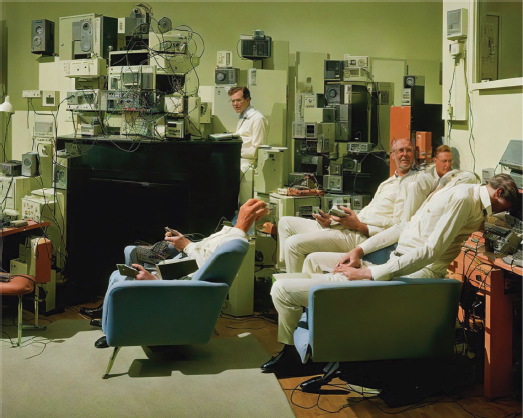
The odd inconsistencies of AI-generated images can themselves be turned to artistic account —media glitches have long been used in the tradition of media art to reflect on the medium. The Finnish artist Roope Rainisto, for instance, exaggerates the inconsistencies that are, at least for now, fairly typical, in order to construct outlandish, photorealistic scenarios of incoherence (see Figure 4). He thereby underscores and amplifies the dreamlike, often nightmarish quality of AI-generated images and so their occasionally involuntary surrealist tendencies (on dream and AI image see Schröter, 2023a; see Bomba & De Angeli, 2025 for other artistic approaches to GAI using glitches). Especially this image reflects on the agency of GenAI: old white men, representing science as a central form of modern epistemology, are surrounded by a mysterious technological ensemble.
Figure 4: Roope Rainisto, Hands of Fate, 2023. AI-generated image.
Source: Reprinted with permission of the artist.
Second, the outcome of the GenAI process is not predictable in detail —none of the strange inconsistencies is known beforehand— and this is what makes the creation of images with GenAI at once problematic, for anyone seeking a definite, clearly specified result, and appealing, for anyone hoping to be surprised and inspired. Where simulation in computer graphics yields clearly defined image objects, the result of GenAI, consistent with its general opacity, remains unforeseeable in its particulars. This property also makes GenAI unsuitable, at least so far, for longer sequences, since the continuity of generated scenes and especially of generated figures is poor —which is why AI-generated videos online mostly consist of short, disparate sequences separated by hard cuts. Considerable research is devoted to improving the consistency (Kalinski et al., 2025; on photorealism in AI video see also Moskatova, 2025). Third, prompting places language in a new relation to the image: in a kind of inverted ekphrasis, a verbal description brings forth a picture.
One of the most interesting features of GenAI is precisely that one does not know in advance which image a prompt will yield —in contrast to simulation, where, at least as far as the construction of the image is concerned, the result is in principle known beforehand. GenAI can serve as a source of inspiration because the gap between the verbal prompt and the resulting image is unforeseeable in detail. Asked in an interview how he would assess the surprises that GenAI affords, since even the most detailed prompt can still produce them, Rainisto called this a key feature, noting that traditional methods grant (nearly) total control but no additional creativity and leave the user essentially on their own —“if you use let’s say a 3d app” (personal communication, March 1, 2025). Asked whether he would describe the surprising results of GenAI as inspiration or as irritation —the latter not necessarily in a negative sense— he answered: as inspiration. A note on methodology: The interview with Rainisto is just one example of how the much-discussed opacity of machine learning, which on the one hand can be, as epistemic opacity (Formánek, 2026), a problem in science, on the other hand can be a source of inspiration in art. “Agency in artistic practices is inherently related to creativity, and there is a vigorous debate on whether AI can be creative” (Bomba & De Angeli, 2025, p. 2). This is a well-known discussion. The case of Rainisto shows that GenAI can be seen to have agency in the sense of producing unexpected results that can be used by an artist as source of inspiration and further work. GenAI is not creative in itself; its agency resembles more the function of accident as source of inspiration in, say, the work of Leonardo. A “sponge, saturated with paint in various colours, would be thrown against a wall, so that the spots and splashes left on the wall might then be taken as sources of inspiration” (Bredekamp, 2018, p. 275). Rainisto, in another group of works, trained a network with a specially curated database of artistic photos from so-called “New Color Photography” and could therefore create unexpected new perspectives on the history of artistic photography.
The contrast between the two forms of photorealism is therefore not only technical; it also describes two very different invitations to ascribe agency. Because simulation is tendentially transparent and its results are predictable, at least in certain usages as the ones discussed here11, the simulated image tends to present itself as an instrument: the agency at work is readily traced back to the modeller, the camera parameters and the light source, among others – in short, to a network of human decisions, with the image functioning as their predictable index. In this way the simulated image can be used to make people act in a mostly predictable way, be it pilots in a simulator or audiences witnessing breathtaking special effects in cinema. GenAI behaves differently. Its opacity, and the unforeseeability of its results in detail, mean that the picture seems to do something the user did not foresee and cannot fully reconstruct. The system thereby acquires the appearance of an agent in its own right – it seems to “surprise,” to “hallucinate,” to “decide.” In the terms of Alfred Gell’s (1998) anthropology of art, in which agents, patients and indices are distributed across a field of intentionalities, the GenAI image is far more easily mistaken for a primary agent than read as an index of a distributed, ultimately social agency (on distributed agency see also Latour, 1999). My comparison suggests that this appearance is an artefact of opacity rather than evidence of autonomous creativity. The very same statistical procedure that produces the photorealistic surface also produces the impression of an autonomous picture-maker; and it is precisely this impression that technology companies exploit when they invoke creativity as a pretext for extolling the agential capacities of AI. The two photorealisms, then, do not differ only in their glitches. They differ in how visibly the human and technical network behind the image remains available to be acknowledged and therefore in how strongly each tempts us to treat the image, or the system, as an agent.
The mentioned (potentially) inspiring quality of images produced with GenAI of course also extends to images that are not photorealistic. But GenAI makes it possible to produce photorealistic images (although sometimes with glitches) far more easily than with the older simulation methods. On the one hand this allows nearly everyone to do experiments with the photographic “look”, be it for artistic or purely entertaining purposes. On the other hand, this casts a shadow over the credibility on all images-that-look-like-photos, a well-known contemporary discussion, which I will not enter into here (Schröter, in press). But this problematic potential is also an agency of photorealistic images: making people doubt the veracity of images.
Conclusion
As this discussion has shown, photorealism by simulation and photorealism by statistics differ in significant ways. This is also where the comparison answers back to the question of the agency of images. If agency is something attributed rather than simply possessed, then the two photorealisms are best understood as two distinct regimes for the attribution of agency. Simulation keeps the network of human and technical decisions comparatively legible and therefore tends to present its images as indices of a distributed, traceable agency. Statistical generation, by contrast, withdraws that network into an opaque latent space and so lends its images the semblance of autonomous, self-acting entities. The photorealistic quality of GenAI imagery is regularly offered as proof of the creative and cognitive powers of the underlying systems; the comparison undertaken here suggests, rather, that the impression of autonomous agency is a by-product of opacity. Recognising this does not dispel the agency of images —pictures continue to act upon us, to mobilise and to inspire— but it relocates that agency: not in an autonomous machine, but in the historically specific, socially distributed networks of modelling, data, labour and economic interest from which photorealistic images, of either kind, are made. Read in this light, the choice between simulation and statistics is also a choice between two ways of making the agency behind an image visible or invisible.
Moreover, the different forms of photorealism point us to the agency of the photographic as such. A central goal of computer graphics was to make images that resemble photographs. That shows the hegemonic role of photography for the modern image regime.
In the near future, image generation will in all likelihood also pursue a hybrid path that combines simulation and GenAI. Pixar already does this: a scene is generated by simulation for the sake of stability, predictability and continuity, but at a lower resolution, which saves time, energy and therefore cost; AI is then used to “denoise” the images12. As early as 2018, Nvidia introduced a technology called Deep Learning Super Sampling, in which images in computer games, rendered by simulation at lower resolution, are likewise upsampled by a neural network13. The technology has since been improved several times. Although at first sight it delivers more photorealistic images, it remains controversial: some regard its results as aesthetically problematic, as “lifeless” (meaning: not having enough agency?) or as too close to the strange, distorted look that is sometimes characteristic of GenAI (Thomas, 2026; Weidemann, 2026). Whether the newer methods of GenAI will ultimately supersede and replace the older methods of simulation, or whether both will be used together in future processes of image generation, remains to be seen.
Bibliography
Barthes, R. (1968). L’effet de réel. Communications, 11, 84–89. https://doi.org/10.3406/comm.1968.1158
Bomba, F. & De Angeli, A. (2025). Agency and authorship in AI art: Transformational practices for epistemic troubles. International Journal of Human–Computer Studies, 205, 103652, 1–9. https://doi.org/10.1016/j.ijhcs.2025.103652
Bredekamp, H. (2018). Image acts. A systematic approach to visual agency. De Gruyter.
Formanék, N. (2026). How I stopped worrying and learned to love opacity. In J. M. Durán & G. Pozzi (Eds.), Philosophy of Science for Machine Learning. Core Issues and New Perspectives (pp. 25–36). Springer. Synthese Library 527. https://doi.org/10.1007/978-3-032-03083-2_2
Geigel, J. & Musgrave, F. K. (1997). A model for simulating the photographic development process on digital images. In Proceedings of the 24th Annual Conference on Computer Graphics and Interactive Techniques (SIGGRAPH ’97) (pp. 135–142). https://doi.org/10.1145/258734.258813
Gell, A. (1998). Art and agency. An anthropological theory. Clarendon Press.
Gooch, B. & Gooch, A. (2001). Non-photorealistic rendering. AK Peters.
Humphreys, P. (2004). Extending ourselves: Computational science, empiricism, and scientific method. Oxford University Press.
Kalinski, M., Podstawski, M., Ostrowski, K., Kudelska, M., Bartkowiak, P., Lyczko, P., Piasecki, M., Visscher, T. & Wang, H. (2025). Addressing character consistency challenges in AI filmmaking. In 2025 International Conference on Computing, Networking and Communications (ICNC) (pp. 642–648). https://doi.org/10.1109/ICNC64010.2025.10993630
Kittler, F. (2001). Computer graphics: A semi-technical introduction. Grey Room, 2, 30–45. https://doi.org/10.1162/152638101750172984
Kramer, A. (2018). Täuschend echt: Fotorealistische Computergrafik in Film, Kunst und Werbung. c’t, 7, 136–138. https://www.heise.de/ct/ausgabe/2018-7-Fotorealistische-Computergrafik-in-Film-Kunst-und-Werbung-3989845.html
Latour, B. (1999). Pandora’s hope: Essays on the reality of science studies. Harvard University Press.
Manovich, L. (1995). Realitätseffekte in der Computeranimation. In S. Iglhaut, F. Rötzer & E. Schweeger (Eds.), Illusion und Simulation: Begegnung mit der Realität (pp. 49–60). Hatje Cantz.
Meyer, G. W., Rushmeier, H. E., Cohen, M. F., Greenberg, D. P. & Torrance, K. E. (1986). An experimental evaluation of computer graphics imagery. ACM Transactions on Graphics, 5(1), 30–50. https://doi.org/10.1145/7529.7920
Meyer, R. (2025). Images from images: Generative AI and the reconfiguration of the ‘photographic’. Photography and Culture, 18(3–4), 281–290. https://doi.org/10.1080/17514517.2025.2522517
Moskatova, O. (2025). Synthetischer Fotorealismus: Soras Ästhetiken des medialen Wandels. Montage AV, 34(1), 105–122. https://montage-av.de/34-1-2025/
Nakamae, E. & Tadamura, K. (1995). Photorealism in computer graphics. Past and present. Computers & Graphics, 19(1), 119–130. https://doi.org/10.1016/0097-8493(94)00127-K
Neunzert, H. (1995). Mathematik und Computersimulation: Modelle, Algorithmen, Bilder. In V. Braitenberg & I. Hosp (Eds.), Simulation: Computer zwischen Experiment und Theorie (pp. 44–55). Rowohlt.
Newell, M. E. & Blinn, J. F. (1977). The progression of realism in computer-generated images. In Proceedings of the ACM 77 Annual Conference (pp. 444–448). Association for Computing Machinery. https://doi.org/10.1145/800179.810236
Offert, F. & Dhaliwal, R. S. (2024). The method of critical AI studies, a propaedeutic. arXiv. https://arxiv.org/abs/2411.18833
Páez, A. (2026). Axe the X in XAI: A plea for understandable AI. In J. M. Durán & G. Pozzi (Eds.), Philosophy of Science for Machine Learning. Core Issues and New Perspectives (pp. 133–156). Springer. Synthese Library 157. https://doi.org/10.1007/978-3-032-03083-2
Parikka, J. (2012). What is media archaeology? Polity Press.
Pehcevski, J. E. (2024). Generative AI models. Arcler Press. https://www.arclerpress.com/subjects/computer-and-information-science/generative-ai-models
Potmesil, M. & Chakravarty, I. (1982). Synthetic image generation with a lens and aperture camera model. ACM Transactions on Graphics, 1(2), 85–108. https://doi.org/10.1145/357299.357300
Schröter, J. (2003). Virtuelle Kamera: Zum Fortbestand fotografischer Medien in computergenerierten Bildern. Fotogeschichte, 23(88), 3–16. https://www.theorie-der-medien.de/text_detail.php?nr=34
Schröter, J. (2023a). The AI image, the dream and the statistical unconscious. Image. The Interdisciplinary Journal of Image Sciences, 37(1), 112–120. https://doi.org/10.1453/1614-0885-1-2023-15460
Schröter, J. (2023b). Medienarchäologie der digitalen Medien. In S. Stollfuß, L. Niebling & F. Raczkowski (Eds.), Handbuch Digitale Medien und Methoden (pp. 1–15). Springer. https://doi.org/10.1007/978-3-658-36629-2_21-1
Schröter, J. (2025). Les images de synthèse photoréalistes, entre exigence de réalisme et viabilité économique: Le cas du facteur de flare. Transbordeur, 9, 58–67. https://doi.org/10.4000/13dwv
Schröter, J. (in press). Abschied von der Wirklichkeit? Zum Weltbezug in verschiedenen Bildtypen. In J. Kermanchi, O. Schmidt & T. Weber (Eds.), Abschied von der Wirklichkeit? KI und die audiovisuellen Medien. Publisher is not yet known.
Somaini, A. (2025). A theory of latent spaces. In A. Ackerman et al. (Eds.), The world through AI (pp. 21–51). Jeu de Paume/JBE Books.
Thomas, J. (2026, March 20). “It’s re-rendering the game!” – It turns out game artists don’t love DLSS 5, despite Nvidia’s claims. IGN. https://www.ign.com/articles/it-turns-out-game-artists-dont-love-dlss-5-despite-nvidias-claims
Varenne, F. (2019). From models to simulations. Routledge.
Watt, A. (1996). Rendering techniques: Past, present and future. ACM Computing Surveys, 28(1), 157–159. https://doi.org/10.1145/234313.234380
Weidemann, A. (2026, March 19). Bilderstreit: Was KI mit Videospielen macht. Frankfurter Allgemeine Zeitung, 66, p. 33.
Wilde, L. & Thon, J. N. (2025). AI aesthetics: AI-generated images between artistics and aisthetics. Routledge. https://doi.org/10.4324/9781003676423
Xu, Z., Jain, S. & Kankanhalli, M. (2024). Hallucination is inevitable: An innate limitation of large language models. arXiv. https://arxiv.org/abs/2401.11817
BIO

 Jens Schröter. Prof. Dr. Jens Schröter has held the chair for media studies at the University of Bonn since 2015. Director (together with Prof. Dr. Anna Echterhölter, PD Dr. Andreas Sudmann and Prof. Dr. Alexander Waibel) of the VW-Main Grant “How is Artificial Intelligence Changing Science?” (Start: 1.8.2022, 4 Years); PI (together with Felix Hüttemann) of the VW-Research Project “The Computerized Palate” (Start: 1.4.2025); Winter 2021/22: Fellowship, Center of Advanced Internet Studies. Recent publications: Medien und Ökonomie, Wiesbaden: Springer 2019; (together with Christoph Ernst): Media Futures. Theory and Aesthetics, Basingstoke: Palgrave 2021; (together with Andreas Sudmann et al., eds.) Beyond Quantity. Research with Subsymbolic AI, Bielefeld: Transcript 2023; (together with Christoph Ernst): UFOs. Mediale Sichtungen, Stuttgart: Metzler 2025; (together with Christoph Ernst, Katerina Krtilova, and Andreas Sudmann, eds.), Handbuch Medientheorien des 21. Jahrhunderts, Springer, ongoing online and in print: 2026; Visit www.medienkulturwissenschaft-bonn.de / www.theorie-der-medien.de Contacto: schroeter@uni-bonn.de.
_______________________________
1 Searching for “photorealistic rendering” online returns, to a striking degree, pages that sell rendering software or advertise rendering as a paid service – see, for instance, https://www.render4tomorrow.com/photorealistic-rendering.
2 Editing conventions, montage and comparable filmic procedures are deliberately set aside here.
3 Compare Geigel and Musgrave (1997, p. 136), who speak of a “generalised photographic model.” Please note: I’m just saying that photorealistic computer graphics imitate in different ways the look of indexical images —that is not to say that photorealistic computer images are indexical.
4 It is, incidentally, no coincidence that a counter-trend toward non-photorealistic rendering took hold among the more “artistically” minded computer-graphics community: here painting, ink drawing and even the recognisable manner of individual artists are simulated on purpose (cf. Gooch & Gooch, 2001). Such procedures serve not only to imitate painterly techniques but also to generate cartoon-like imagery, which in turn makes non-photorealistic rendering attractive to the film industry —Disney, in particular, has invested in this line of research.
5 Again: a search for “photorealistic rendering” will surface numerous vendors offering rendering software for sale.
6 Kittler (2001) demonstrated that two of the central algorithms for global illumination —ray tracing and radiosity (the latter used in Figure 1)— are mutually incompatible, even though they are nowadays combined or superseded by newer techniques. It should be noted, however, that Kittler addresses only global illumination and not the photo-specific algorithms for motion blur and the further effects discussed above.
7 A distinction is usually drawn between supervised learning, in which the model is trained on annotated data; unsupervised learning, in which the model itself detects structures of similarity within the data; and so-called reinforcement learning.
8 A large research centre in Bielefeld and Paderborn, “Constructing Explainability,” is devoted precisely to this problem; see https://trr318.uni-paderborn.de/ (accessed 10 May 2026). On the question of explainability see also Páez (2026).
9 As with simulation, GenAI need not aim at photorealism at all; one can equally prompt the system to produce, say, a painting-like image. The present discussion, however, is concerned specifically with photorealistic output.
10 This can be observed at https://thispersondoesnotexist.com (accessed 10 May 2026): by simply reloading the page one obtains an endless chain of highly photorealistic portraits of non-existent people. Yet the images often display minor – and occasionally major – local inconsistencies. The flaws seem to follow a pattern of their own: a second figure at the edge of the frame is typically distorted, eyeglasses are a recurring problem, and coloured speckles sometimes appear on the faces.
11 To be precise: simulation in the natural sciences is often used because the dynamics of complex systems cannot be computed with classical mathematical methods and one must use simulations to see how a given system will evolve over time. In that sense, the results are not known beforehand (Varenne, 2019). Emergent behaviour plays also a major role in agent-based simulations where the interactions of many agents produce unexpected results. But for example, in generating special effects for a movie, simulation is often used in a very controlled way to get results specified beforehand. Moreover, complex simulations can produce a certain “epistemic opacity” (Humphreys, 2004, pp. 147–151) by themselves, so the difference between the transparency of simulation and the opacity of machine learning is more gradual than absolute. But the opacity in machine learning is strongly emphasized even in the most recent literature, see Formanék (2026), who also compares different forms of opacity.
12 Cf. “Disney Research, Pixar Animation Studios and UCSB Accelerate Rendering With AI,” https://la.disneyresearch.com/innovations/denoising/ (accessed 10 May 2026).
13 Cf. “Supreme Speed. Superior Visuals. Powered by AI,” https://www.nvidia.com/en-gb/geforce/technologies/dlss/ (accessed 10 May 2026).