
THE AESTHETIC ENGINE. GENERATIVE AI AND THE POLITICS OF THE IMAGE
LA MÁQUINA ESTÉTICA. LA IA GENERATIVA Y LA POLÍTICA DE LA IMAGEN
Luciana Nunes Nacif
Universidade Federal de Minas Gerais (UFMG)
DOI: 10.33732/ASRI.993
.........................................
Recibido: (02 03 2026)
Aceptado: (29 06 2026)
.........................................
Cómo citar este artículo
Nacif, Luciana N. (2026). The Aesthetic Engine. Generative AI and the Politics of the Image. ASRI. Arte y Sociedad. Revista de investigación en Arte y Humanidades Digitales, (31), e993. Recuperado a partir de https://doi.org/10.33732/ASRI.993
Abstract
What kind of images does artificial intelligence produce, and what world do they make possible? This essay approaches these questions through the philosophy of Vilém Flusser, for whom aesthetic phenomena do not represent reality but constitute it. Reading contemporary generative AI through this lens reveals that, rather than expanding the horizon of the visible, these images promote a flattening of experience: reference to the real is supplanted by statistical circularity, historicity is transformed into a continuous present, image creation becomes increasingly entangled with military technologies, and the disruptive potential of beauty gives way to a vectorfascist, kitsch reality. Drawing on Vilém Flusser, Jonathan Beller, Grégory Chatonsky, the Taller Estampa collective, and Hito Steyerl, the analysis unfolds through six interlocking movements that propose that generative images have become inseparable from what Steyerl calls “damage images”: pictures that wound the very reality they claim to depict. They are built on precarious labor, they enable automated warfare, and they enclose perception in self-referential loops. Yet if image-making has become damage-making, perhaps art's task today is to make this entanglement visible: to turn the tools of surveillance against themselves, to expose what is erased, and to clear a space for what has not yet been imagined.
Keywords
Generative AI, aesthetics, beauty, Vilém Flusser, Hito Steyer, Taller Estampa.
Resumen
¿Qué tipo de imágenes produce la inteligencia artificial y qué mundo hacen posible? Este ensayo aborda estas preguntas a través de la filosofía de Vilém Flusser, para quien los fenómenos estéticos no representan la realidad, sino que la constituyen. Leer la IA generativa contemporánea a través de este lente revela que, más que expandir el horizonte de lo visible, estas imágenes promueven un aplanamiento de la experiencia: la referencia a lo real es suplantada por la circularidad estadística, la historicidad se transforma en un presente continuo, la creación de imágenes se enreda cada vez más con tecnologías militares, y el potencial disruptivo de la belleza da paso a una realidad vectorfascista y kitsch. A partir de Vilém Flusser, Jonathan Beller, Grégory Chatonsky, el colectivo Taller Estampa e Hito Steyerl, el análisis se despliega a través de seis movimientos entrelazados que proponen que las imágenes generativas se han vuelto inseparables de lo que Steyerl denomina “imágenes daño”: imágenes que hieren la propia realidad que pretenden representar. Se construyen sobre trabajo precario, habilitan la guerra automatizada y encierran la percepción en bucles autorreferenciales. Sin embargo, si la creación de imágenes se ha convertido en la creación de daño, quizás la tarea del arte hoy sea hacer visible este enredo: volver las herramientas de la vigilancia contra sí mismas, exponer lo que se borra y despejar un espacio para lo que aún no se ha imaginado.
Palabras clave
IA generativa, estética, bello, Vilém Flusser, Hito Steyerl, Taller Estampa.
Introduction
Drawing on Vilém Flusser’s view that art shapes our experience of reality, this essay examines how generative AI operates as an “aesthetic engine”, producing images based on statistical patterns, financial logic, and Western-biased data. Rather than expanding our world, AI-generated imagery flattens historical, cultural, and semantic differences into a reproducible, derivative aesthetic that reinforces existing power structures and deepens representational inequality. Ultimately, the text argues that AI’s visual output signals not artistic innovation, but a retreat from the disruptive potential of beauty into a controlled, commodified, and circular reality.
Metodology
This article adopts a methodological approach inspired by Vilém Flusser's concept of Pilpul, an interpretative movement that circles around the object through successive perspectival leaps, illuminating its multiple determinations without claiming to exhaust it. The investigation is structured around six interconnected analytical layers:
• Models of reality: Establishes the Flusserian premise that aesthetic phenomena constitute models of reality, providing the theoretical and conceptual foundation for the analysis.
• Derivative reality: Examines the internal functioning of image generators through Jonathan Beller's theory, which conceives contemporary images as derivative entities analogous to financial instruments.
• Circular reality: Investigates the loss of semantic context in the latent space of generative models based on Grégory Chatonsky's concept of “vectofascism”.
• Reduced reality: Critically analyses the labelling processes that compress the representational dimensions of images, drawing on the work of the Taller Estampa collective.
• Concealed reality: Unveils the economic, social, and political layers rendered invisible in the production of generative images, employing Hito Steyerl's theoretical framework.
• Kitsch reality: Assesses the aesthetic status of generative images in light of the Flusserian concept of beauty, arguing that their computational nature distances them from the expansion of the spectrum of the real.
Each layer is approached through conceptual analysis and bibliographical review, articulating primary and secondary sources in a circular and recursive movement. The aim is not to offer a definitive synthesis, but to construct a plural interpretative framework that contributes to the understanding of the politics and aesthetics underpinning generative images
Results
Models of reality
Art and aesthetic phenomena play a fundamental role in the way we experience reality. As Vilém Flusser suggests, “we see the world with the colours of Van Gogh” and “London increasingly resembles a painting by Turner” (1985, p. 1). This means that, although concrete experience is unique and private, to make it communicable we need to compare it with something already existing in culture. In other words, we depend on art to perceive the world.
A love poem, for example, does not summarise a specific amorous experience: it proposes a new way of loving. This goes beyond interpreting love through a model such as Rilke's. If the poem does not exist, love simply does not exist. Art is poiesis: the production of the real. As the author states, “no experience of the concrete is possible without the prior communication of a model” (Flusser, 1975-1976, p. 10-11).
Flusser observes, however, that something changes in the universe of technical images. The information revolution unleashes a non-Darwinian process: the global dissemination of a single model of love, originating in Hollywood. For him, this does not represent the victory of one aesthetic over others in a sort of “survival of cultural species” (Flusser, 1985). Rather, it is a process of technical universalisation. This model imposes itself not because of its intrinsic value, but because there are technological means capable of multiplying it, distributing it and projecting it onto an infinite network of terminals around the world. Its prevalence is, therefore, an effect of its technical form.
These images, Flusser argues, no longer arise from the personal experience of their producers, the artists. On the contrary, they are experiences analysed and calculated at the source to be processed by apparatuses and only then converted into models for others' experience. In this context, the receiver does not access a previously shaped experience, like that of the poet, but rather an experience pre-calculated to be shaped: a raw datum of emotion codified to feed the apparatuses that distribute and replicate it (Flusser, 1985, p. 1). A programme.
Flusser thus offers an important perspective for understanding the impact of new generative images on the shaping of our worldviews. To better understand how they function, he proposes a second line of inquiry: to examine how these images are produced. In The Factory (Flusser, 2007), the media philosopher argues that factories are the decisive instance for deciphering an epoch. The Neolithic pottery workshop or the medieval cobbler's shop, for example, reveal more about the life, thought and revolutions of their societies than the philosophical texts or works of art of a distant elite. Real transformations, therefore, are born from the conflicts and dynamics of these workplaces.
It is in this context that Flusser foresees the emergence of a new human: the “functionary”, permanently connected to apparatuses by “thousands of threads, some of them invisible” (Flusser, 2007, p. 41). This is an individual so intertwined with technology that his very actions can be read as functions of a programme. In this vision, the factory of the future ceases to be a physical location and becomes a ubiquitous network of mediation.
Understanding the mode of production thus becomes an essential step in analysing the forces, networks of mediation and infrastructures that enable the near-instantaneous emergence of the generative images responsible for programming our reality.
Derivative reality
The paradigm of generative image production constitutes a break with the optical model that predominated in the twentieth century. In this traditional model, each photon could, in theory, have its trajectory retrospectively traced back to its origin. In the contemporary thermodynamic environment, causality is replaced by probability, and ray-tracing by statistical prediction.
Unlike the previous representational paradigm, generative images have nothing to do with reality per se, being able to assume the form of pure fictions, dreams or hallucinations (Steyerl, 2025, pp. 37, 84). Their organising principle is filtered through statistical procedures where contact with the exterior is mediated by data aggregation, creating a presumption that scale alone ensures the capture of meaningful patterns.
We are witnessing an inversion of the vectors of meaning: images no longer refer to something “out there”, but signify, rather, their own production “in here” (Flusser, 2008, p. 144). Unlike traditional photography, which always suggested a captured exterior reality, algorithmic images constitute pure computational process made visible, which makes them semantically opaque, for there is no meaning to unveil beyond the very functioning of the apparatus. Hence, the imperative to shed some light into the black box, to understand its internal logic, however opaque it may seem.
A first step is to understand its connection to financial logic. AI image generators function based on probabilistic prediction, and their theoretical framework derives from the financial system. These models estimate the “value” of an image in the same way that the Black-Scholes equation determines the value of financial derivatives. Their work involves not only predicting what people may want to see, but also what they are likely to invest their attention in.
According to the report Prompt Mixing in Diffusion Models using the Black Scholes Algorithm (Kothandaraman & Manocha 2024), diffusion models share a conceptual basis with the Black-Scholes model, widely used in financial markets for pricing European call options. The model uses a certain score (CLIP) to quantify the “price” of the generated image, treating it analogously to a stock. The financialisation of the image is clearly perceived in the variables of the formula: underlying stock price, strike price, time to expiration, and volatility.
As sociologist Donald MacKenzie (2006), explains, the Black-Scholes model evolved from a passive observer into an active creator within financial markets. Originally developed in the early 1970s, the formula was intended to be a “camera”, a descriptive tool that simply calculated an option's theoretical fair price by taking a snapshot of current market conditions. However, as traders, banks, and exchanges universally adopted it to price and trade options, the model transformed into an “engine.” Because everyone used the same formula to agree on prices, the market began to behave exactly as the model predicted, turning its description into a self-fulfilling prophecy. It became an active participant that helped construct the reality it purported to describe. As its use by market participants changed the market itself, the model became more “true” simply because it was used, as the world adapted to it.
Not only are financial derivatives and diffusion models built on the same mathematical foundation, but, as media theorist Jonathan Beller points out,
Images are derivative forms – they are forms of currency. And we work for them and in them. We are market makers and market takers. Structurally they demand wagers in attention in exchange for a return on the social. They are instruments of liquidity and risk. You give them credit. They give you credit. […] images also provide forms of currency, that is, they provide access to a particular set of social values and possible futures (Beller, 2021, p.233].
The hypothesis of authors such as Jonathan Beller, Randy Martin and Yves Citton is that financial instruments, and especially derivatives, emerge as a conceptual resource for thinking about creative practice and the circulation of media images in the post-2008 financial crisis world (Watt, 2022). Martin considers financial derivative products as “magical or fictitious objects, ephemeral and chimerical spectres referring to a world that has rid itself of any basis of value, a world that can no longer orient itself by what is real, a world obsessed with everything spectacular and speculative” (Martin, 2018).
In this scenario, generative artificial intelligence operates a profound transformation in the visual economy. But how do diffusion models, currently the main drivers of image generation, work? In the data training phase of diffusion models like DALL-E and Stable Diffusion, hundreds of millions of images are processed to identify statistical patterns, decomposing each of them into vectors that encode their visual and semantic characteristics. In the latent space of these models, images cease to exist as discrete entities. It is important to note that, by representing data in a compact form, where similar points are closer together, latent space allows models to manipulate complex data more effectively, focusing on the more “significant” aspects and discarding less “relevant” aspects of the images, according to the model’s criteria. This can generate the erasure of the diverse dimensions of the image.
Moreover, generative images operate from an incomplete and asymmetrical digital knowledge base, which systematically leaves vast fields of human knowledge beyond its reach. This digital corpus, inherited from an internet historically dominated by English and Western institutions, functions as a distorted mirror of humanity, reflecting only a privileged fraction of its knowledge.
Circular reality
By reducing millions of images to probabilistic relationships, generative AI eliminates the elements that conferred uniqueness to each image: context, history, etc. Latent space functions as a great anonymous equaliser, where all images become equivalent, provided they are statistically close. It is in the latent space that desemanticization occurs: the loss of language's referential function, a defining characteristic of what Chatonsky terms “vectofascism.”1 The artist clarifies that the term designates a fundamental aesthetic rupture: if historical fascisms expressed themselves through a monumental classicism that glorified a mythicised past, their contemporary expressions adopt a register marked by the grotesque, the kitsch and the appropriation of pop culture elements. This formal shift is symptomatic of profound transformations in current socio-technical structures (Chatonsky, 2025b). And generative artificial intelligence constitutes the ideal medium for the flourishing of this new sensibility.
In this context, neural networks process enormous sets of pre-existing images, eliminate their contexts, and promote a systematic levelling of all references, reducing distinct positions to a generalised equivalence. In this framework, value judgements, ethical distinctions and conceptual hierarchies dissolve before mathematical probability.
Moreover, the capacity to generate massive content at high speed allows the flooding of digital spaces, overwhelming traditional mechanisms of critical filtering. The result is an enclosure in a referential circularity, a repetition of the already known. These images do not project alternative horizons; on the contrary, they confirm and reinforce the prevailing structures of domination, making them omnipresent and inevitable. It is no coincidence that an aesthetic that levels all differences coincides with a technology based on statistical equivalences, showing the intimate relationship between current cultural forms and their technical supports.
Another relevant aspect is the erasure of temporal distinctions. In generative space, different historical periods coexist in a continuous and flattened present, where a portrait “in the style of Van Gogh” ceases to be a reproduction or imitation to become a probabilistic updating of the style, obtained through statistical analysis of his work. This temporal compression generates a permanent present where all styles, epochs and aesthetics become simultaneously available and combinable (Chatonsky, 2025a). In this process, historical events, political ruptures and cultural transformations are reduced to mere equivalent aesthetic variations. The result is the neutralisation of the political, emptied of its historical charge and conflict.
When it is possible to artificially generate any image of anybody in any context, the testimonial and critical value of the image collapses. Deepfakes represent the most evident example: the technical capacity to produce compromising images generates, paradoxically, an immunisation against their effects, creating a generalised scepticism that ends up favouring the existing social order.
Reduced reality
Through their work, artists such as Hito Steyerl, Trevor Paglen, Gregory Chatonsky, and the Taller Estampa Collective critically interrogate the nature and the political entailments of generative images.
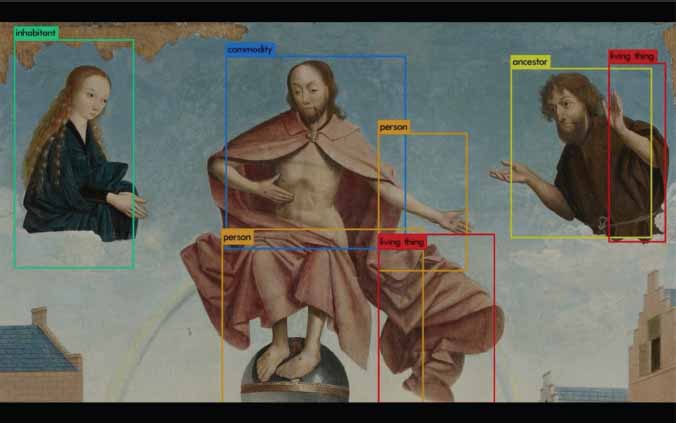
A key example is Taller Estampa's project (2019) What do you see, YOLO9000?, which exposes the lack of context, fragmentation, and inherent flaws in machine “vision.” For this work, the collective employed YOLO9000, a neural network trained on millions of images, as a case study of the computer vision tools currently being developed for automated image labeling (Figure 1).
Figure 1: Taller Estampa. What do you see, YOLO9000? 2019. Still from the video.
Source: https://tallerestampa.com/en/estampa/que-es-el-que-veus-yolo9000/.
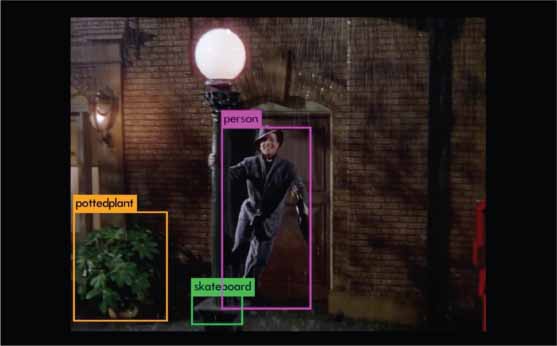
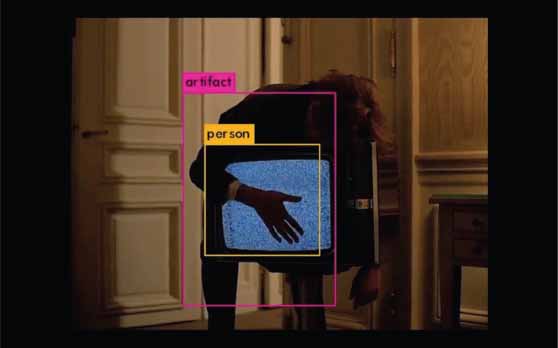
The work illustrates how YOLO9000 perceives the world: it identifies fragments of an image as discrete objects or living beings without synthesizing them into a coherent whole (Figures 2 and 3). By highlighting this piecemeal and incomplete nature of machine identification, the project explores the gap between verbal and visual recognition, positing that:
There is increasing interaction between images and languages. Still, language in itself cannot accurately define the image. For instance: how do you describe an event? Sense and nonsense. How do you describe exactly what happened? But are these the right words and images to use? Aren’t there other possibilities? Am I speaking too loud? Am I too close or too far? Where are all these signs that make me distrust language and submerge me in meanings, drowning reality, not freeing it of the imaginary? How do you describe an event? (Estampa, 2019)
Figures 2 and 3: Taller Estampa. What do you see, YOLO9000? 2019. Still from the video.
Source: https://tallerestampa.com/en/estampa/que-es-el-que-veus-yolo9000/.
In metaphysics, an event is understood as a concrete change or occurrence taking place at a specific location and moment. It is not a static object or a continuous state, but rather a particular happening marked by a transition from one situation to another. It’s inherently temporal, unfolding within a definite timeframe, whether instantaneously or over a duration. This temporality presents a challenge for generative AI, as its processes often compress or flatten the temporal axis, treating time as a simplified dimension rather than a lived continuum. Moreover, each event is singular and non-repeatable, uniquely defined by its specific time, place, and circumstances. This uniqueness means that events resist full automation or systematization; they cannot be entirely captured or classified through automated processes alone. Events also play an essential role in causal relationships, which are distinct from the statistical correlations often identified by generative AI. Finally, events are transient: they emerge and cease, constituting changes rather than enduring entities (Bulley, 1996).
The work What do you see, YOLO9000? Reveals that naming the visible is a profoundly complex human endeavor. When mediated by algorithms, this process becomes starkly reduced, decontextualized, and confined within rigid, predetermined and biased taxonomies.
Concealed reality
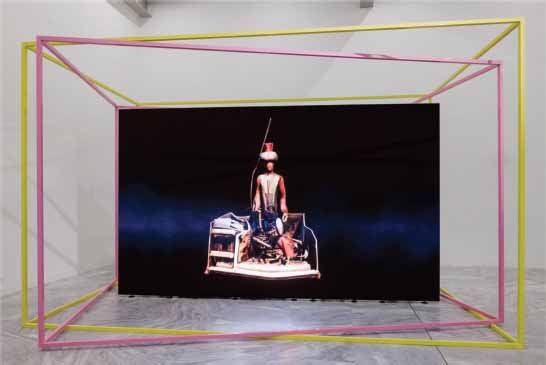
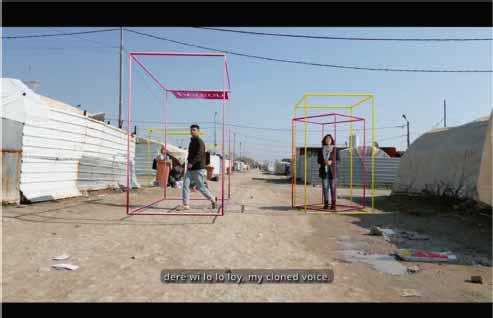
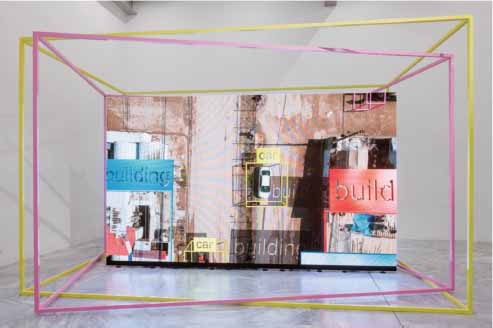
Another work particularly revealing is Mechanical Kurds by Hito Steyerl (2025). By blending fiction, documentary, and critical speculation, the German artist investigates the invisible chains of micro-labour, the geopolitics of the image, and the mechanisms of delegation that structure so-called “autonomous” technologies. The installation thus exposes the territories and conflicts hidden behind the fabrication of artificial intelligence (Figure 4).
Figure 4: Hito Steyerl. Mechanical Kurds. 2005. Still from the video.
Source: kunst-dokumentation.com/MAK.
The title articulates two central references: the 18th-century chess-playing automaton, the “Mechanical Turk”, famous for being secretly operated by a human, and the contemporary micro-labour platform Amazon Mechanical Turk, where thousands of tasks intended to train AI systems are performed by a largely anonymous and precarious workforce. In the installation, the “Turk” becomes “Kurd”, shifting the focus to workers situated on the geopolitical periphery of the digital economy. Steyerl exposes the logics of delegation, concealment, and exploitation that structure these supposedly autonomous technologies.
Mechanical Kurds thus questions the political violence encapsulated in images and algorithms, showing that behind the complex digital facade operates an army of “click workers”, individuals tasked with moderating content, evaluating responses, verifying data, and labelling images. This labour force, scattered globally, toils incessantly to refine the functioning of artificial intelligence, often under precarious conditions and for meagre pay. Frequently, these very populations also become the targets of the surveillance, control, and warfare technologies they help to create (Figures 5 and 6).
Figures 5 and 6: Hito Steyerl. Mechanical Kurds. 2025. Stills from the video.
Source: kunst-dokumentation.com/MAK.
The moderation and classification tasks, performed by these ghost workers, which are intended to identify hate speech, political controversy, sexual content, and extreme violence within the training data, are often outsourced to countries such as Kenya and Uganda, or to migrant communities in the metropolises of the Global North (Estampa, 2024).
A Time magazine report (Perrigo, 2023) revealed that OpenAI, the creator of ChatGPT, subcontracted Kenyan workers through the company Sama to filter toxic content from the chatbot's training data. These workers, paid between $1.32 and $2 per hour, were exposed to graphic descriptions of child sexual abuse, murder, suicide, torture, self-harm, incest, and other traumatic material (Xiang, 2023). Human filtering was essential to solve the problems of the predecessor GPT-3, which produced sexist and violent content because it had been trained on data indiscriminately collected from the internet. The process caused severe psychological impacts on the workers, with reports of “recurrent visions” after reading particularly shocking material.
It is also crucial to recognise that these technologies are profoundly entangled with warfare. In a potent UN report, special rapporteur Francesca Albanese (Marsi, 2025) exposes the intricate web of complicity linking US tech giants to the genocide in Gaza. Companies such as Microsoft, Alphabet, Amazon and Palantir are accused of having evolved from mere collaborators into structural components of a “genocide economy.” This transformation occurs via multiple channels: providing unrestricted access to cloud and artificial intelligence platforms, which expands surveillance capabilities; managing biometric databases of the Palestinian population; and developing predictive AI systems for automated target selection. In this last aspect, Palantir stands out with algorithms such as “Lavender”, “Gospel” and “Where’s Daddy?”, which turn war into a process of systematised extermination. These platforms process mass surveillance data on Gaza's entire population to determine, algorithmically and at scale, who should be killed, which buildings destroyed, and what level of “collateral damage” is deemed acceptable.
Major technology companies have been progressively abandoning their self-imposed ethical limits to pursue military contracts. In early 2025, both Google (Dave, 2025) and OpenAI (Biddle, 2024) quietly revoked their public commitments not to develop AI for warfare, signalling a strategic realignment with defence and national security sectors. Just weeks after the change to their principles, Google entered into a formal partnership with Lockheed Martin, the world's largest arms manufacturer and a key supplier to the Israeli military. In November 2024, Meta announced it would make its large language models, Llama, available to US government agencies and national security contractors (Clegg, 2024). Lockheed Martin subsequently integrated Llama into its operations (Fatafta, 2025). Meanwhile, despite its non-profit structure, OpenAI collaborated with Anduril to deploy its technology in combat scenarios.
A telling sign of the growing convergence between Silicon Valley and the military complex is the US Army's decision to grant the rank of lieutenant colonel to senior executives from Palantir, Meta, OpenAI and Thinking Machines Labs, formally integrating them as advisers within the armed forces (Harper, 2025). Presented as an initiative to “guide rapid, scalable technology solutions to complex problems”, the measure aims to make the military “leaner, smarter, and deadlier” (U.S. army public affairs, 2025). Technology leaders are no longer mere arms suppliers, they are being formally integrated into the military chain of command.
In parallel, the financial architecture underpinning this ecosystem proves equally significant. Investment managers such as BlackRock and Vanguard function as central hubs, channelling institutional capital into arms manufacturers, military technology firms and tech giants with government contracts. Albanese's report raises urgent ethical questions about the transformation of conflict zones into laboratories for testing emerging technologies, where civilian populations become involuntary test subjects for experiments (and traumas) involving AI systems (Marsi, 2025). This symbiosis between the techno-financial complex and the military apparatus constitutes a new paradigm of systematised violence.
Previously, visual data functioned as tools in the service of war, surveillance, and production, taking shape in the form of so-called operational images that intervene directly in the world. Today, however, we are witnessing the opposite movement: conflict now appears to be mobilised to fuel data production, as though the collection of military information were as significant as war itself. This is because the battlefield environment proves favorable to the race to develop artificial general intelligence (AGI), whose progress depends on enormous datasets. Are we witnessing, then, a shift from data as a tool for war to war as a factory for data, one that reframes modern conflict not merely as a geopolitical event, but as a critical infrastructure project for the tech industry? At the same time, war also enables the exploitation of an AI workforce, as evidenced by the labour of ghost workers—people displaced by violence and oppression (Steyerl, 2025, p.9). In the words of Steyerl,
It remains unclear whether it bears social benefits for anyone other than major corporations, authoritarian states, emerging war economies, fossil and nuclear energy providers, extreme right-wing organisations and the like. To be sure, big data analysis and statistical pattern recognition could lead to massive breakthroughs in many areas of science, such as cancer treatments, but this is not being prioritised right now […] Machine learning technology could even potentially be used to develop a more rational way to distribute resources, optimise energy consumption, lessen massive inequality, improve health and social systems, and prevent wasteful misallocation, but this would probably be labelled communism, not AI (Steyerl, 2025, p.32).
By listing who does benefit (corporations, authoritarian states, war economies, and the like), Steyerl makes clear who does not. In doing so, she dismantles any technological determinist argument that AI must develop along its current path, reminding us that this is a matter of prioritisation, not inevitability.
Within this landscape, art increasingly seems to serve as a pretext for imbuing the top-down implementation of generative AI tools (and their encroachment into every moment of life) with meaning or purpose (Steyerl, 2025, p. 11). This dynamic is illustrated by an exhibition held in Leipzig, Germany, in 2023: Dimensions, sponsored by Palantir. The choice of venue alone invites reflection: What narrative is meant to unfold when digital art is displayed within the walls of what was once Europe's largest factory for manufacturing gun barrels and munitions?
Alex Karp, CEO of Palantir, leveraged the visibility of digital artists such as Refik Anadol and Lu Yang to promote his ideas in the German press. He made three main arguments: the company uses AI in Ukraine in various ways; Artificial General Intelligence (AGI) is inevitable, requiring a strong and militarized West; and art should play a central role in this project. Karp presents himself as an artist and Palantir as a “community of artists,” going so far as to declare in a New York Times interview, “I'm an artist with a gun!” (NYTimes, 2024). Four months after the start of the Russian invasion, in June 2022, Karp visited Ukraine. Since then, the country has become a laboratory for military AI technologies, with more than six Ukrainian ministries using Palantir products, notably for generating military targets (Steyerl, 2025, p.27-28).
While the exhibition's curator, Dr. Dan Xu, frames the work in terms of creativity and “contextual competence,” much of it remains silent on the social conditions that make AI possible, such as the underpaid content moderators who filter out the worst pornography and violence on social media platforms, often at the expense of their own mental health (BBK Berlin, 2023).
In this context, the exhibition functions as a distraction, steering public attention away from the political dimensions of AI by framing it primarily as an aesthetic phenomenon—as though the aesthetic were not itself deeply political. In doing so, it evades urgent questions about democratic control over surveillance technologies and the appropriation of data by corporations like Palantir, all while inviting audiences to remain enchanted by art as spectacle.
Kitsch reality
Building on this text’s initial premise, that art and aesthetic phenomena are constitutive of our experience of the world, we can now examine how the aesthetic form of AI-generated images constitutes a departure from the very concept of beauty. For Vilém Flusser, an aesthetic proposition is only beautiful to the extent that it breaks with previous models, since its value lies in expanding the horizon of the real: “beauty is the increase of the parameter of the real” (Flusser, 1975-1976, p.12). In other words, beauty enriches our reality by proposing new possibilities of experience.
This concept is directly linked to information theory. The beauty of a model corresponds to the amount of new information it communicates. At one extreme, Kitsch offers no significant information, limiting itself to reproducing models already “stored” in our collective memory. That is why it is so pleasant: it is perfectly aligned with our prior “program” of experiences, requiring no effort of comprehension. The “pleasant”, thus, is what comfortably accommodates itself within this program (Flusser, 1975-1976, p.12). For Flusser, Kitsch is
a method that allows us to dwell in garbage. This is feasible because garbage is spent information, easily stored. It does not disturb, as all new information does. One need only re-chew spent information; no effort is required to apprehend it. Kitsch is tasty. Chewing again and again [...] In re-presenting the past, kitsch negates the future. (Flusser, n.d.).
In this sense, beauty is necessarily dangerous and unpleasant. It challenges and can destroy our models of behaviour and knowledge, proposing a disturbing modification of the experience of the real. The new and creative emerges from the inarticulate, from error, from noise. “Creativity begins with the ugly” (Flusser, 1975-1976, p.12), with that which causes repulsion and destroys the prevailing models. This suggests that, if what is sought is beauty, one must break with previously established aesthetic models. And what is creation, if not the invention of something that does not yet exist, the conception of a novel form, “something that needs to be shown, a monster”? (Flusser, 1991).
In this context, rather than expanding the horizon of the real, generative AI models promote a double movement: the erasure of difference and the underrepresentation of diverse realities. The “reality” they produce does not broaden our parameters of experience but instead consolidates and reproduces hegemonic patterns. In the shopping cart of generative AI, what is pleasant prevails.
The models that shape our perception of reality are now generated algorithmically, engineered and owned by technological corporations. In this new paradigm, reality is no longer poiesis, a creative act of making, but a derivative output: a flattened reflection of aggregated data, governed by financial logic and trapped in self-referential loops.
Conclusion, or when image-making becomes damage-making
Given the complexity of this landscape, we cannot pretend to exhaust the relationship between generative images and the politics of images. Instead, we turn to Steyerl and her concept of “damage images” to sketch a partial and ephemeral conclusion:
images wrecking their surroundings through the extraction of labour, data and resources, rendering warfare, marketing and surveillance as variations on the same spectrum […] Each one of these creates some kind of damage or partial destruction of reality […] How does it impact on the work of making images, or for that matter art, when image-making is inseparable from da/mage-making? How does the creation of autonomous weapons impact on so-called autonomous art? (Steyerl, 2025, p.10)
Steyerl’s ingenuity hinges on the deliberate misspelling of “damage” as “da/mage-making”, which splits the word into two components that reveal a hidden entanglement: “mage”, an archaic term for a magician, sage, or mystical creator (here represents the artist as a visionary image-maker), while “damage” names the very harm, destruction, and violence the passage describes.
The images generated by AI are damage images: they flatten historical difference, extract value from precarious labor, devour vast amounts of energy, enable automated warfare, and enclose perception within a self-referential loop. When image creation is built on the same infrastructure and shares the same logic as modern warfare and mass surveillance, what then is the ethical status of the aesthetic gesture?
Perhaps the task of art in the face of AI today is to make this entanglement visible: to create images capable of exposing the damage embedded in today’s generative image, and to turn the tools of surveillance against themselves, opening the possibility for the unprecedented, the unimagined, and the truly new.
Funding and acknowledgments
Luciana Nacif's research was developed with support from FAPEMIG (Fundação de Amparo à Pesquisa do Estado de Minas Gerais), Grant No. 502/2025, through the Mobility CONFAP Italy (MCI) scholarship, during a postdoctoral research period at the University of Bologna (UNIBO), Italy.
References
BBK Berlin. (2023, May 8). Artwashing Leipzig – Open letter: Why is Palantir sponsoring the Dimensions art exhibition in Leipzig? https://www.bbk-berlin.de/en/news/08052023-artwashing-leipzig-open-letter-why-palantir-sponsorin
Beller, J. (2021). The world computer: Derivative conditions of racial capitalism. Duke University Press.
Biddle, S. (2024, January 12). OpenAI quietly deletes ban on using ChatGPT for “military and warfare.” The Intercept.
Bulley, M. (1996). Events and things. Philosophy Now, (15). https://philosophynow.org/issues/15/Events_and_Things
Chatonsky, G. (2025a). La fin des mèmes / The end of memes. https://chatonsky.net/la-fin-des-memes-the-end-of-memes/
Chatonsky, G. (2025b). L'esthétique vectofasciste / Vectofascist aesthetics. https://chatonsky.net/tag/vectofascisme/
Clegg, N. (2024, November 4). Open source AI can help America lead in AI and strengthen global security. Meta Newsroom.
Dave, P. (2025, February 4). Google lifts a ban on using its AI for weapons and surveillance. WIRED.
Estampa, T. (2019). ¿Qué es el qué veus? YOLO9000. https://tallerestampa.com/en/estampa/que-es-el-que-veus-yolo9000/
Estampa, T. (2024). Cartography of generative AI. https://cartography-of-generative-ai.net/
Fatahta, M. (2025). AI for war: Big tech empowering Israel’s crimes and occupation. Al-Shabaka: The Palestinian Policy Network. https://al-shabaka.org/briefs/ai-for-war-big-tech-empowering-israels-crimes-and-occupation/
Flusser, V. (1975–1976). A arte: o belo e o agradável [Unpublished lecture]. Théâtre du Centre, Aix-en-Provence. (Translated by Rachel Cecília de Oliveira Costa).
Flusser, V. (1985). Sintetizar imagens. http://flusserbrasil.com/art264.pdf
Flusser, V. (1991). Menschliche Kommunikation III [Bochumer Vorlesungen 1991]. https://web.archive.org/web/20220812063522/https://www.magmamater.cl/flusser/pdfs/bochumer-91/menschliche-kommunication3.pdf
Flusser, V. (2007). O mundo codificado: por uma filosofia do design e da comunicação. Cosac Naify.
Flusser, V. (2008). O universo das imagens técnicas: elogio da superficialidade. Annablume.
Flusser, V. (n.d.). Kitsch e pós-história. Flusser Archive Berlin. https://attachments.are.na/185813/23ae46b397d118312babd69d95be069f.pdf?1389358870
Harper, J. (2025, June 13). Army recruits officers from Meta, OpenAI and Palantir to serve in new detachment. DefenseScoop. https://defensescoop.com/2025/06/13/army-detachment-201-executive-innovation-corps-meta-openai-palantir/
Kothandaraman, D., Lin, M. & Manocha, D. (2024, May 22). Prompt mixing in diffusion models using the Black Scholes algorithm. arXiv preprint. https://www.arxiv.org/abs/2405.13685
MacKenzie, D. (2006). An engine, not a camera: How financial models shape markets. MIT Press.
Marsi, F. (2025, July 1). UN report lists companies complicit in Israel’s “genocide”: Who are they? Al Jazeera. https://www.aljazeera.com/news/2025/7/1/un-report-lists-companies-complicit-in-israels-genocide-who-are-they
Martin, R. (2018). La logique sociale de la dérivation financière. Multitudes, (71). https://www.multitudes.net/category/l-edition-papier-en-ligne/71-multitudes-71-special-mai-2018/majeure-71-deriver-la-finance/
Perrigo, B. (2023, January 18). Exclusive: OpenAI used Kenyan workers on less than $2 per hour to make ChatGPT less toxic. Time. https://time.com/6247678/openai-chatgpt-kenya-workers/
Renshaw, D. (2024, August 17). Alex Karp has money and power. So what does he want? The New York Times. https://www.nytimes.com/2024/08/17/style/alex-karp-palantir.html
Steyerl, H. (2025). Medium hot: Images in the age of heat. Verso.
U.S. Army Public Affairs. (2025, June 13). Army Reserve soldiers front and center of Army's new Detachment 201: Executive Innovation Corps. https://www.usar.army.mil/News/News-Display/Article/4216167/army-reserve-soldiers-front-and-center-of-armys-new-detachment-201-executive/
Watt, C. (2022). Derivative images: Financial derivatives in French film, literature and thought. Edinburgh University Press.
Xiang, C. (2023, January 18). OpenAI used Kenyan workers making $2 an hour to filter traumatic content from ChatGPT. VICE. https://www.vice.com/en/article/openai-used-kenyan-workers-making-dollar2-an-hour-to-filter-traumatic-content-from-chatgpt/
BIO

 Luciana N. Nacif holds a PhD in Philosophy from UFMG, with a research internship at Université Panthéon-Sorbonne through the CAPES/COFECUB Program. She also holds a Master's in Global Fashion Management from the Institut Français de la Mode (IFM-Paris) and a degree in Social Communication from UFMG. She completed a postdoctoral fellowship in Philosophy at UFMG and is currently undertaking postdoctoral research at the Università di Bologna (UNIBO) through the CONFAP Italy Program. She participates in the research groups “Modes of Presence in Contemporary Aesthetic Phenomena” (CNPq) and “REDd: Network for Studies on Democracy and Disinformation” (IEAT-UFMG). Her research lies at the intersection of philosophy, technology, and fashion. Contact: nacif.lu@gmail.com
_______________________________
1 “Vectofascism”, a concept developed from Wark’s notion of vectoral classes, which referred to a particular informational regime, adapts fascist mechanisms to the latent space of AI, operating through algorithmic manipulations in high-dimensional spaces rather than through mass rallies. It industrializes the production of disputes, rendering all positions statistically equivalent and truth obsolete. By fragmenting shared reality through personalized radicalization channels, “vectofascism” creates a relativism in which critical judgment becomes impossible, serving authoritarian power through the systematic dissolution of common epistemological ground and the proliferation of alternative realities (Chatonsky 2025b).