












ISSN: 2174-7563

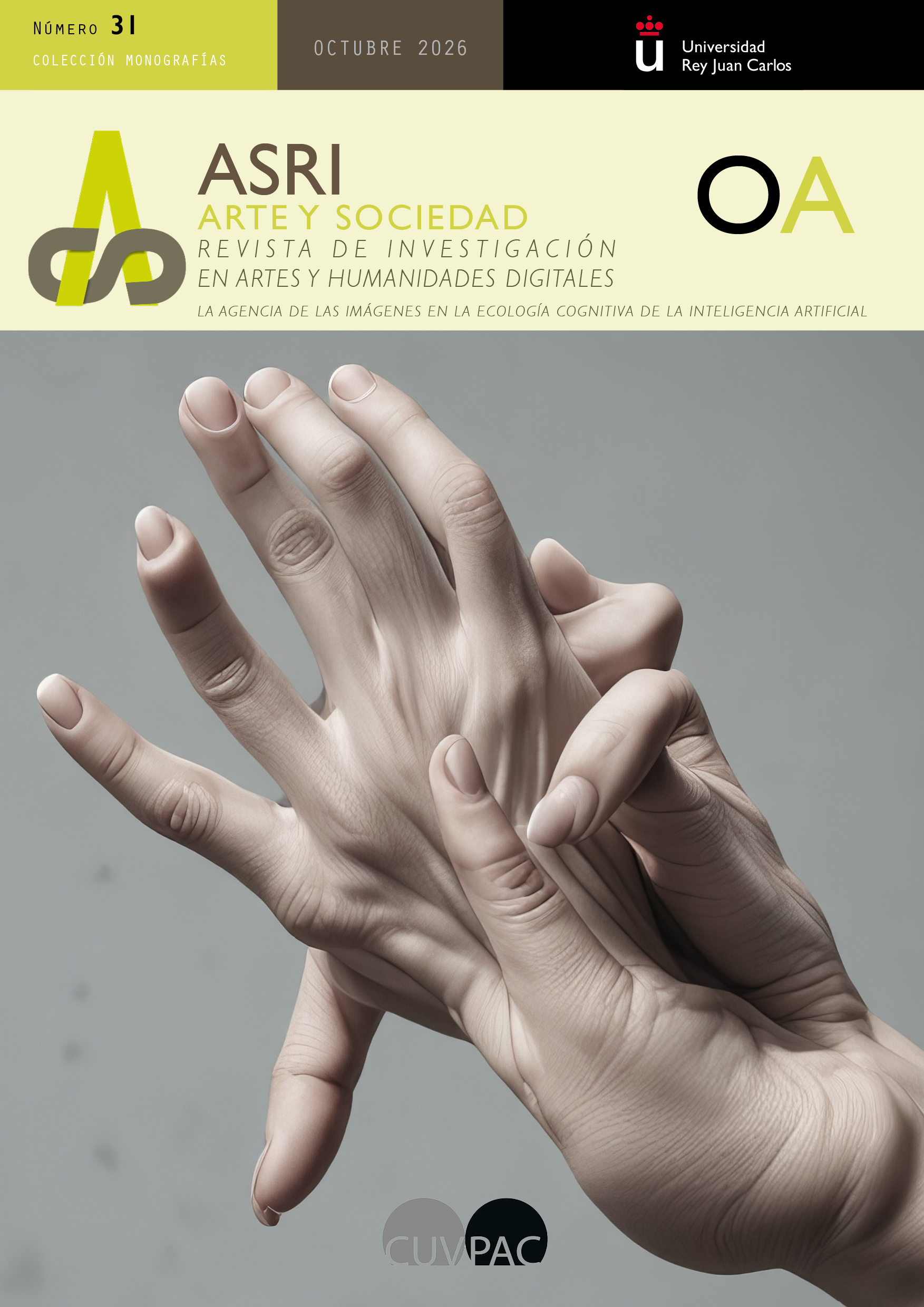
In the cognitive ecology of AI, the ontological distinction between persons and artifacts appears more blurred today than ever before. This renders the question of image agency a cross-cutting issue for both the phenomenon of AI and contemporary artistic practice—a shift driven primarily by technical advances in generative AI (GenAI) and its promise of autonomous creativity, which challenges the very capacity for human agency. Furthermore, technology companies leverage creativity to extol the agency of AI: the aesthetic and photorealistic quality of GenAI-generated images is presented as evidence of the supposed creative and cognitive capabilities of AI systems.
Against this backdrop, this special issue presents an ontological and epistemological discussion regarding the agency of GenAI and the images it produces. Its central aim is to question the extent to which GenAI can be considered an autonomous creative agent and to explore the possibilities—or limitations—its images create for cognition, artistic practice, and contemporary critical action. The articles included in this issue engage in a dialogue to offer a multifaceted perspective on the algorithmic image and its forms of agency.
Editors: Andrés Pachón & Luís Quintais
ASRI. Art and Society. Journal of Research in Digital Arts and Humanity, is an academic publication coordinated by the research group in Visual Culture and Contemporary Artistic Practices CUVPAC of Rey Juan Carlos University. The main objective is to offer an exchange instrument for research and dissemination of the multiple forms of expression and representation of the material and virtual world we inhabit. A critical thinking platform that is aimed at researchers and artists in art, cultural and visual studies, digital humanities, doctoral and master's students, and enthusiasts of hypermedia culture, internet and communication technologies, information, and visual representation. In order to broaden the discussion and debate of ideas, 4 lines of thought have been created: Poetics of the Image (Green Collection); Art and Science (Blue Collection); Design and Space (Orange Collection); and Culture and Society (Purple Collection)

ISSN: 2174-7563











ASRI. Art and Society. Research journal in Art and Digital Humanities. ISSN: 2174-7563, edited by the Publications Service of the Rey Juan Carlos University.
It is an online publication coordinated by the CUVPAC research group of Rey Juan Carlos University, and It is open access, free, and entirely free for readers and authors. The magazine does not require a subscription fee, nor does it require any payment from the authors to publish and access the content.

This work is licensed under a Creative Commons Attribution 4.0 International License. Creative Commons Attribution 4.0 International License.

The contents may be read and used, copied, distributed, transmitted, publicly displayed or transformed, provided that they comply with the following terms:
Authors are encouraged and allowed to spread the contents of the journal on their social networks and electronic publications (with their logos, pagination, an indication of the volume and number of the journal, ISSN, included), to favor its circulation and dissemination and with this, a possible increase in its citation and reach among the academic community.
Publications Service of the Rey Juan Carlos University. Paseo de Artilleros, s/nº, 28032 MADRID (Spain)