STUDIA HUMANITATIS JOURNAL, 2025, 5(2), pp. 128-163
ISSN: 2792-3967
DOI: https://doi.org/10.33732/shj.v5i2.158
Artículo / Article
Miscelánea
Miscellaneous section
DOCUMENTING THE ŁÓDŹ GHETTO THROUGH THE PHOTOGRAPHS BY MENDEL GROSSMAN
DOCUMENTANDO EL GUETO DE ŁÓDŹ A TRAVÉS DE LAS FOTOGRAFÍAS DE MENDEL GROSSMAN
Antonia Tejeda Barros
Tiergarten 4 Association, Berlin (Holocaust researcher)
ORCID: 0000-0002-7292-1939
tejedabarros@tiergartenstrasse4.org

| Abstract |
The Polish Jewish photographer Mendel Grossman captured with his camera (officially and clandestinely) the harsh and cruel reality of the Łódź ghetto: industrial production, suffering, starvation, deportation, and death. In this paper, I depict the Łódź ghetto and the agony of the Jewish people through Grossman’s eyes, as well as the cultural, religious, and Zionist activities that took place in the ghetto in the midst of so much destruction and death. I assert that Grossman’s photographs humanize the victims and are a crucial source of the suffering and annihilation of the Jewish victims of the Łódź ghetto. Moreover, I argue that Grossman’s photographs symbolize courage and defiance (two acts that fall within the spectrum of the term amidah) and are an invaluable source for researching both the Łódź ghetto and the Shoah.
Keywords: Łódź ghetto; Mendel Grossman; Chełmno; Auschwitz-Birkenau; Shoah; Photography; Amidah.
| Resumen |
El fotógrafo polaco judío Mendel Grossman captó con su cámara (oficial y clandestinamente) la dura y cruel realidad del gueto de Łódź: la producción industrial, el sufrimiento, el hambre, la deportación y la muerte. En el presente artículo describo el gueto de Łódź y la agonía del pueblo judío a través de la mirada de Grossman, así como las actividades culturales, religiosas y sionistas que tuvieron lugar en el gueto en medio de tanta destrucción y muerte. Afirmo que las fotografías de Grossman humanizan a las víctimas y son una fuente crucial del sufrimiento y la aniquilación de las víctimas judías del gueto de Łódź. Además, sostengo que las fotografías de Grossman simbolizan coraje y desafío (dos actos que entran dentro del espectro del término amidah) y son una fuente inestimable para la investigación tanto del gueto de Łódź como de la Shoah.
Palabras clave: Gueto de Łódź; Mendel Grossman; Chełmno; Auschwitz-Birkenau; Shoah; Fotografía; Amidah.
| Introduction |
The Shoah, שואה, in Hebrew (called sometimes in Yiddish Churban, חורבן, destruction, in reference to the destruction of the first and second Temples) is the quintessential catastrophe and the ultimate atrocity. Six million Jewish men, women, and children perished and were murdered during the Shoah, in the ghettos, the transports, the massacres of the Einsatzgruppen1 and the six extermination camps (Vernichtungslager, also called death camps, Todeslager): Chełmno, Bełżec, Sobibór, Treblinka II, Auschwitz-Birkenau, and Majdanek. The extermination camps were exclusively designed to annihilate the European Jewry (‘all’ the European Jewish men, women, and children). It is important to stress that Birkenau and Majdanek were hybrid camps, i. e., extermination camps and concentration camps. Chełmno operated with exhaust fumes in gas vans; Bełżec, Sobibór, and Treblinka II (the Aktion Reinhardt camps) operated with exhaust fumes in gas chambers; Birkenau used Zyklon B to murder Jewish victims; and Majdanek used Zyklon B and exhaust fumes. The distinction between extermination camp (Vernichtungslager) and concentration camp (Konzentrationslager), as well as the distinction between Jewish victims and non-Jewish victims, is crucial for understanding the Shoah.
The Łódź ghetto (renamed Litzmannstadt by the Germans) was the second largest ghetto of all German-occupied territories (after the Warsaw ghetto) and the longest surviving ghetto.2 Łódź was located in the Warthegau, the western part of Poland annexed to the Reich.3
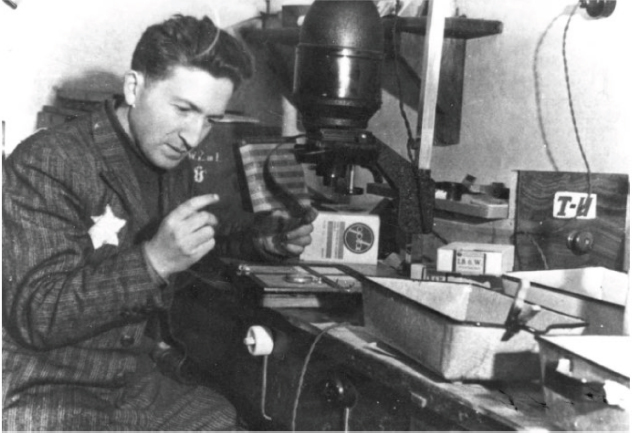
Mendel Grossman (Gorzkowice, June 27, 1913–April 30, 1945, near Außenlager Königs Wusterhausen) (Figure 1) came from a Hasidic family. His surname is actually Grosman, with one ‘s’, although it is often written with two ‘s’ –in fact, his two photography stamps were “„Grosman“ LITZMANNSTADT MARYNARSKA 55 m.12” and “FOTO „Grosman“ LITZMANNSTADT MARYNARSKA 55 m.12,”4 both with one ‘s’. Since he is more known as ‘Grossman’, I use that spelling for his surname. Grossman was a professional photographer before the war. In the Łódź ghetto he worked in the Department of Statistics of the Judenrat, taking ‘official’ ID photos for the identity cards and ‘official’ photos of the productivity and ‘good’ conditions of the ghetto, which were carefully organized in albums. After the liquidation of the Łódź ghetto, Grossman was deported to Außenlager Königs Wusterhausen, one of the 70 Sachsenhausen subcamps, 40 km south of Berlin, and he either collapsed or was shot by the Germans during the death march.
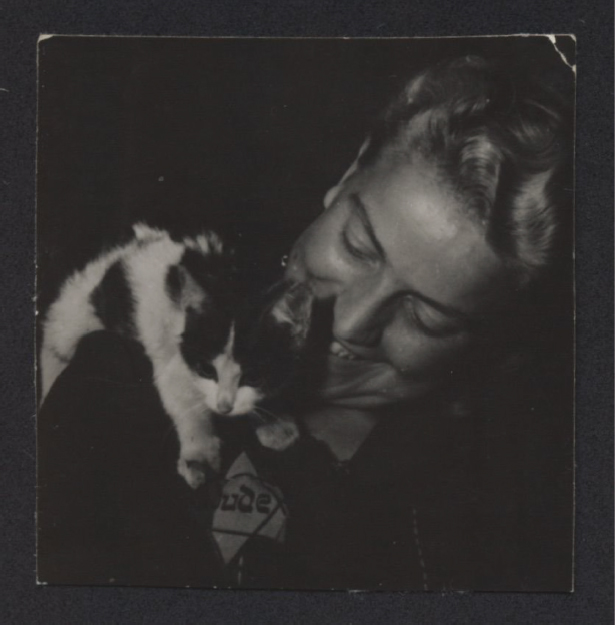
Grossman took 10,000 photographs in the Łódź ghetto, and hid the negatives right before the liquidation of the ghetto. Nachman Zonabend also hid material from the ghetto archives. Grossman’s sister Rozka (born in 1918 and immortalized by Grossman in a photograph holding a cat and wearing the Judenstern, Figure 2) rescued the negatives and prints after the war together with Nachman Zonabend and Arieh Ben Menachem, and brought them with her to Eretz Israel. Sadly, most of the negatives were destroyed by the Egyptians in the War of Independence.5 Zonabend’s donation to the YIVO Institute for Jewish Research in 1948, which includes over 2,000 documents (in Polish, Yiddish, and German), newspapers, maps, photo albums, ID cards, and photographs from the Łódź ghetto, is extremely important as well.6 Today, Grossman’s surviving photos are preserved at Yad Vashem, the United States Holocaust Memorial Museum, the Ghetto Fighters’ House, YIVO, and the Wiener Holocaust Library.7
Figure 1. Mendel Grossman in the photo lab of the Łódź ghetto
Yad Vashem. Archival signature: 1602/39.
Figure 2. Grossman’s sister, Rozka, in the Łódź ghetto holding a cat
United States Holocaust Memorial Museum. Accession number: 2005.214.2 (File 5, number 27).
Grossman had an assistant, Arieh Ben Menachem (born as Arie Princ), who was a photographer as well, writer, and Zionist; he survived the Shoah (he was born in Łódź in 1922 and died in Ramat HaSharon, Israel, in 2006). Grossman and Ben Menachem worked together; so, it should be noted that some of the photos attributed to Grossman may have been taken by Ben Menachem. In fact, many of the photos of the present paper are part of the Yad Vashem Photo Collection entitled “A Collection of Photographs From the Lodz Ghetto Photographed By Ghetto Photographer Mendel Grossman and His Assistant Aryeh Ben Menachem”.
Besides Grossman and Ben Menachem, there were other photographers in the Łódź ghetto, notably Leib Maliniak (1908–1945) (who had a photo studio in the Łódź ghetto called Foto-Kasprowy), Nachman Zonabend (Łęczyca, 1918–2006), Henryk Ross (Warsaw, 1910–Israel, 1991) (whose photographs are a vital legacy of the Łódź ghetto), and the chief accountant of the Łódź ghetto, the Austrian Walter Genewein (1901–1974) (who was a perpetrator and took more than 450 color photographs). These photographs are likewise an invaluable source for ghetto research. However, in this paper I focus solely on the photographs taken by Grossman; his photos are heartbreaking, insightful, and harrowing, and perfectly portray the misery and brutality of the Łódź ghetto.
In the first section, I analyze the Łódź ghetto in numbers. In the second section, I feature the Judenrat photo albums made by Grossman and other Jewish photographers. The third section focuses on the suffering of the Jewish children in the Łódź ghetto. In the fourth section, I examine starvation and disease in the ghetto through Grossman’s photos, as well as burials and graves at the Jewish cemetery. The fifth section is dedicated to cultural, religious, and Zionist activities in the Łódź ghetto, and to the term amidah. In the sixth section, I delve into the deportations to Chełmno and the Allgemeine Gehsperre (September 1942), while analyzing the role of the Judenrat. In the seventh section, the Łódź ghetto as a labor camp is documented through Grossman’s photographs. The eighth section is dedicated to the deportations of 1944 (to Chełmno and to Birkenau) and to the liquidation of the ghetto. In the Conclusion, I discuss how we can approach these photographs, the challenges we may face in using photography in Holocaust research, and the value of Grossman’s photographs for researching both the Łódź ghetto and the Shoah.
| The Łódź ghetto in numbers |
In order to identify, concentrate (and, later, annihilate) the Jewish people, the Germans created more than 1,100 ghettos.8 The Jewish people of the Łódź ghetto “suffered an agonizing and prolonged process of debilitation and decimation until the final liquidation of the ghetto in the summer of 1944” (Browning, 2012, p. xxxi).
Nine days after the invasion of Poland, the Germans imposed the Judenstern in Łódź: the “German authorities in Łódź forced Jews to wear white armbands as early as September 10, 1939” (White and Dean, 2012, p 35). The ghetto was announced five months later, on February 8, and sealed on April 30, 1940. 162,000–180,0009 Jewish men, women, and children were trapped in the ghetto, which was created in the Northern part of Łódź, “in the Old Town and Bałuty district, a poor and densely populated area with a large Jewish community” (Trębacz, n. d.). The ghetto “covered an area of 4.13 km2 (...) The borders were marked by fences made of planks and barbed wire” (Sitarek, 2020, pp. 9, 11).
Starting in the fall of 1941, about 18,000-20,000 Jewish men, women, and children from the liquidated ghettos in the Warthegau were deported to the Łódź ghetto.10 In October and November 1941, Jewish families from Germany, Austria, Bohemia and Moravia, and Luxembourg were deported to the ghetto (the first transport left Vienna on October 15, 1941). Some 20,000 Western Jewish men, women, and children arrived to the Łódź ghetto in twenty transports;11 in addition, 5,00012 Austrian Roma and Sinti men, women, and children were deported to the ghetto in five transports.13
Shlomo Frank writes in his diary on October 19, 1941: “Today 1,000 deportees from Vienna arrived in the ghetto. Among the new arrivals are physicians, engineers, professors, famous chemists, dental technicians” (Adelson and Lapides, 1989, p. 174) (according to Browning, the first transport, which came from Vienna, arrived to the Łódź ghetto on October 1614, and the transport that arrived on October 19 came from Berlin). On October 23, Frank writes: “Today a transport of Jews arrived from Frankfurt (...) They greeted us with a bright ‘Shalom, Yehudim’... exhorted us to... not to surrender, not to despair” (Adelson and Lapides, 1989, p. 175) (according to Browning, the transport that arrived to the Łódź ghetto on October 23, 1941, came from Cologne, not Frankfurt).15
Overall, about 210,000 men, women, and children (205,000 Jews and 5,000 Roma and Sinti) were trapped in the Łódź ghetto. Almost all died in the ghetto or were murdered in the gas vans of Chełmno (or shot upon arrival in the Waldlager) or in the gas chambers of Auschwitz-Birkenau. In total, only about 5,000 Jewish people survived (some had been transferred to labor camps from the Łódź ghetto or to various KZ after Birkenau, and some managed to hide in the Łódź ghetto); that number accounts for barely 2.38% of the ghetto population.
Grossman’s photographs are a reminder of the humanity, suffering, and death of the victims of the Łódź ghetto. Their value is absolutely inestimable. They help us to bear in mind that the victims of the Łódź ghetto were not mere numbers like the figures that have just been presented here, but human beings who suffered, despaired, starved, and succumbed in the ghetto, perished in the transports, or were murdered by the most horrific methods of extermination in Chełmno and Birkenau.
| The Judenrat photo albums |
The Judenrat of the Łódź ghetto created an ‘official’ archive, which consisted in the famous chronicle (from January 12, 1941 until July 30, 1944) and the encyclopedia (only from spring 1944), as well as various documents and 27 photo albums. The purpose was to ‘officially’ record life in the ghetto and to preserve “a record for posterity” (Löw, 2015, p. 391). However, the fact that the Chronicle of the Łódź Ghetto is written in Polish and German (without a single entry in Yiddish) reveals the nature of the chronicle: an invaluable document, certainly, but one to be approached with caution; indeed, “the tone of these texts was extremely careful” (Löw, 2015, p. 391).
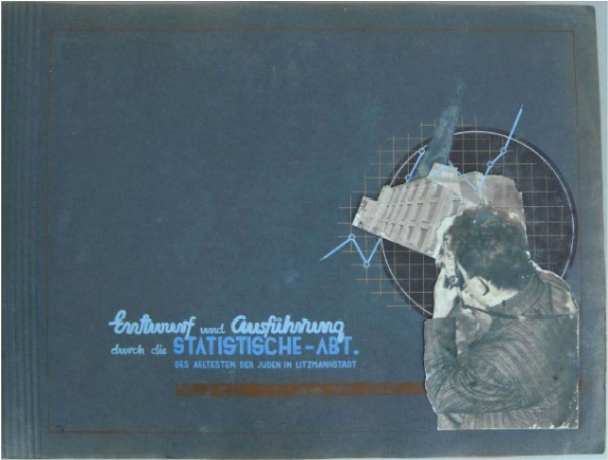
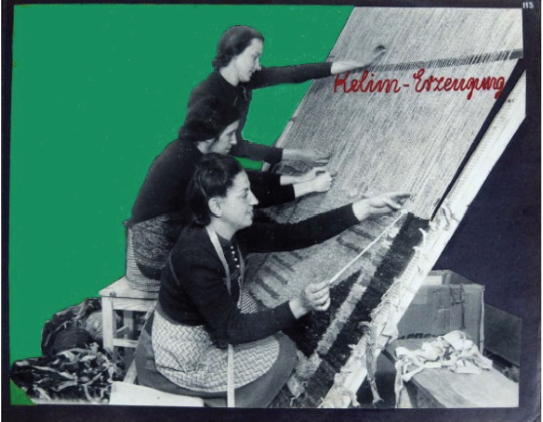
Grossman, Ross, Maliniak, and Ben Menachem worked for the Department of Statistics of the Judenrat16 and produced 27 albums with photos, collages, graphics, text, and a stunning modern design depicting the ‘great productivity’ of the Łódź ghetto (Figures 3, 4, 5, 6, and 7). Indeed, these astonishing modern albums are “visual propaganda created by Jews about Jews, intended to create a false image of the ghetto... as a survival strategy” (Michna, 2020, pp. 81–82).
Figure 3. An album prepared by the Judenrat Statistics Department in the Łódź ghetto. Grossman is on the cover
Yad Vashem. Album number: FA45/1.
Figure 4. An album prepared for the Łódź ghetto Judenrat, presenting the textile industry in the ghetto
Yad Vashem. Album number: FA45/58.
Figure 5. An album prepared for the Łódź ghetto Judenrat, presenting the textile industry in the ghetto
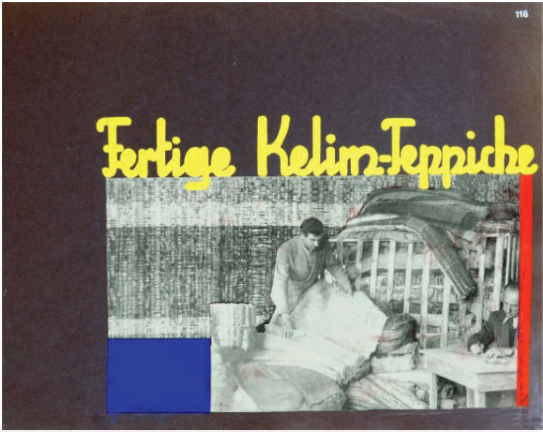
Yad Vashem. Album number: FA45/60.
Figure 6. An album prepared for the Łódź ghetto Judenrat, presenting the textile industry in the ghetto
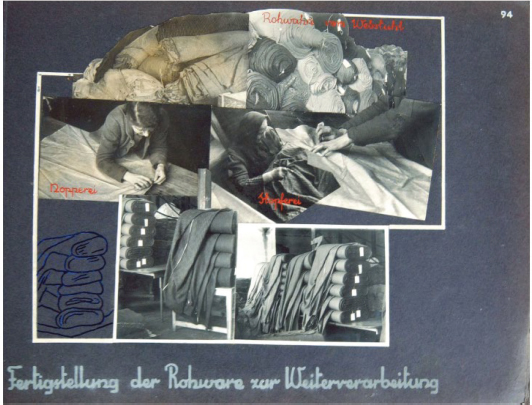
Yad Vashem. Album number: FA45/48.
Figure 7. Statistics of manufacturing in a textile workshop in the ghetto, September 1940–August 1941. An album prepared for the Łódź ghetto Judenrat, presenting the textile industry in the ghetto
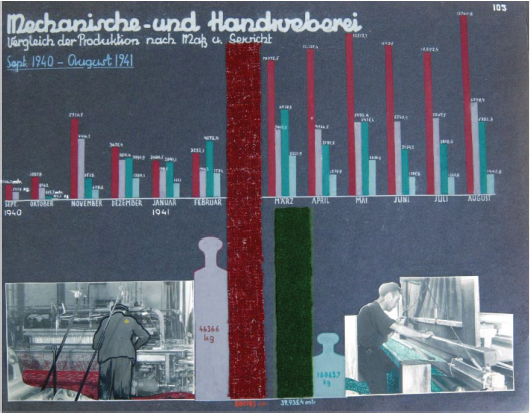
Yad Vashem. Album number: FA45/53.
| The Jewish children of the Łódź ghetto |
One of the most horrific and harrowing aspects of the Shoah is the premeditated death and murder of 1,500,000 Jewish children and babies in the ghettos, the transports, the massacres of the Einsatzgruppen (bullets and gas vans) and in the gas vans and the gas chambers of the six extermination camps: Chełmno, Bełżec, Sobibór, Treblinka II, Auschwitz-Birkenau, and Majdanek.
The fate of the Jewish children of the Łódź ghetto was death: in the ghetto by “exhaustion, environmental conditions..., infectious diseases, or starvation” (Weisz, 2022, p. 207); in Chełmno by gas inside the gas vans or by bullets in the Waldlager; and in Birkenau by gas inside the gas chambers of the four Krematoria (Krematorium II, Krematorium III, Krematorium IV, and Krematorium V). Death inside the crammed gas vans of Chełmno17 (as well as inside of the overcrowded gas chambers of Birkenau) was utterly painful, anguishing, and horrific.18
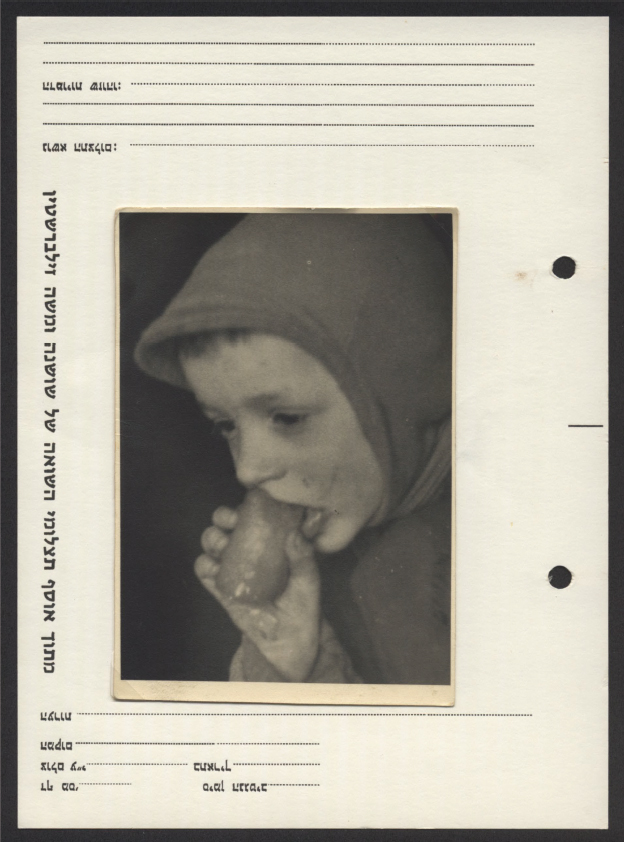
Grossman’s photographs of Jewish children in the Łódź ghetto are absolutely devastating. Why? Because even if some of the photographs depict children playing (Figure 8) or eating (Figure 9), we know that all those children perished either in the ghetto (by starvation and disease) or in the most horrific conditions, suffocated and crushed inside the transports, murdered by gassing or by bullets in Chełmno or gassed in the gas chambers of Birkenau.
Figure 8. Two Jewish children in the Łódź ghetto. Photo by Mendel Grossman
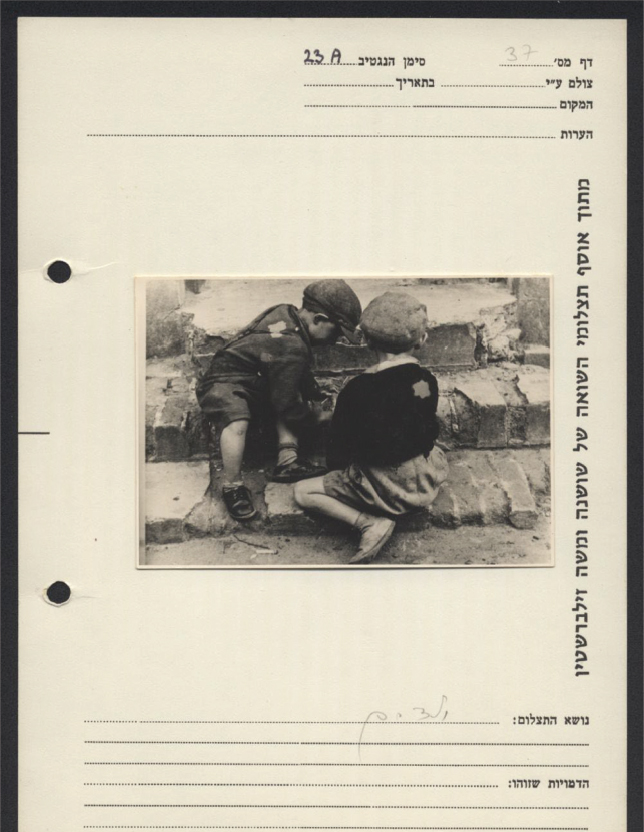
United States Holocaust Memorial Museum. Accession number: 2005.214.2 (File 7, number 10).
Figure 9. A Jewish child eating in the Łódź ghetto. Photo by Mendel Grossman
United States Holocaust Memorial Museum. Accession number: 2005.214.2 (File 7, number 40).
| Hunger, disease, funerals, and Jewish graves |
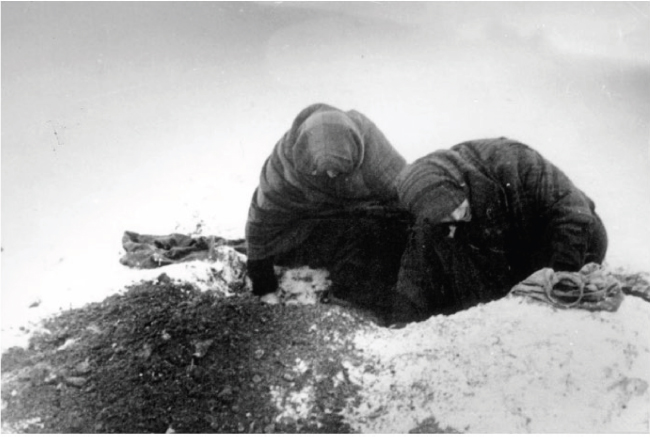
The Łódź ghetto was isolated, without sewers and very well guarded, so smuggling or escaping was impossible: “The German guard system was so effective that virtually no one entered or left the ghetto illegally. This isolation led to extremes of deprivation” (Unger, 2014). Starvation was one of the leading causes of death in the ghetto: “hunger [was] a dominant topic in all the extant diaries and memoirs from the Lodz Ghetto” (Löw, 2015, p. 390). Scarcity and deficiency of food and catastrophically low calorie intake resulted in many deaths, while worsening and exacerbating many diseases (tuberculosis and heart disease): “The angel of death of the Łódź Ghetto was hunger” (Trunk, 2006, p. 207). Due to the restriction or lack of electricity in the houses, a great number of Jewish men, women, and children ate in soup kitchens: “Most Jews subsisted on a daily bowl of watery cabbage or potato soup, a piece of bread, and a small evening snack of radish greens or potato peels” (Crago, 2012, p. 78). By 1944, “more than 45,000 people would die... of hunger and disease” (Löw, 2015, p. 390). The main causes of death were starvation, typhus, dysentery, tuberculosis, heart failure, and suicide.
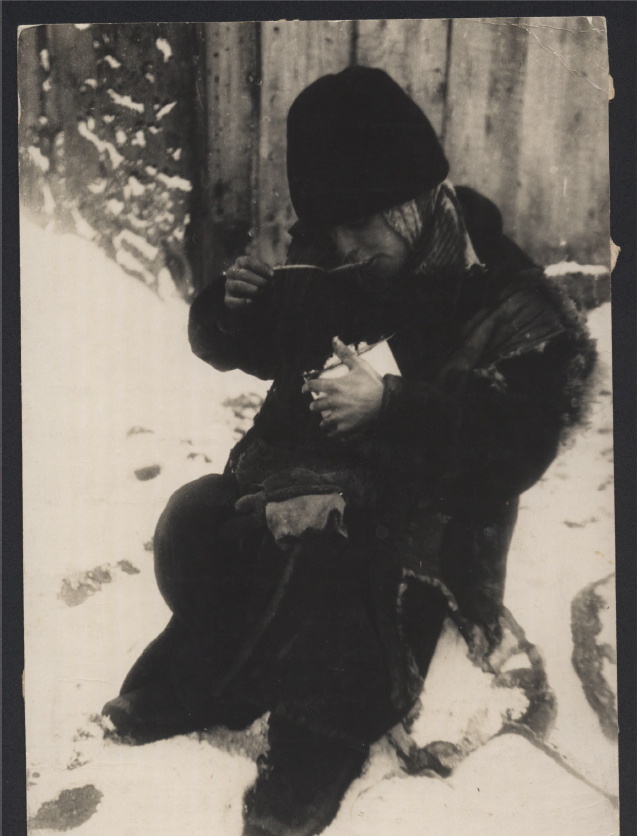
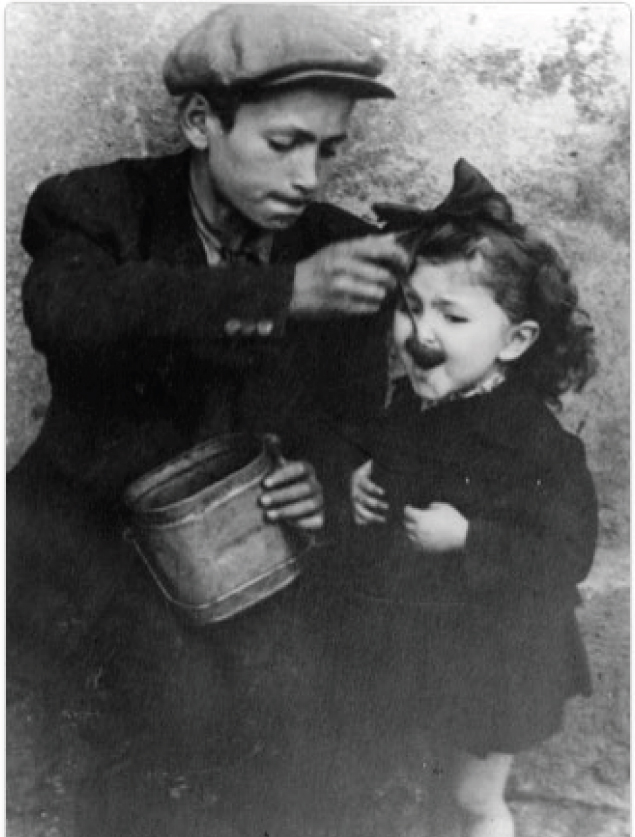
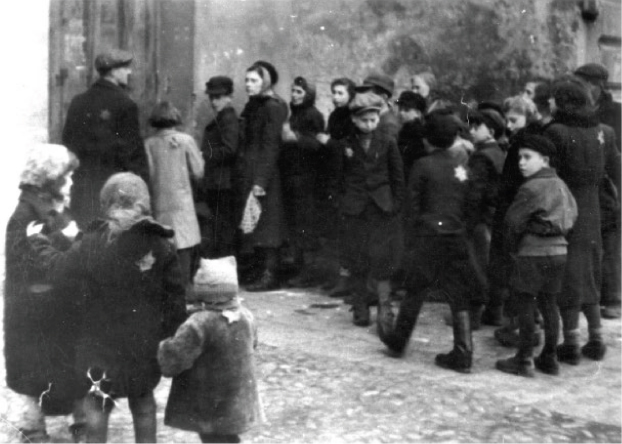
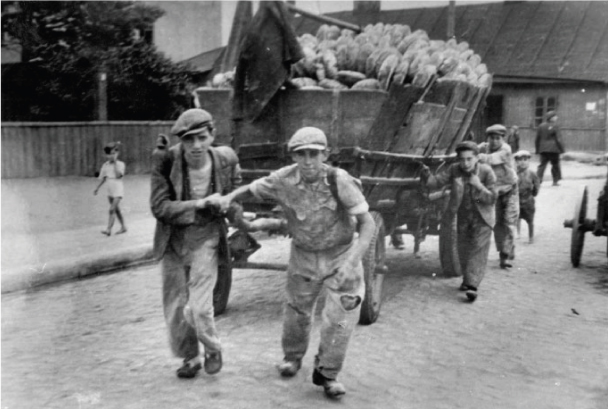
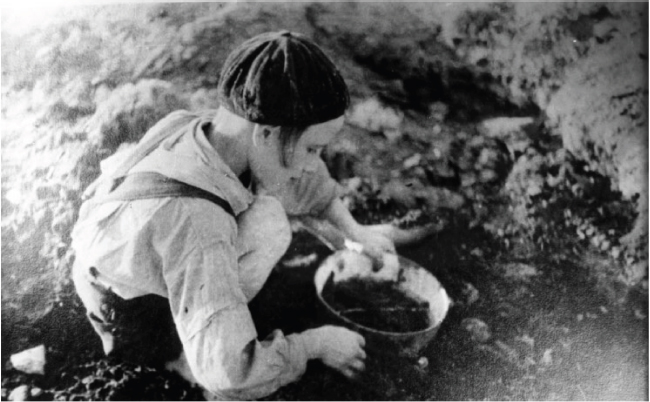
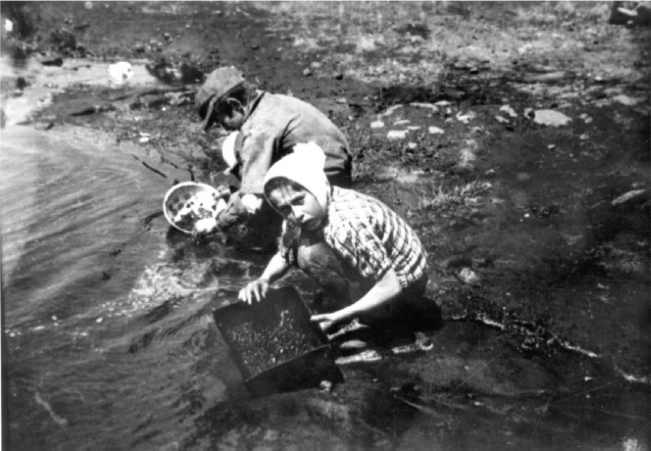
Grossman photographed hunger (Figuress 10 and 11), Jewish people lining up for food (Figure 12), distributing bread (Figure 13), and desperately searching for food (Figure 14). Many children were engaged in the search for coal (Figuress 15 and 16).
Figure 10. Jakow (Jakov, Jacob, Yaakov) Jankusz (Janush) Frajtag (Freitag) (Grossman’s nephew) eating a frozen carrot in the Łódź ghetto. He was born in 1938 and deported to Auschwitz-Birkenau in 1944 and murdered. Photo by Mendel Grossman
United States Holocaust Memorial Museum. Accession number: 2005.214.2 (File 7, number 23).
Figure 11. A Jewish boy feeding a little Jewish girl (possibly his sister) in the Łódź ghetto
Yad Vashem. Archival signature: 503/2117.
Figure 12. Jewish men, women, and children in the Łódź ghetto, probably lining up for food
Yad Vashem. Archival signature: 4062/48.
Figure 13. Distribution of bread in the Łódź ghetto (as a rule, a loaf of bread had to last for a week)
Yad Vashem. Archival signature: 4062/62.
Figure 14. Jewish women desperately searching for edible roots in the ground
Yad Vashem. Archival signature: 4062/91 and YIVO, Nachman Zonabend Collection, RG 241, 1074.6 (Box 28, Folder 1074). From the Archives of the YIVO Institute for Jewish Research, New York.
Figure 15. A Jewish boy looking for coal in the Łódź ghetto
Yad Vashem. Archival signature: 4062/59.
Figure 16. Jewish children looking for coal in the Łódź ghetto
Yad Vashem. Archival signature: 4062/166.
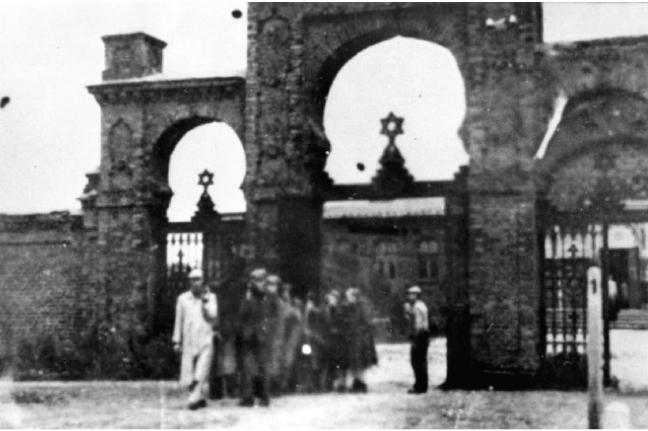
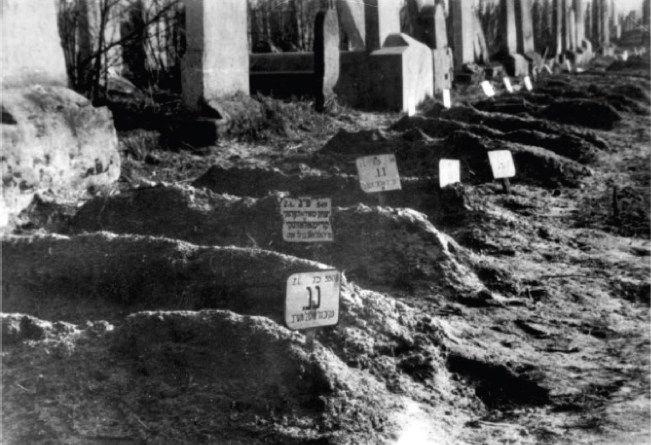
Grossman also photographed several funeral processions and graves at the Jewish cemetery in the eastern border of the ghetto (Figures 17 and 18). Both Grossman’s parents, Chana Ruchla (1887–1942) and Shmuel Dawid Grossman (1882–1942), perished in the Łódź ghetto. It remains unknown whether they were buried in the Jewish cemetery.
Figure 17. Burial at the Jewish cemetery
Yad Vashem. Archival signature: 4062/479.
Figure 18. Jewish graves at the Jewish cemetery
Yad Vashem. Archival signature: 4062/479.
| Culture, religion, and Zionism in the ghetto |
As a rule, after the occupation of Poland, the Germans enjoyed mocking Judaism and harassing Hasidic Jews: “In many ghettos the Germans from the start demanded that Jews report to work on the Sabbath and even during high holy days. In Łódź the authorities ordered that all Jewish business stay open on Yom Kippur 1939 [September 22-23]” (Trunk, 1977, p. 188). Nevertheless, the Judenrat managed in Yom Kippur 1940 (October 11–12) to keep the Shabbat (although only for a year, until October 17, 1941).19
Culture and religion were very present in the ghetto: “[d]espite the grim living conditions, the ghetto sustained a variety of cultural activities. Until September 1942, religious observance continued in 27 Batei Midrash” (Crago, 2012, p. 79). The Judenrat created “numerous organizations and departments that dealt with food supplies, health, welfare, justice, education” (Löw, 2015, p. 389), as well as industrial production. Theater, music, and poetry were performed “in soup kitchens and at a cultural hall, opened in March 1941” (Crago, 2012, p 79). Grossman’s photographs “show the victimized finding reason to laugh and joke, finding community and purpose even in [the most atrocious] circumstances” (Jacobson, 2000, p. 2). Incredible as it may seem, despite hunger, cold, fear, and uncertainty, children attended school in the ghetto, and many young people and adults participated in cultural and Zionist events.
Preserving the dignity and humanity amidst annihilation is amidah, עמידה. To resist (spiritually or physically, armed or unarmed)20 falls under the term amidah21. Thus we can consider Grossman’s acts of bravery as a form of amidah. Due to the isolation and the lack of guns, “no armed resistance arise[d]” (Trunk, 1981, p. 329) in the Łódź ghetto.
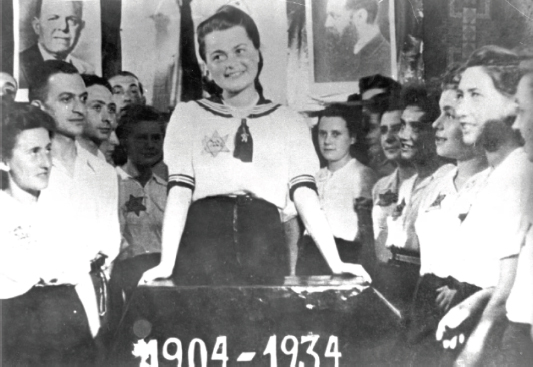
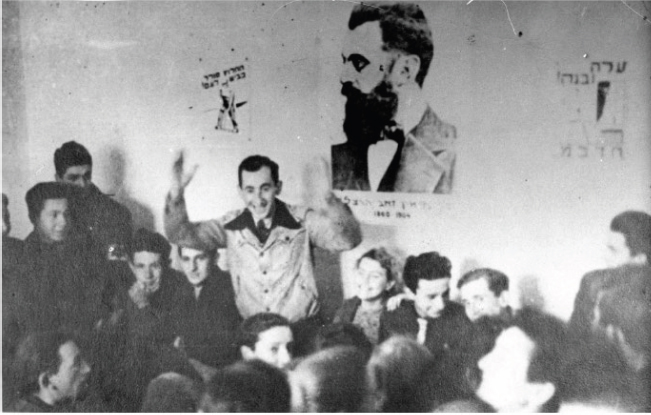
Zionism is a national, political, cultural, and religious movement of liberation and self-determination that called for the return to the ancestral land of the Jewish people, a revival of the Jewish nation of the Diaspora in its homeland (a nation forced to live in exile for almost two millennia after the destruction of the Second Temple in Jerusalem by the Romans, in the year 70). Grossman took several photographs of several Zionist youth movements active in the Łódź ghetto, and of Jewish men and women celebrating Zionism (Figures 19, 20, 21, and 22).
Figure 19. Celebrating Zionism in the Łódź ghetto. Photo by Mendel Grossman or Arieh Ben Menachem
Yad Vashem. Archival signature: 4062/277.
Figure 20. Celebrating Zionism in the Łódź ghetto. Photo by Mendel Grossman or Arieh Ben Menachem
Yad Vashem. Archival signature: 4062/444.
Figure 21. Zionist men and women in the Łódź ghetto. Photo by Mendel Grossman
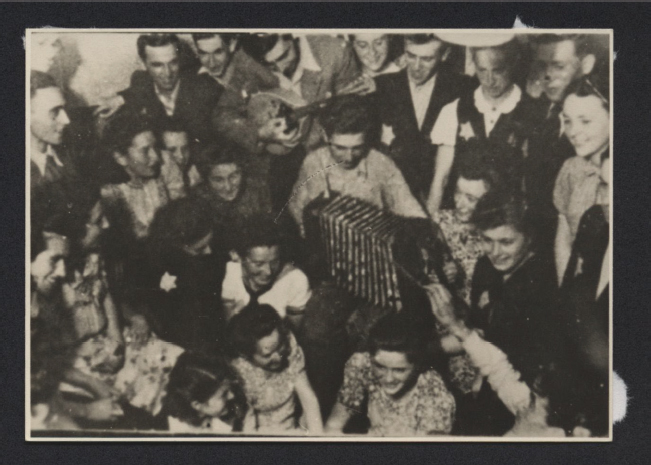
United States Holocaust Memorial Museum. Accession number: 2005.214.2 (File 8, number 7).
Figure 22. Zionist men and women in the Łódź ghetto. in the Łódź ghetto. Photo by Mendel Grossman
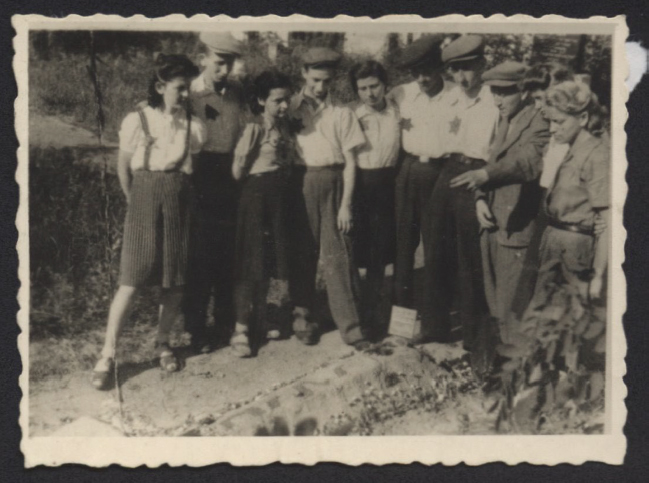
United States Holocaust Memorial Museum. Accession number: 2005.214.2 (File 8, number 6).
Either Grossman or Arieh Ben Menachem took several pictures of his friends celebrating Rosh HaShana 1942 (5703), towards the end of the Allgemeine Gehsperre (Figure 23). All these photos depict hope and strength amidst starvation and death, serving as a clear example of the term amidah.
Figure 23. Rosh HaShana 1942 (September 11–September 13, 1942). Photo by Mendel Grossman or Arieh Ben Menachem
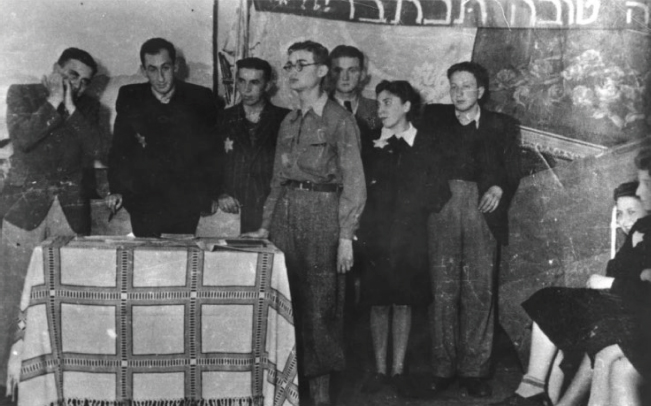
Yad Vashem. Archival signature: 4062/246.
| Deportations to Chełmno, the Allgemeine Gehsperre, and the Judenrat |
The construction of Chełmno began two months prior to the first gassings, which started on December 8, 1941. 22 Chełmno “was, in fact, a gas van station. From the beginning of December, people from the surrounding areas from the ‘Litzmannstadt’ ghetto in particular were murdered here using exhaust fumes. At that time, this location was known as ‘Kulmhof’” (Klein, 2023, p. 27). The killing capacity of Chełmno “was approximately 1,000 people a day (around fifty people could be crammed into each of the three vans” (Friedländer, 2008, p. 316). The victims too weak to walk were shot upon arrival.23
On January 16, 1942, deportations of Jewish men, women, and children from the Łódź ghetto to Chełmno began. Less than a month earlier, the Roma and Sinti men, women, and children of the Łódź ghetto had already been deported to Chełmno.24
Szlama Ber Winer (who managed to escape from Chełmno but was later murdered in Bełżec in April 1942) told about the gassings at Chełmno to Hersz Wasser and his wife Bluma (from the Oyneg Shabes); they wrote Szlama’s testimony (known as the Szlamek/Grojnowski report). Szlama states that on Friday, January 16, 1942 “[a]ll the victims came from Łódź. We could tell by their emaciated bodies covered in wounds and ulcers (...) The dead did not weight much. Previously, three vans of corpses formed one layer in the grave; now four vans (...) After dinner... [we] had buried another four transports. Finally, seven gravediggers were killed” (Pawlicka-Novak, 2004, p. 116). According to Szlamek, 750 Jewish families from the Łódź ghetto had arrived in Koło the day before (Thursday, January 15) and had been kept inside the synagogue. Szlamek states on Saturday, January 17: “That day we also buried Jews from Łódz –seven fully loaded vans” (Pawlicka-Novak, 2004, p. 116). It is important to clarify that there were only two or three gas vans at Chełmno, which went back and forth from Chełmno to the Rzuchowski Forest (4 km away), where the victims were buried by the Jewish gravediggers.
Jewish men, women, and children were first deported to Chełmno in 55 transports “in three deportation waves (January 16–29, February 22–April 22, and May 2–15, 1942)” (Crago, 2012, p. 80). In this first three Aktions, 57,06425 Jewish people were murdered in the gas vans at Chełmno or shot.
On September 2, 1942, the Germans ordered the deportation of an additional 20,000 Jewish children under the age of ten and elderly people over the age of sixty-five, as well as the sick. Rumkowski’s controversial speech with the command ‘Give me your children’ was delivered on September 4, 1942. Dawid Sierakowiak writes that same day in his diary (five notebooks, originally written in Polish): “The mood of panic is intensifying by the second. All kinds of rumors are repeated from lips to lips that we should expect the worst. At four Rumkowski and Warszawski... gave speeches on Firemen’s Square (13 Lutomierska Street)” (Sierakowiak, 1998, p. 216). Jósef Zelkowicz copied Rumkowski’s speech in his 345-page manuscript (written in Yiddish, translated as In These Nightmarish Days): “I never imagined I would be forced to deliver this sacrifice to the altar with my own hands... I must stretch out my hands and beg: Brothers and sisters, hand them to me! Fathers and mothers, give me your children!” (Adelson and Lapides, 1989, p. 328). Rumkowski added: “I must perform this difficult and bloody operation –I must cut off limbs in order to save the body itself! (...) I come to you like a bandit, to take from you what you treasure most in your hearts! (...) A broken Jew stands before you” (Adelson and Lapides, 1989, pp. 329, 330).
Grossman photographed Rumkowski on several occasions. Rumkowski “adhered to the principle ‘work, peace, order’ (...) [his] policy of ‘salvation through work’ however, was successful only in the short term” (Sitarek, 2020, pp. 13, 14). All the Judenrat “policies of mitigation... would prove tragically illusory” (Browning, 2012, p. xxxvii). Indeed, the Judenräte were powerless: “Ultimately, Jewish leaders had no option or choice at their disposal that could save their communities (...) the catastrophic and tragic end result was determined by German intent and power, not by Jewish decisions” (Browning, 2012, p. xxxviii). Indeed, the Judenrat members were victims amongst the victims: all the Judenrat members of the Łódź ghetto (and of all the other ghettos) were in the end shot, hanged, or deported to the extermination camps as well.
In the Allgemeine Gehsperre, 15,68226 Jewish children, Jewish elderly, and sick Jewish people were deported to Chełmno and murdered by gas (and bullets). An entry by Zelkowicz of September 14, 1942, states: “The period of September 5–12, 1942, will leave indelible memories among that portion of the ghetto’s population... who survives the war (...) Dramatic scenes were played out in the hospitals. Escape attempts came to a bloody end” (Dobroszycki, 1984, pp. 250, 252). Nevertheless, soon after, life in the ghetto seemed to ‘get back to normal’: “some 15,000 people (no one knows the exact number yet) [have been deported] and life appears to have resumed its former course” (Dobroszycki, 1984, p. 250), writes Zelkowicz; “there are some mothers weeping in a corner for a child or children shipped from the ghetto, but, as a whole, the mood of the ghetto does not reflect last week’s terrible ordeal. Sad but true!” (Dobroszycki, 1984, p. 255).
Through Grossman’s photographs, one can feel the desperation, hopelessness, and fear of some deportees in the face of uncertainty (Figure 27), but also observe the absolute unawareness the Jewish victims had of the atrocious end that awaited them: children wait patiently to be deported (Figure 24), a woman writes a note or a letter prior to her deportation (Figure 25), a boy carries as many belongings as he can (Figure 26), friends or family bid farewell to a little boy (Figure 28, photo above), deportees walk in line (Figure 28, photo below), a woman embraces and kisses a deportee (Figure 29).
Figure 24. Jewish children in the Łódź ghetto before being deported to Chełmno, 1942. Photo by Mendel Grossman
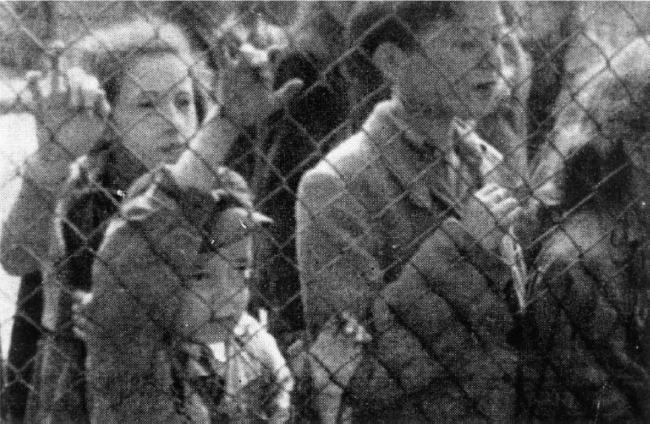
Yad Vashem. Archival signature: 4062/410 and YIVO, Nachman Zonabend Collection, RG 241, 1094.24 (Box 30, Folder 1094). From the Archives of the YIVO Institute for Jewish Research, New York.
Figure 25. A Jewish woman writing a note or a letter prior to her deportation
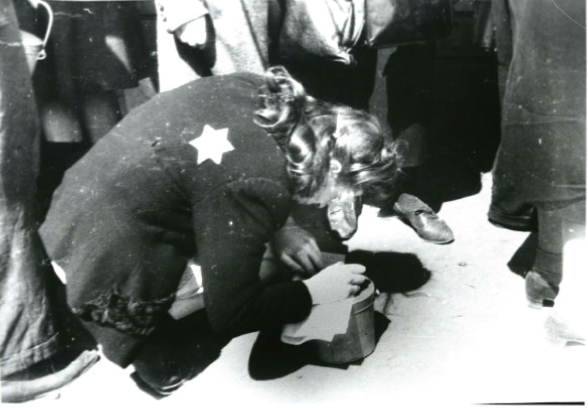
Yad Vashem. Archival signature: 4062/447.
Figure 26. Three Jewish women and a Jewish boy prior to their deportation, 1942
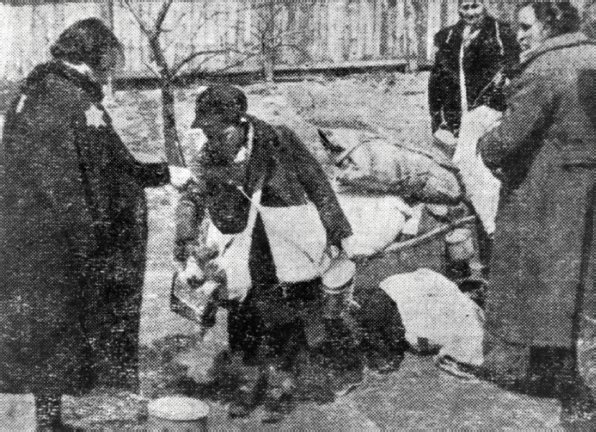
Yad Vashem. Archival signature: 4062/61 and YIVO, Nachman Zonabend Collection, RG 241, 1091.20 (Box 30, Folder 1091). From the Archives of the YIVO Institute for Jewish Research, New York.
Figure 27. Pola Znamirowski (born in Łódź in 1926) crying before being deported to Chełmno, September 1942. She was murdered on September 10, 1942, in Chełmno (aged 16)
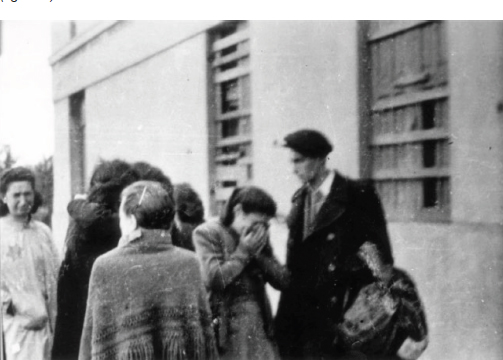
Yad Vashem. Archival signature: 4062/109 and YIVO, Nachman Zonabend Collection, RG 241, 1094.4 (Box 30, Folder 1094). From the Archives of the YIVO Institute for Jewish Research, New York.
Figure 28. Two photos by Mendel Grossman: A Jewish child behind a fence before being deported to Chełmno; Jewish men, women and children being deported
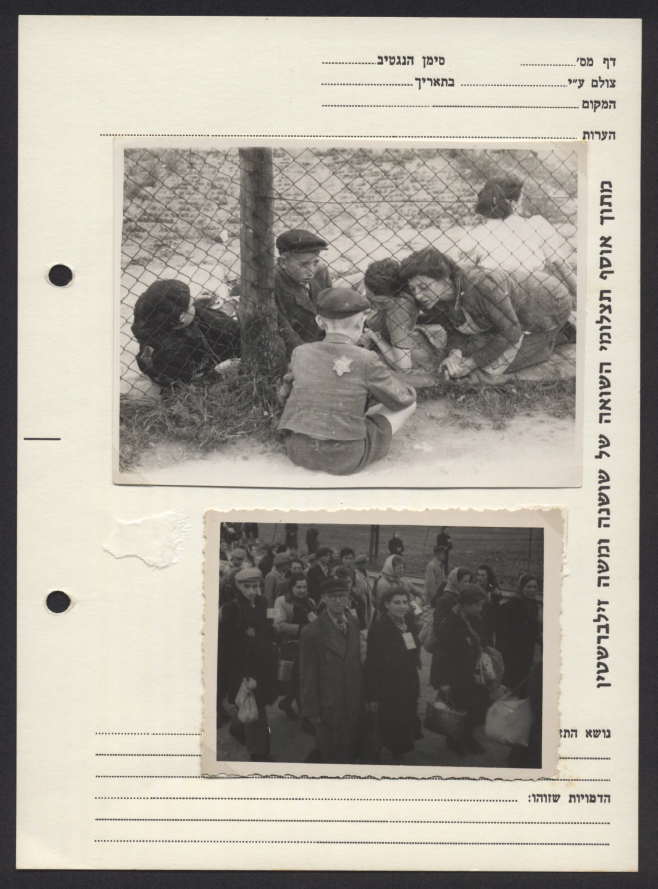
United States Holocaust Memorial Museum. Accession number: 2005.214.2 (File 7, number 11).
Figure 29. Two copies of the same photo by Mendel Grossman: A Jewish woman embracing and kissing a deportee
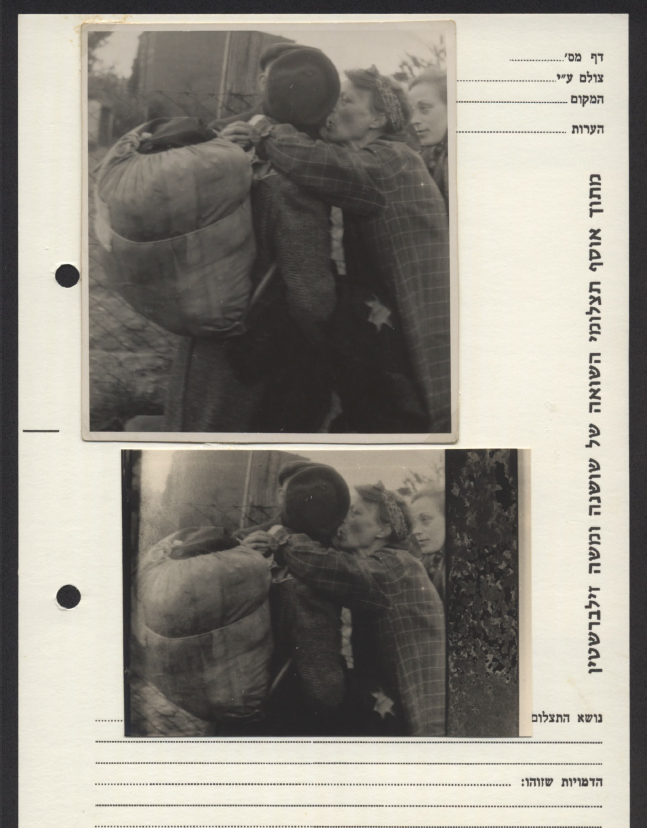
United States Holocaust Memorial Museum. Accession number: 2005.214.2 (File 7, number 5).
Although the general atmosphere of the photographs of the deportations is calm (the victims were deceived: they were told they were being ‘resettled’ to work), it is very important to highlight that Grossman took several photographs of Jewish men and women beaten and killed during the deportations. This proves that many victims did not obey quietly and resisted deportation because they knew they would most likely be killed. These graphic photos can be found at the Yad Vashem Photo Collection and at the YIVO Nachman Zonabend Collection.
All the transports to Chełmno (and, in August 1944, to Birkenau) left from the Radegast station, which in the ghetto “was commonly called the Bahnhof, Radegast station, or Marysin station” (Grzegorczyk, 2020, p. 25). However, the railway did not arrive directly to Chełmno: in Koło the victims had to transfer to a narrow-gauge railway track (which was next to the main track) leading to Chełmno.
The Łódź ghetto was completely ‘sealed’ (i.e., guarded) and isolated, and these facts “had a devastating consequence for the ghetto population: the total lack of information from outside” (Unger, 2014). Nevertheless, it is hard to believe that no one suspected that the deportees were going to be murdered, since after the deportations the ghetto inhabitants never heard from them again.
| The Łódź ghetto as a labor camp |
Rumkowski’s policy was salvation through work; his famous motto was: “Unser einziger Weg ist –Arbeit!”27 After September 1942, “nearly 90 percent of the population worked in the ghetto factories or in the administration. Very few children and elderly remained” (Löw, 2015, p. 390). From October 1942 to May 1944, the Łódź ghetto functioned as a forced labor camp (although there was one isolated transport to Auschwitz-Birkenau on March 30, 1943).28 In 1942 there were “74 ghetto workshops, officially called Arbeitsressorte (work sections) but popularly known as ressorts. Some 90 percent of all production was for the Wehrmacht” (Crago, 2012, p. 78). 29 In 1943 there were 96 ghetto workshops: “A twelve-hour day was instituted. On their prison diet... [the Jewish inhabitants of the Łódź ghetto] labored on in the hope of surviving to the end” (Hilberg, 2019, p. 328). Grossman took several photos of Jewish men, women and children working in various workshops (Figures 30 and 31).
Figure 30. Jewish men and boys working in a workshop in the Łódź ghetto
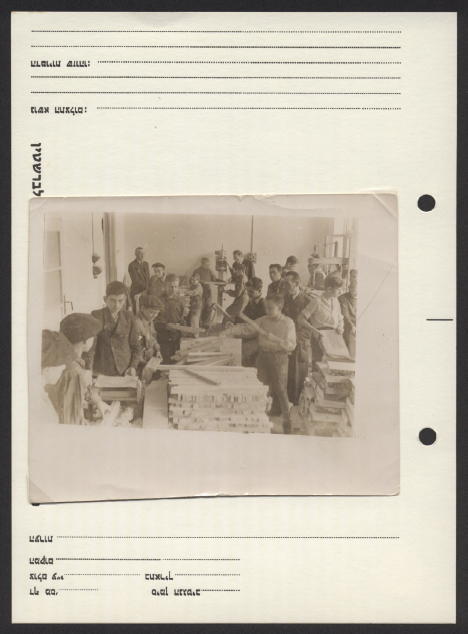
United States Holocaust Memorial Museum. Accession number: 2005.214.2 (File 7, number 22).
Figure 31. Jewish women working in a textile workshop in the Łódź ghetto
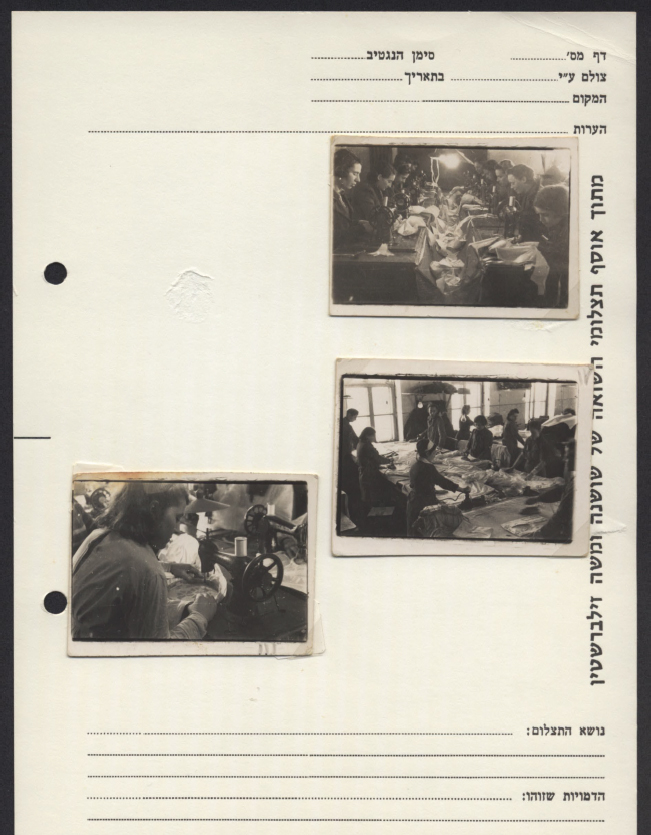
United States Holocaust Memorial Museum. Accession number: 2005.214.2 (File 7, number 29).
From June to July 1944, 7,000 Jewish men and women (along with almost all the remaining children) were deported to Chełmno and murdered inside the gas vans (or by shooting).
| The deportations to Birkenau in August 1944 and the liquidation of the ghetto |
In August 1944, 67,000 Jewish men and women were deported to Auschwitz-Birkenau. It is impossible to know with certainty whether Grossman’s photographs capturing the deportations are from the deportations to Chełmno (January 16, 1942 to September 1942, and June-July 1944) or to Birkenau (August 1944). However, we could assume that the photographs in which there are no children (Figure 32) are probably from 1944 (although there is no certainty as to whether this is so).
Figure 32. Jewish women being deported to Chełmno or to Auschwitz-Birkenau
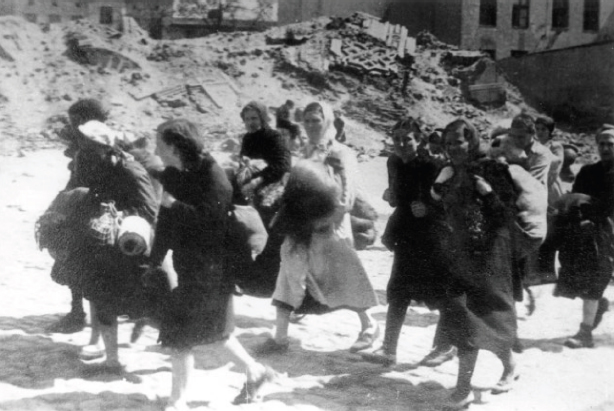
Yad Vashem. Archival signature: 4062/447.
The Łódź ghetto was liquidated on August, 1944. 1,500 Jews were forced to stay in order to liquidate the ghetto (Aufräumungskommando): “In October 1944, some people from this group... were sent to work in factories in Dresden and Königs Wusterhausen” (Sitarek, 2020, p. 22); Grossman was one of them. The members of the Aufräumungskommando who remained in Łódź (about 900) were to be shot in mass graves in the Jewish cemetery, but they managed to hide and ultimately survived.
Only five years earlier, in 1939, there had been in Łódź a vibrant and large Jewish community of 233,000 men, women, and children. Before the Shoah, Łódź had been the second Polish city (after Warsaw) with the largest Jewish population. In five years Łódź has lost forever a precious cultural richness: nearly all its Jewish inhabitants (men, women, and children) were discriminated against, trapped, starved, deported, and murdered in gans vans and in gas chambers.
| Conclusion |
Mendel Grossman’s photographs are an invaluable source for researching the Łódź ghetto. The Judenrat photo albums are extremely valuable, but they must be approached with caution, as their purpose was primarily to highlight the productivity of the ghetto and the ‘good’ conditions of the ghetto (as the albums dedicated to ‘education’ and ‘medical care’ try to demonstrate).
When approaching a photograph, it is crucial to ask: Where and when was the photograph taken? Who took the photograph? A Jewish victim/survivor or a perpetrator? What was the purpose of the photograph? In which archive is the photo located? From which collection is the photo? What is the photo reference number? (even so, we need to be careful about the possible errors –date, attribution– that may be in the archives).
Knowing the events of the Shoah is crucial for analyzing photographs of the ghettos and the Holocaust. All of Grossman’s photographs are heartbreaking because (in retrospect) we know the fate of the victims. Thus, these photos are a powerful and harrowing source that depict the victims alive before their death in the Łódź ghetto, the transports, Chełmno, or Birkenau.
Grossman took many ‘official’ photos and many clandestine ones; they speak of hope and of suffering and death. These photographs do not portray the final fate of the victims; an exception, however, is the series of photographs taken by Grossman of Jewish victims murdered during the deportations (which have not been shown in this paper, out of respect for the murdered victims).
The written contemporary testimonies of the Jewish victims of the Łódź ghetto (personal diaries and The Chronicle of the Łódź ghetto) and the photographs by Grossman and other Jewish photographers (as well as other sources like drawings, contemporary films, paper money and coins, German decrees, newspapers) complement each other. Undoubtedly, every source is unique and extremely valuable, but photography occupies a privileged place in Holocaust research: “The information in photographs is different from verbal descriptions. The details are not the same. Although a snapshot is momentary, it would not be easy to summarize all that it contains in words” (Hilberg, 2001, p. 15). Indeed, a picture is worth a thousand words, and each photograph tells a unique story.
Grossman portrayed hope in the midst of hunger and death in the photos where Zionism is celebrated. The hope of returning to the ancestral land and the perseverance in loving Judaism despite all the persecutions and pogroms that the Jewish people have suffered, the prayers of the Jewish people in the Diaspora facing Jerusalem and the unwavering faith in the return to the homeland perfectly define the powerful resilience of the Jewish people.
In Grossman’s photos, the Jewish victims are humanized; they are not mere numbers. To be able to see the faces of the victims, although in most cases we do not know their names, is both heartbreaking and saddening, but it also brings us a little closer to the harsh reality of the Łódź ghetto.
Some academic books about the Shoah and some Holocaust museums’ websites depict photos by Grossman (and other Jewish photographers), but surprisingly often do not acknowledge the photographer. It would be unthinkable not to properly cite or credit a survivor, historian, or researcher, but with photographs the photographers are often not acknowledged. I argue that it is paramount that academics, historians, writers, and publishers give credit to the Jewish photographers who risked their lives documenting the crude reality of the ghettos. This is not just an academic problem, but a moral issue. Moreover, for serious research, it is crucial to credit the photographer and the archive where the photo is located, as well as the photo reference number.
The clandestine photographs taken by Grossman (and other Jewish photographers) are a symbol of courage, endurance, and defiance. The Jewish inhabitants of the Łódź ghetto did not ‘resist’ or ‘fight’ like those of the Warsaw ghetto and Vilna ghetto; however, the spiritual resistance expressed in cultural, religious, political and national (Zionism), and educational preservation, as well as the act of leaving a record for posterity through clandestinely taken photographs, are a precious triumph in the midst of extermination and annihilation. We could use here the term amidah (as proposed by Yehuda Bauer): standing up against. Even if Havi Dreifuss (2022) states that “Holocaust research should avoid... using the term amidah to describe acts of resistance, as it is a moral term as opposed to a historical one” (p. 51) (the reason she gives is the ambiguity of the term amidah), courageous acts like the one of Grossman do fall under the spectrum of the term amidah and have (or should have) a tremendous impact for historians and Holocaust researchers. Be that as it may, Grossman’s contribution and legacy are a courageous cry against dehumanization and atrocity, and an invaluable source for both the research of the Łódź ghetto and the Shoah.
| References |
Adelson, A. and Lapides, R. (Eds.). (1989). Łódź Ghetto. Inside a Community Under Siege. New York: Viking Penguin.
Arad, Y. (2018). The Operation Reinhard Death Camps. Belzec, Sobibor, Treblinka, rev. and exp. ed. Bloomington: Indiana University Press & Yad Vashem.
Bauer, Y. (2002). Rethinking the Holocaust. New Haven: Yale University Press.
Bergen, D. L. (2010). Antisemitism in the Nazi Era. In A. S. Lindemann and R. S. Levy (Eds.), Antisemitism: A History (pp. 196–211). New York: Oxford University Press.
Browning, Ch. R. (2004). The Origins of the Final Solution. London: Arrow Books.
Browning, Ch. R. (2012). Introduction. In G. P. Megargee and M. Dean (Eds.), The United States Holocaust Memorial Museum. Encyclopedia of Camps and Ghettos, 1933–1945. Volume II: Ghettos in German-Occupied Eastern Europe. Part A (pp. xxvii–xxxix). Bloomington: Indian University Press & USHMM.
Corni, G. (2001). I ghetti di Hitler. Voci da una società sotto assedio 1939–1944. Bologna: Società editrice il Mulino.
Crago, L. (2012). Łódź. In G. P. Megargee and M. Dean (Eds.), The United States Holocaust Memorial Museum. Encyclopedia of Camps and Ghettos, 1933–1945. Volume II: Ghettos in German-Occupied Eastern Europe. Part A (pp. 75–82). Bloomington: Indian University Press & USHMM.
Dobroszycki, L. (Ed.). (1984). The Chronicle of the Lodz Ghetto, 1941–1944 (abridged). (R. Lourie, J. Neugroschel, et al., Trans.). New Haven: Yale University Press.
Dreifuss, H. (2022, February 8). Conceptualizing Jewish Reactions: Between Amidah and Resistance. The Journal of Holocaust Research 36 (1): 50–59. doi:https://doi.org/10.1080/25785648.2022.2025693.
Friedländer, S. (2008). The Years of the Extermination: Nazi Germany & the Jews 1939–1945. London: Phoenix.
Grzegorczyk, A. (2020). The history of the Radegast Station (1941–1944). In Radegast Station. A Guide To A Place of Remembrance (pp. 24–32) (K. Ojrzyńska-Stasiak, Trans.). Łódź: Muzeum Tradycji Niepodległościowych.
Hilberg, R. (2001). Sources of Holocaust Research. An Analysis. Chicago: Ivan R. Dee.
Hilberg, R. (2019). The Destruction of the European Jews. Eastford: Martino Fine Books.
Jacobson, H. (2000). Introduction. In My Secret Camera. Life on the Lodz Ghetto (photographs by Mendel Grossman; text by F. Dabba Smith). London: Frances Lincoln Limited.
Klein, P. (2023). The Wannsee Conference on 20 January 1942. An Introduction. Berlin: Metropol.
Löw, A. (2015). Documenting as a ‘Passion and Obsession’: Photographs from the Lodz (Litzmannstadt) Ghetto. Central European History 48, no. 3: 387–404.
Michna, P. (2020). Modernism in the Lodz Ghetto. A Tentative Interpretation of Forgotten Holocaust Documents. Miejsce 6: 81–111. https://doi.org/10.48285/8kaewzgo3p
Mozer, Y. Dir. (2016). Ben-Gurion, Epilogue; Screen IL, 2024.
Munro, C. A. (2025). Engineered for Mass Murder–The Nazi Gas Vans: 1939-1945. Berlin: Tiergarten 4 Association e. V.
Munro, C. A. (2023, November 22). Understanding the Development of Nazi Mass Murder Policies. Tiergarten 4 Association. https://www.youtube.com/watch?v=ZmanFsidFeU.
Munro, C. A. (2023, May 11). The Science and Engineering of Murder–The Nazi Gas Vans: 1939–1945. Tiergarten 4 Association. https://youtu.be/qbgfZSDjh68.
Muzeum byłego niemieckiego Obozu Zagłady Kulmhof w Chełmnie nad Nerem (n. d.). History of the camp. https://chelmno-muzeum.eu/en/history-of-the-camp/
Pawlicka-Novak, Ł. (Ed.). (2004). Chełmno Witnesses Speak. (J. D. Golden and A. Kaminski, Trans.). Łódz: The Council for the Protection of Memory of Combat and Martyrdom. The Disctric Museum in Konin.
Pressac, J.-C. (1993). Les crématoires d’Auschwitz: la machinerie du meurtre de masse. Paris: CNRS Éditions.
Shapiro, P. A., Rosenfeld, A. H., and Bloomfield, S. J. Preface. In G. P. Megargee and M. Dean (Eds.). (2012). The United States Holocaust Memorial Museum. Encyclopedia of Camps and Ghettos, 1933–1945. Volume II: Ghettos in German-Occupied Eastern Europe. Part A (p. xxv). Bloomington: Indian University Press & USHMM.
Sierakowiak, D. (1998). The Diary of Dawid Sierakowiak. Five Notebooks from the Łódz Ghetto, A. Adelson (Ed.) (K. Turowski, Trans.). New York: Oxford University Press.
Sitarek, A. (2020). The Łódz Ghetto (1940–1944). In Radegast Station. A Guide To A Place of Remembrance (pp. 9–23). (K. Ojrzyńska-Stasiak, Trans.). Łódz: Muzeum Tradycji Niepodległościowych, 2020.
Trębacz, Z. (n.d.). From the city to the ghetto. Żydowski Instytut Historyczny. https://www.jhi.pl/en/articles/from-the-city-to-the-ghetto,435.
Trunk, I. (1977). Judenrat. The Jewish Councils in Eastern Europe Under Nazi Occupation. New York: Scarborough House.
Trunk, I. (1981). Note: Why Was There No Armed Resistance against the Nazis in the Lodz Ghetto? Jewish Social Studies 43, no. 3/4: 329–34.
Trunk, I. (2006). Łódź Ghetto. A History. R. M. Shapiro (Ed. & Trans.) Bloomington: Indiana University Press & USHMM.
Unger, M. (2014). Interview with Dr. Michal Unger, Historian. The Lodz Ghetto. Jackie Metzger, interviewer. Yad Vashem. https://www.yadvashem.org/articles/interviews/michal-unger.html
United States Holocaust Memorial Museum (n.d.). Motto of Mordechai Chaim Rumkowski. https://encyclopedia.ushmm.org/content/en/photo/motto-of-mordechai-chaim-rumkowski
Van Pelt, R. J. (Ed.) (2017). Auschwitz. Not long ago. Not far away. Madrid: Musealia & Ed. Palacios y Museos.
Weisz, G. M. (2022, April). Starvation Genocide: Diabetes and Cancer in the Lodz Ghetto. Israel Medical Association Journal, Vol. 24, no. 4: 207–209.
White, R. J. and Dean, M. (2012). Warthegau region (Reichsgau Wartheland). In G. P. Megargee and M. Dean (Eds.), The United States Holocaust Memorial Museum. Encyclopedia of Camps and Ghettos, 1933–1945. Volume II: Ghettos in German-Occupied Eastern Europe. Part A (pp. 33–38.) Bloomington: Indian University Press & USHMM.
Wiener Holocaust Library (n.d.). Mendel Grosman & Lajb Maliniak: Łódź Ghetto photographs. https://whlcollections.org/grosman-and-maliniak/
Yad Vashem. (n.d.). Jakow Janush Frajtag. https://collections.yadvashem.org/en/names/13941308
Yad Vashem. (n.d.). Lodz Ghetto. https://www.yadvashem.org/holocaust/about/ghettos/lodz.html
Yad Vashem. (n.d.). Mendel Grosman. [sic] https://collections.yadvashem.org/en/names/13974559
Yad Vashem. (n.d.). Pola Znamirowski. https://collections.yadvashem.org/en/names/1313854
Yad Vashem. (n.d.). Transport from Lodz, Ghetto, Poland to Auschwitz Birkenau, Extermination Camp, Poland on 30/03/1943. https://collections.yadvashem.org/en/deportations/12767199.
YIVO Institute for Jewish Research (n.d.). Nachman Zonabend Collection, RG 241. https://archives.cjh.org/repositories/7/resources/3577
Ziółkowska, A. (2012). Koło. In G. P. Megargee and M. Dean (Eds.), The United States Holocaust Memorial Museum. Encyclopedia of Camps and Ghettos, 1933–1945. Volume II: Ghettos in German-Occupied Eastern Europe. Part A (pp. 62–63). (K. Reichelt, Trans). Bloomington: Indian University Press & USHMM.
Photo credits
Ghetto Fighters’ House. https://www.gfh.org.il/
United States Holocaust Memorial Museum. Mendel Grossman Photograph Collection. https://collections.ushmm.org/search/catalog/irn537115
Yad Vashem Photo Collection. https://collections.yadvashem.org/en/photos
YIVO Institute for Jewish Research. Nachman Zonabend Collection, RG 241. https://archives.cjh.org/repositories/7/resources/3577
| Biographical Note |
Dr. Antonia Tejeda Barros (Barcelona, 1975) is a Holocaust researcher at the Tiergarten 4 Association in Berlin (Research of Nazi War Crimes), Doctor in Philosophy (UNED, 2023, cum laude), MA in Philosophy (UNED, 2015, cum laude) and Bachelor of Music (Early Music, Recorder, and Pedagogy, 2002, Koninklijk Conservatorium, The Hague). Her areas of research are the Shoah, antisemitism, Viktor Frankl, Primo Levi, Sartre, Ortega, Hannah Arendt, and Golda Meir. She is writing a book about Sartre, Frankl, Auschwitz and the meaning and meaninglessness of the victims’ suffering. She has been invited to lecture about Viktor Frankl, Primo Levi, and the Shoah at the Centro Sefarad Israel (Madrid, Spain).
_______________________________
Recibido/Received: 21/03/2025
Aceptado/Accepted: 07/07/2025
1 The Einsatzgruppen massacred 2,000,000 Jewish men, women, and children with the effective help of the Wehrmacht, the Orpo (Ordnungspolizei), the Waffen-SS, and the Schuma (Schutzmannschaft) –mainly Ukrainian, Lithuanian, Latvian, and Estonian, without the need of extermination camps: “The mass extermination of the Jews of occupied Europe ... began ... on June 22, 1941 (...) Four SiPo and SD especial SS Einsatzgruppen advanced with the front units of the German army, and one of their ‘special tasks’ was to murder Jews” (Arad, 2018, p. 17). The Einsatzgruppen “followed the Wehrmacht into Soviet territory where they rounded up Jews of all ages and killed them, usually by shooting them into mass graves” (Bergen, 2010, p. 207). The Einsatzgruppen used mainly bullets to massacre Jewish men, women, and children; however, besides shooting, they also used gas vans as a method of extermination.
2 “The main point that contributed to Lodz being the longest surviving ghetto was undoubtedly Jewish forced labor” (Unger, 2014).
3 “On October 26, 1939, almost two months after the German invasion of Poland, the German authorities established Reichsgau Posen, renaming it Reichsgau Wartheland in January 1940 (...) Although the Wartheland is best remembered for the Łódź ghetto, there were in total some 57 ghettos established in the territory” (White and Dean, 2012, p. 34).
4 See Series XIII of the Nachman Zonabend Collection (RG 241) at the YIVO Institute for Jewish Research (n.d.).
5 Less than 24 hours after the proclamation of the State of Israel on May 14, 1948, five Arab nations, Transjordan/Jordan, Egypt, Syria, Lebanon, and Iraq (plus Saudi Arabia, which sent troops under Egypt), supported by the Muslim Arabs of the region, launched a war against Israel (the ancestral land of the Jewish people), invading Israel the day after its (re)birth. As Ben-Gurion stated: “I think this is the unique case in the history of the world ... that a new state, in the same day when it was proclaimed, ... it was attacked by all [its] neighbors” (Mozer, 2016).
6 See the Nachman Zonabend Collection (RG 241) at the YIVO Institute for Jewish Research (n.d.). Some of the Judenrat albums are in Series XII; the photographs are in Series XIII, which include several hundred photographs by Mendel Grossman, Lajb Maliniak, Henryk Ross, Nachman Zonabend, and other unidentified photographers.
7 See the Grossman and Maliniak collection entitled “Mendel Grosman & Lajb Maliniak: Łódź Ghetto photographs, Wiener Holocaust Library”.
8 “Many people have heard of the ghetto in Warsaw and perhaps of others in places such as Kaunas and Łódź. Some people may even have heard that they were ‘hundreds’ of ghettos. But how many people would guess that the Germans alone set up more than 1,100? The Holocaust sites ... existed ... from Poland to Russia, from the Baltic to the Black Sea. Approximately 75 percent of all the victims of the Holocaust lived in that area, and about half of that huge number endured a ghetto experience” (Shapiro et al., 2012, p. xxv).
9 “The ghettoization decree was announced on February 8, and some 162,000 Jews were sealed off on April 30, 1940,” Browning, Introduction, xxix; “On April 30, the gates closed on its 163,777 residents (including 6,741 refugees)” (Crago, 2012, p. 77); “In the spring of 1940 some 164,000 Jews were incarcerated in the Lodz ghetto with no electricity or water. Exploiting Jewish labor, the ghetto lasted for over 4 years” (Yad Vashem, n.d., Lodz Ghetto); “I estimate that about 180,000 Jews were finally closed into the [Łódź] ghetto although the official German estimate was about 164,000” (Unger, 2014).
10 In September 1941 there was one transport of 3,072 Jewish men, women, and children from Włocławek. In spring, summer and fall 1942 only Jews ‘capable for working’ in the Warthegau were deported to the Łódź ghetto (the rest, the elderly, Jewish mothers and their children, were deported directly to Chełmno and murdered); “Deportations from provincial ghettos to Łódź covered approximately 18,000 people” (Grzegorczyk, 2020, p. 24).
11 “The transports arriving every day from October 17 to November 4, 1941, brought a total of 19,945 Jews from Western Europe” (Grzegorczyk, 2020, p. 28).
12 5,007 according to Laura Crago: “From November 5–9, 5,007 Roma arrived from Burgenland, Austria” (Crago, 2012, p. 77).
13 “Beginning on November 5 [1941] and continuing for a few days, transports arrived at the Gypsy camp” (Dobroszycki, 1984, p. 82). Some 700 Roma and Sinti men, women and children died in the ghetto and some 4,300 were later deported to Chełmno and murdered there.
14 “City: Vienna [;] Date of departure: 15 Oct. 41 [;] Arrival 16 Oct. 41” (Browning, 2004, p. 375). Twenty transports of Jewish men, women and children from Vienna, Prague, Luxembourg, Berlin, Frankfurt, Cologne, Hamburg, and Düsseldorf arrived to the Łódź ghetto between October 16 and November 4, 1941. “These were followed by five transports of ‘Gypsies’ from Austria” (Browning, 2004, p. 376). These Roma and Sinti families came from Hartberg, Furstenfeld, Mattersberg, Rotenturm, and Oberwart, and the transports left (respectively) on November 5, 6, 7, 8 and 9, 1941.
15 “City: Cologne [;] Date of departure: 22 Oct. 41 [;] Arrival: 23 Oct. 41” (Browning, 2004, p. 375).
16 “A photographic office functioned within ... [the Statistical Department] from August 1940 to April 1944. The photographers’ official tasks included taking photographs for the identity cards that every ghetto resident had to carry with them, as well as documenting work in the ghetto factories and workshops” (Löw, 2015, p. 392).
17 “The gas vans were constructed such that the Kastenaufbau floor lay substantially above the arches of the rear wheel axle so that a minimum of inside space was wasted, ensuring maximum killing capacity (...) The RSHA Series 1 gas van had an expected maximum killing capacity of 78 persons (...) The RSHA Series 2 gas van had an expected maximum killing capacity of some 114 persons” (Munro, 2025, pp. 77, 87). “The gas vans were horrific for the victims; this is a horrific way to die” (Munro, 2023, May 11).
18 “La mort dans les chambres à gaz était atroce” [Death in the gas chambers was horrific] (Pressac, 1993, p. 76).
19 “On October 17, 1941, Biebow suggested to the Gestapo that the day of rest in the Łódź Ghetto should be changed from Saturday to Sunday (...) The Gestapo gladly accepted Biebow’s suggestion” (Trunk, 1977, pp. 188, 189).
20 Yehuda Bauer clearly states that amidah includes both armed and unarmed resistance: “the Hebrew term amidah ... is almost impossible to translate (...) When I speak of resistance, I mean amidah, and that includes both armed und unarmed actions” (...) What does amidah include? It includes smuggling food into ghettos, mutual self-sacrifice ...; cultural, educational, religious, and political activities taken to strengthen morale; the work of doctors, nurses, and educators ...; and, of course, armed rebellion or the use of force (with bare hands or with ‘cold’ weapons) against the Germans and their collaborators” (Bauer, 2002, p. 120).
21 “The term amidah was first coined in the 1950s and 1960s by Holocaust survivors who were the first researchers of the period (...) Dworzecki analysed aspects of documentation, religious and cultural life during the Holocaust” (Dreifuss, 2022, p. 51); Dworzecki’s perception of amidah was a form of Jewish opposition against destruction and deshumanization. Yehuda Bauer made the term amidah well-known in The Death of the Shtetl. However, Dreifuss (2022) argues that scholars “never produced a clear definition of the term amidah” (p. 52).
22 Overall, during the Shoah, in Chełmno were murdered 156,000–200,000 Jewish men, women and children (and 4,300 Roma and Sinti, and some hundreds of Poles): “Jewish losses by location and/or murder method: Kulmhof (Chelmno): 156-172 thousand” (Van Pelt, 2017, p. 126); “The most probable number of those exterminated is approximately 200,000” (Muzeum byłego niemieckiego Obozu Zagłady Kulmhof w Chełmnie nad Nerem, n.d.). Chełmno operated in two periods: from December 8, 1941 until April 11, 1943, and in June-July of 1944. The first victims were the Jewish men, women and children from the Koło ghetto: “The extermination camp in Chełmno was located only 14 kilometers (9 miles) from Koło. On the first day of the liquidation of the ghetto, about 800 Jews were transferred to [Chełmno] in groups of several dozen by truck. During this aktion, between 2,000 and 2,300 Jews from Koło were killed in Chełmno. The Jews of Koło were the first victims of [Chełmno]” (Ziółkowska, 2012, p 63).
23 “The ill, the sick, the weak, those who can’t walk, slow the process, so therefore they are taken out and shot” (Munro, 2023, November 22).
24 “The Roma [of the Łódź ghetto] were the first to be transported to the extermination center in Chełmno nad Nerem between December 20, 1941, and January 10, 1942” (Crago, 2012, p. 80).
25 According to Crago (2012, p. 80).
26 According to Crago (2012, p. 80).
27 [Our only way is –work!]. Written also in Yiddish (USHMM, n. d.); “Rumkowski perseguì con grande decisione e coerenza la politica dell’ ottimizzazione produttiva, vedendo in essa l’unica possibilità di salvezza” [Rumkowski pursued, with great decision and consistency, the policy of productive optimization, seeing it as the only possibility of salvation] (Corni, 2001, p. 283).
28 “On March 30, 1943, a transport with 945 Jews left the Łódź ghetto for Auschwitz-Birkenau. Our research shows that this was the first transport from the ghetto bound for Auschwitz. However, the reason behind this particular transport is not known” (Yad Vashem, n.d., Transport from Lodz, Ghetto, Poland to Auschwitz Birkenau, Extermination Camp, Poland on 30/03/1943).
29 “Ressort workers labored 10 to 14 hours a day in poorly ventilated, overcrowded workshops, earning wages on a piece-work basis. The wages were held low, because Gau authorities took 35 percent off the top, the GV [Ghetto Administration] another 30 percent, and the Jewish administration another 10 percent. The most skilled worker received at best 4 ghetto mark daily, Non skilled labor received 1 mark” (Crago, 2012, p. 78).