STUDIA HUMANITATIS JOURNAL, 2026, 6(1), e173
ISSN: 2792-3967
DOI: https://doi.org/10.33732/shj.v6i1.173
Artículo / Article
Miscelánea
Miscellaneous section
A PORTAL FOR A DATABASE OF REGULATORY DOCUMENTATION FOR CULTURAL EXPORTS AND IMPORTS
UN PORTAL PARA UNA BASE DE DATOS DE DOCUMENTACIÓN NORMATIVA SOBRE EXPORTACIONES E IMPORTACIONES CULTURALES
Ana Vico Belmonte
Universidad Rey Juan Carlos
ORCID: 0000-0002-2043-8881
ana.vico@urjc.es
Katharina Nothnagel Vivas
Universidad Rey Juan Carlos
ORCID: 0000-0002-7549-547X
katharina.nothnagel@urjc.es
Paula de la Fuente Polo
Universidad Rey Juan Carlos
ORCID: 0000-0001-5460-7607
paulamaria.fuente@urjc.es
Jesús Palomo Martínez
Universidad Rey Juan Carlos
ORCID: 0000-0002-1027-449X
jesus.palomo@urjc.es

| Abstract |
Amid escalating international concern regarding the safeguarding of cultural heritage in contexts of armed conflict and systemic risk, the project Destructive Exploitation and Care of Cultural Objects and Professional/Public Education for Sustainable Heritage Management (DECOPE) addresses critical challenges in heritage conservation, governance, and protection. DECOPE establishes an interdisciplinary and transnational research framework that integrates applied methodologies and institutional cooperation to advance sustainable heritage management and professional capacity building. Within this initiative, Rey Juan Carlos University (Madrid) develops a research strand focused on the antiquities market and the mechanisms ensuring traceability in commercial transactions. Central to this effort is the design and implementation of the Database of Regulatory Documentation for Cultural Exports and Imports, conceived as a tool for systematic monitoring and regulatory compliance. This article presents preliminary findings derived from the analysis of this database, highlighting patterns of documentation, regulatory gaps, and implications for policy development and sustainable heritage governance.
Keywords: Illicit traffic; Cultural heritage protection; Traceability; Regulatory documentation; Sustainable heritage management; DECOPE.
| Resumen |
En el contexto de una creciente preocupación internacional por la protección del patrimonio cultural en situaciones de conflicto, el proyecto Destructive Exploitation and Care of Cultural Objects and Professional/Public Education for Sustainable Heritage Management (DECOPE) se propone abordar algunos de los desafíos más urgentes en materia de conservación, gestión y protección del patrimonio en riesgo. DECOPE articula una red interdisciplinaria e internacional de investigación aplicada y cooperación institucional orientada a la sostenibilidad patrimonial y la formación de profesionales en este ámbito. Dentro del proyecto, la Universidad Rey Juan Carlos de Madrid desarrolla una línea de investigación centrada en el estudio del mercado de antigüedades y los mecanismos de trazabilidad de su comercialización a través de la creación de la Database of Regulatory Documentation for Cultural Exports and Imports, cuyos primeros resultados del análisis realizado se exponen en esta publicación.
Palabras clave: Tráfico ilícito de bienes culturales; Patrimonio cultural; Exportación de bienes culturales; UNESCO; Protección del patrimonio cultural; DECOPE.
| Introduction |
In the context of increasing international concern for the protection of cultural heritage in situations of armed conflict, the project Destructive Exploitation and Care of Cultural Objects and Professional/Public Education for Sustainable Heritage Management (DECOPE) seeks to address some of the most pressing challenges in conservation, management, and safeguarding of endangered heritage assets. Funded with €674,000 by the European initiative Joint Programming Initiative on Cultural Heritage and Global Change (JPI CH), DECOPE establishes an interdisciplinary and international network for applied research and institutional cooperation aimed at heritage sustainability and professional training in this domain.
Coordinated by Josephine Munch Rasmussen of the Norwegian Institute for Cultural Heritage Research (NIKU), the project brings together key entities such as the Norwegian Directorate for Cultural Heritage, Historic Environment Scotland, and Ukrainian organizations including the Museum Crisis Center and the Center for Urban History of East Central Europe. Alongside these institutions, the University of Stirling (UK), under the leadership of Professor Siân Jones plays a central role in developing a research strand focused on the antiquities market and on mechanisms for ensuring traceability throughout its commercialization.
Over its two-year implementation period (2023–2025), extendable in certain countries such as Spain until 2026, DECOPE is conceived as a critical and collaborative research platform to evaluate national and international responses to threats against cultural property in war contexts. Through fieldwork, network analysis, and policy review, the project aims to contribute to the design of effective protocols for heritage protection and capacity building among professionals, with particular emphasis on the Ukrainian case. Complementarily, research on the traceability of cultural objects in the legal antiquities market addresses a key dimension of heritage sustainability: preventing illicit trafficking through customs control tools and market regulation.
Overall, this project operates at the intersection of applied research, international cooperation, and professional training, striving to build sustainable frameworks for fair, efficient, and resilient cultural heritage management in crisis scenarios. In response to the overarching research question—How is care legislated, implemented, and regulated in the fight against the destruction of cultural heritage and the illicit trafficking of cultural property? —our team’s investigation focuses on mapping communication among art market stakeholders against the backdrop of diverse European heritage regulations and other actors combating illicit trade. It addresses misinformation arising from communication barriers and seeks to facilitate stakeholder access to export documentation requirements to better control the movement of artworks. To this end, we will develop a public database of export documentation for cultural artifacts, promoting knowledge and understanding of laws and regulations, thereby supporting due diligence practices and exposing disregard for compliance.
Additionally, using open-source data and netnographic methods, Work Package 4 (WP4) examines the interactions between crimes against cultural property—specifically looting and trafficking—and political violence during Russia’s war against Ukraine. It further explores the corrosive effects of legal nihilism on the behavior of individuals involved in criminal activities, law enforcement agents, and society at large in Eastern Europe, as well as its implications for responses aimed at minimizing cultural and other forms of harm in both victimized countries with manifestly weak rule of law and market countries with ostensibly strong legal frameworks.
| Legal Protection of Cultural Property |
Cultural property is regulated in most States under cultural heritage protection laws. The legal protection afforded to these assets serves both preventive and punitive purposes: it seeks to avert damage before it occurs and to remedy or sanction it once inflicted. Agents causing harm to cultural heritage may vary in nature; protection may be directed against natural forces, human actions, or the deterioration caused by the passage of time. Natural disasters, armed conflicts, theft, acts of vandalism, poor restoration practices, uncontrolled archaeological excavations, illicit transfers between private parties, and unlawful export or import are among the situations that result in damage, loss, or impairment of cultural heritage assets (Yáñez & Rodríguez Temiño, 2021).
Consequently, these assets are legally protected through cultural heritage legislation, and offenses against such property are typically codified in the criminal codes of most States: any act undermining their conservation and defense may be subject to judicial sanction (García Calderón, 2020).
Specifically, protection against the illicit export and import of cultural property is regulated in most national legal systems (Fuentes García, 2020). Complementing these domestic frameworks, an international protection regime exists, comprising three principal treaties addressing the illicit transfer and circulation of cultural property: UNESCO Convention for the Protection of Cultural Property in the Event of Armed Conflict, The Hague, 14 May 1954 (hereinafter “Hague Convention 1954”), the first comprehensive multilateral treaty exclusively dedicated to safeguarding cultural heritage both in peacetime and during armed conflict; UNESCO Convention on the Means of Prohibiting and Preventing the Illicit Import, Export and Transfer of Ownership of Cultural Property, Paris, 14 November 1970 (hereinafter “UNESCO Convention 1970”); UNIDROIT Convention on Stolen or Illegally Exported Cultural Objects, Rome, 24 June 1995 (hereinafter, “UNIDROIT Convention 1995”); and Council of Europe Convention on Offences relating to Cultural Property, Nicosia, 19 May 2017 (“CE Nicosia Convention 2017”).
The UNESCO Convention 1970, ratified by 147 States to date, has had the greatest international impact. In Article 7, it requires States Parties to undertake three key protective measures: adopt safeguarding measures within their territories, control the movement of cultural property, and return stolen cultural property to its country of origin through diplomatic channels. This convention was followed by the 1995 UNIDROIT Convention, which operates within the realm of private international law to facilitate restitution between private entities. The most recent instrument—the 2017 Nicosia Convention—remains the least popular internationally, as most States have shown reluctance to sign and ratify it. Its purpose is to harmonize criminal offenses and sanctions related to illicit trafficking of cultural property among States Parties; however, this objective has often been perceived as an interference with State sovereignty, since it would require amendments to domestic criminal law and the adaptation of national penal systems to internationally agreed standards.
Within the European Union, cultural regulations generally take the form of soft law1, with the notable exception of provisions governing the circulation of cultural goods. Exports, imports, and restitutions are governed by two Regulations (Regulation (EC) No 116/2009; Regulation (UE) 2019/880)—directly applicable in all Member States—and one Directive (Directive 2014/60/EU), which must be transposed into the national legal systems of the Member States.
The rationale for this regulatory framework is grounded in Article 36 of the Treaty Establishing the European Economic Community, Rome, 25 March 1957 (Treaty of Rome), which remains in force under the current Treaty on the Functioning of the European Union (TFEU), 13 December 2007. This provision establishes the sole exception to the free movement of goods among Member States, encompassing services and goods that must be protected by virtue of belonging to the “national artistic, historical or archaeological heritage” (TEU & TFEU, 2007; consolidated version, 2016). From this article, the following interpretations are derived:
- A limitation on the free movement of such goods among Member States;
- The differentiation of these goods from other commodities within the internal market, elevating them above ordinary goods on the basis of their cultural value.
- A restriction on the Union’s competence in the field of cultural property protection, which consequently falls under the responsibility of the Member States (Martín Rebollo, 1994; Julià Barceló, 2022; Sabel del Estal, 2014).
Consequently, each Member State retains sovereign authority to protect cultural property that, as testimony to the nation’s history, must be preserved within its own territorial boundaries. It is therefore incumbent upon the States to define, within their domestic legislation, which objects or antiquities may potentially hold value for their cultural heritage, and which do not—namely, which may circulate freely as commodities, and which must remain within national borders to prevent their loss.
Notwithstanding the existence of national cultural heritage protection laws, the European Economic Community moved swiftly in the early 1990s to regulate the export of cultural goods that might leave the Community’s territory, with the objective of safeguarding the interests of Member States that could otherwise see part of their heritage exit via other Member States. The completion of the internal market under the Single European Act of 1986 strengthened the free movement of goods between Member States, eliminating customs duties and other barriers and thereby stimulating trade and economic growth within the Community. However, this development also created challenges in controlling cultural property belonging to individual States. Importantly, the classical Treaty-based exceptions for the protection of “national treasures possessing artistic, historic or archaeological value,” now codified in Article 36 TFEU (formerly Article 36 EEC), were neither displaced nor undermined. These exceptions continue to allow Member States to maintain or introduce restrictive measures justified on cultural-heritage grounds, subject to the principles of proportionality and non-discrimination. To address this situation, Council Regulation (EEC) No 3911/92 (current Regulation (EC) No 116/2009 of 18 December 2008 on the export of cultural goods) introduced a mechanism enabling Member States to control the export of cultural goods through a certified authorization system in relation to third countries, remaining an exclusive competence of the States to regulate more restrictive controls of export of cultural property out of their territory (including to other Member States)2 (Álvarez Jiménez, 2010). This constitutes a harmonized export control regime complementing national legislation and mandatorily implemented across all Member States. The Regulation includes an Annex listing categories of goods with corresponding age and value thresholds, beyond which an export license must be requested from the competent authority of the State where the goods are located. Upon a positive assessment by the competent authority, such goods may be exported outside the Union’s territory with the requisite license. Conversely, a negative decision prohibits exports beyond Union borders, and in some cases, national law grants the administration a right of pre-emption through an irrevocable purchase offer to the owner3. Nonetheless, situations may arise where national legislation, applying less stringent protection standards than those of the Union, permits the transfer of goods to another Member State, while still requiring authorization for export beyond Union territory.
Complementing current Regulation (EC) No 116/2009, (Directive 2014/60/EU) of the European Parliament and of the Council of 15 May 2014 on the return of cultural objects unlawfully removed from the territory of a Member State and amending Regulation (EU) No 1024/2012 (previous Council Directive 93/7/EEC) was adopted concerning the return of cultural objects unlawfully removed from the territory of a Member State. This Directive provides Member States with a harmonized restitution mechanism more efficient than the diplomatic channels envisaged under the 1970 Paris Convention. It offers stronger guarantees for the return of stolen or illicitly exported cultural property to its country of origin by establishing a clear procedural framework between the requesting and requested States, including defined deadlines, forms of request, and specific requirement.
With these two instruments adopted in 1992 and 1993—and subsequently updated in 2009 (Regulation (EC) No 116/2009) and 2014 (Directive 2014/60/EU)—the remaining legislative gaps concerned the regulation of imports of cultural goods originating from third countries. This was addressed in 2019 with the adoption of Regulation (EU) 2019/880 of the European Parliament and of the Council on the introduction and import of cultural goods. This Regulation arose from the need to protect cultural property illicitly exported from particularly vulnerable regions affected by armed conflict, which could potentially finance terrorist activities by occupying powers in territories such as Syria, Iraq, or Afghanistan. The only viable solution was to implement an authorization mechanism for goods originating from third countries seeking entry into Union territory. This approach also entails recognition of foreign legal frameworks governing cultural property protection. In other words, the Union undertakes to prevent the illicit import of goods classified as cultural heritage under the legislation of their country of origin. This Regulation primarily aims to safeguard the Union’s international security by preventing the circulation of illicit economic flows—in the form of cultural goods—within its territory. Consequently, the art market becomes more secure and legally compliant, albeit inevitably more restrictive.
| Commercialization of Cultural Property |
Cultural Property as a Tradable Asset
Cultural property, as a material manifestation of identity, memory, and creativity within a community, has historically been imbued with multiple layers of meaning—ranging from the symbolic and historical to the artistic and, not least, the economic. Although contemporary institutional and legal discourse tends to emphasize its inalienable character or its necessary public guardianship, the reality is that cultural objects have long been subject to private transactions, international circulation, and economic valuation (Sánchez-Vasconcellos et al., 2020 & Vico et al., 2015). Their marketability does not negate their heritage value; on the contrary, in many instances, it has constituted a mechanism for their preservation (Vico Belmonte, 2015).
Recognizing cultural property as a tradable asset does not necessarily entail a reductive commodification; rather, it acknowledges the active role of non-state actors—primarily private collectors (Fernández-Iriondo Gortázar, 2015) and market agents—in the conservation, restoration, and transmission of heritage objects. Far from contravening the mandate of heritage protection, these actors contribute resources and specialized expertise that frequently exceed the capacities of public administrations, particularly in contexts of economic crisis, armed conflict, or political disinterest.
Historical Development of the Art Market
The art market is not a modern invention but a structure with a long and complex genealogy. Since Antiquity, works of art have circulated as valuable objects within courtly, religious, and aristocratic contexts. During the European Renaissance, the rise of Florentine, Venetian, and Burgundian patrons consolidated a proto-commercial system in which artists, dealers, and collectors operated under emerging logics of supply and demand. Documentary sources attest to the use of auction sales for centuries. However, it was in the seventeenth and eighteenth centuries that collecting practices expanded to the enlightened bourgeoisie, accompanied by the emergence of the first organized auction houses and commercial galleries—such as Spink (London, 1666), which, despite intermittent closures, remains active today, and the renowned Christie’s (1766) and Sotheby’s (1744), initially focused on bibliophilic markets before diversifying into multiple sectors.
Far from posing a threat to heritage, these commercial structures enabled numerous artworks to survive large-scale processes of destruction, including wars, religious reforms, confiscations, and revolutions. Private collecting, sustained by this market, functioned as a parallel network for safeguarding cultural property. Indeed, the art market has evolved into a controlled distribution channel for historical and cultural heritage.
Collecting Before Museums
Prior to the emergence of the modern museum as an Enlightenment public institution —epitomized in the nineteenth century by the Louvre (1793) —major private collectors were the principal custodians of artistic heritage. From Renaissance Wunderkammern to the collections of the Medici, Habsburgs, and Bourbons, Europe’s artistic legacy was accumulated, studied, and preserved in private contexts that later served as the foundation for public collections.
This historical trajectory demonstrates that the conservation of cultural heritage has historically depended on the commitment, taste, and capital of individuals who, through collecting, exercised decisive patronage. The museum is, to a large extent, the heir to this private impulse rather than its negation. To portray collecting as unethical to heritage protection is, therefore, an inaccurate simplification.
The Market as a Mechanism for Heritage Protection
The legal art and antiquities market, regulated under clear ethical and legal standards4, constitutes today an essential channel for sustaining a form of collecting committed to heritage protection. This market not only facilitates the circulation and visibility of works but also their restoration, documentation, and historical contextualization, through the work of auction houses, galleries, specialized dealers, and informed collectors. Furthermore, by establishing criteria for traceability, provenance, and certification, the formal market contributes to combating illicit trafficking and provides tools for customs control and fiscal oversight of cultural property.
In this context, the value of lawful collecting must be recognized as a form of civic participation in the protection of cultural heritage. Through private investment, collectors assume a significant portion of the costs that would otherwise fall exclusively in the States. This private subsidy to public responsibility helps ensure the survival of works and objects whose conservation might otherwise be jeopardized by institutional neglect or resource scarcity.
Ultimately, an intelligent and sustainable cultural policy should not exclude collecting or the art market but rather integrate them as strategic allies in the protection and dissemination of cultural heritage. The contemporary challenge lies in designing regulatory frameworks that enhance their heritage dimension, guarantee the legality of transactions, and foster transparent collaboration between public and private sectors.
| Illicit Trafficking of Cultural Property |
Circulation and Transfer of Cultural Property: Between Legality and Regulatory Gaps
The circulation and transfer of cultural property constitute an essential dimension of international trade in art and cultural heritage. In legal terms, these practices refer to the set of operations involving the transfer of ownership, physical relocation, and assignment of rights over cultural objects, whether within the domestic market or across international borders. It is important to underscore that there is no autonomous and universally recognized criminal offense of “illicit trafficking of cultural property,” which has resulted in significant normative disparities among States. Illegality does not arise from circulation per se but from its concurrence with criminal conduct typified under various legal systems, such as theft, larceny, misappropriation, forgery, smuggling, or intentional damage.
In most cases, the problem lies not in the act of circulation itself but in the absence of traceability, the lack of effective controls, and non-compliance with administrative regulations on export, heritage protection, or conservation. This situation has rendered illicit trafficking in cultural property (ITCP) a form of criminality that operates invisibly and in parallel within the legal market, hindering criminal prosecution and facilitating the cultural laundering of objects originating from illicit contexts.
Concurrence of Criminal Offenses within the Framework of ITCP
Although ITCP is not autonomously codified in most jurisdictions, it frequently overlaps with offenses expressly recognized in national criminal codes, as exemplified by the Spanish case:
- Crimes of damage to Historical Heritage (Articles 321–324) of the Organic Law 10/1995, of 23 November, on the Criminal Code (“Spanish Criminal Code”): penalizing acts ranging from the demolition of protected buildings to intentional or negligent damage to cultural, archaeological, or documentary assets.
- Crimes of administrative malfeasance (Article 322 of the Spanish Criminal Code): involving public authorities who authorize alterations that may constitute unlawful actions against protected heritage.
- Crimes of heritage smuggling Spanish Organic Law 12/1995, of 12 December, on the Suppression of Smuggling (“Spanish Law on Suppression of Smuggling”): sanctioning the illegal export of assets forming part of the Spanish Historical Heritage when exceeding a value of €50,000.
- Administrative infringements under the Spanish Law 16/1985, of 25 June, on Spanish Historical Heritage (“LPHE”, by its Spanish acronym) and Royal Decree 111/1986, of 10 January, partially implementing Law 16/1985, of 25 June, on Spanish Historical Heritage (“RD 111/1986”): including fines of up to €601,000, restitution obligations in some cases5, and limitation periods ranging from 5 to 10 years depending on severity.
Additionally, looting, as defined in Article 4 of the LPHE encompasses any act or omission that endangers the historical, artistic, or cultural values of a protected asset or disturbs its social function. Article 149.1.28 of the Spanish Constitution, in turn, grants the State exclusive competence over the protection of Spain’s cultural, artistic, and monumental heritage against export and plundering. While this constitutional provision does not provide a substantive definition of looting, it establishes the legal basis for State intervention. This framework enables the Spanish Ministry of Culture to adopt immediate protective measures, even in the absence of a criminal judgment.
A Singular Market: Distinctions from Other Forms of Organized Crime
Illicit trafficking in cultural property differs from other forms of organized criminality in its ability to blend seamlessly with the structures of the legal market. Unlike drug, arms, or human trafficking, ITCP frequently operates through recognized intermediaries—auction houses, galleries, and digital platforms—where objects progressively lose their illicit provenance due to the absence of reliable registries or the use of falsified documentation.
Nevertheless, this form of criminality is deeply intertwined with international networks of money laundering, terrorist financing, and organized crime, offering high profitability with comparatively low levels of criminal risk. The “Operación Pasante,” conducted jointly by the Spanish Civil Guard and the Italian Police between 2014 and 2018, revealed the scale of these networks: more than 148 individuals implicated and hundreds of archaeological objects recovered, many already in transit toward the legal art market. The investigation began after authorities learned that an organization dedicated to the looting of artworks from Italian archaeological sites was allegedly commercializing them through various dealers specializing in such objects. During the operation, three Italian nationals were arrested, and a significant group of archaeological pieces originating from Italy—where they had previously been looted—was intercepted at the port of Barcelona (Ministerio de Cultura y Deporte, 2018).
Collecting as a Protective Agent of Heritage
Within this complex scenario, responsible collecting plays a pivotal role as a containment barrier against illicit trafficking and as an active agent in the protection and conservation of cultural heritage. Far from constituting a threat, collectors acting in compliance with legal frameworks and ethical codes contribute significantly to safeguarding historical legacy.
The democratization of art has brought profound transformations to the cultural sphere. It has not only enabled society at large to access and enjoy works in cultural institutions but also to acquire cultural property within the art market, which has grown steadily due to greater accessibility, sector professionalization, the development of new sales channels, and the perception of cultural goods as investment assets.
This dynamic illustrates how plural access to a well-regulated and monitored art and antiquities market can serve as a heritage defense mechanism, particularly when private collectors collaborate with public institutions in documenting, studying, and exhibiting acquired objects. Many collectors act as temporary custodians of cultural property that eventually returns to the public domain through loans, donations, or deposits in museums and archives.
It is therefore essential to distinguish between ethical and lawful collecting—guided by principles of provenance, traceability, and protection—and actors who facilitate illicit circulation. Consequently, measures against ITCP should not demonize the art market per se but rather strengthen mechanisms of control, transparency, stakeholder training, and international cooperation.
| Methodology |
To achieve the objectives set forth by the project—namely, to provide protection for cultural heritage, particularly that which is especially vulnerable in situations of armed conflict through the study of its legal safeguards—an open-access tool was designed to be practical, intuitive, and user-friendly. This tool, the Database of Regulatory Documentation of Cultural Exports and Imports, consolidates information previously dispersed across multiple sources, some of which were outdated and/or contradictory, into a single open-access digital environment. The data have been adapted to ensure clarity and usability for all stakeholders in the art market, including collectors, museums, institutions, and law enforcement agencies, enabling them to consult, when necessary, the legal requirements for the lawful and informed export of cultural property. This initiative seeks to resolve a critical accessibility gap in information, addressing a key contemporary need within the art and antiquities market.
Sample Composition
The development of the database required a systematic investigation of a broad sample of countries with significant presence in the art and antiquities market, characterized by high volumes of transactions, exports, and imports. To date, 102 territories (96 countries and 6 special administrative regions) have been analyzed. The countries included in the database are organized by continent as follows:
- Africa: Morocco, Algeria, Egypt, Libya, South Africa, Tunisia.
- Asia: Saudi Arabia, China (+ Hong Kong), South Korea, United Arab Emirates, Philippines, Japan, India, Iran, Iraq, Israel, Malaysia, Qatar, Singapore, Syria, Thailand, Taiwan.
- Central America: Belize, Costa Rica, Cuba, El Salvador, Guatemala, Honduras, Nicaragua, Panama, Dominican Republic.
- Europe: Albania, Germany, Andorra, Austria, Belgium, Belarus, Bosnia and Herzegovina (+ Srpska), Bulgaria, Vatican City, Czech Republic, Cyprus, Croatia, Denmark (+ Greenland, Faroe Islands), Slovakia, Slovenia, Spain, Estonia, Finland, France (+ French Guiana), Greece, Hungary, Ireland, Iceland, Italy, Kosovo, Latvia, Liechtenstein, Lithuania, Luxembourg, North Macedonia, Malta, Moldova, Monaco, Montenegro, Norway, Netherlands, Poland, Portugal, United Kingdom, Romania, Russia, San Marino, Serbia, Sweden, Switzerland, Turkey, Ukraine.
- North America: Bahamas, Canada, United States (+ Puerto Rico), Mexico.
- South America: Argentina, Bolivia, Brazil, Chile, Colombia, Ecuador, Guyana, Paraguay, Peru, Suriname, Uruguay, Venezuela.
- Oceania: Australia and New Zealand.
Data
The dataset comprises heterogeneous information: legal data derived primarily from interpretative analysis of regulatory frameworks and administrative data obtained through direct consultation of official sources. The diversity and complexity of the data collected necessitated its structuring into seven distinct datasets to ensure systematic management. These datasets encompass all categories of information gathered throughout the project.
The investigation of this sample has generated a defined yet highly heterogeneous volume of data, which was structured into seven datasets to ensure systematic management. These data blocks encompass all categories of information collected throughout the project:
- Legal Framework: The first dataset compiles information on the national, supranational (in the case of the European Union), and international legal frameworks. National frameworks typically include, at a minimum, a cultural heritage protection law, although in many cases regulation is fragmented across multiple legal instruments addressing specific domains such as archaeological heritage, movable property, and the export and import of cultural goods. Regarding the international normative framework, the dataset records the conventions ratified by each State (UNESCO Convention, 1954; UNESCO Convention, 1970; UNIDROIT Convention, 1995; UNESCO Convention, 2001; Council of Europe Convention, 2017). Additionally, data have been collected regarding the temporary implementation of special protective measures—such as those adopted by the United Nations Security Council—for cultural heritage particularly vulnerable in conflict zones such as Ukraine, Syria, and Iraq. Finally, bilateral agreements concerning the control of export, import, and restitution of cultural property maintained by each State, where applicable, have also been compiled.
- Levels of Cultural Heritage Protection: The interpretation of diverse regulatory frameworks on cultural heritage protection—at least one per State—necessitated the development of a standardized method for classifying the levels of protection granted to cultural property, including movable assets. The protection levels established are as follows:
- Level 1: Registered movable property, non-exportable
o Level 1a: Unregistered movable property, non-exportable6
- Level 2: Registered movable property, exportable subject to prior authorization
- Level 3: Unregistered movable property, exportable subject to prior authorization
- Level 4: Unregistered movable property, exportable without authorization 7
These protection levels serve as a preliminary classification for analytical purposes. In the publicly accessible database, the legal denominations, categories of protected heritage, and definitions of cultural property established under national legislation have been incorporated.
- Art Market: Information has been gathered on regulatory requirements governing the art market, particularly provisions related to the trade in antiquities. The data compiled are heterogeneous and not uniformly present across all legal systems. They include: due diligence obligations; mandatory maintenance of transaction records by dealers; licensing requirements for trading in antiquities; the State’s right of pre-emption; mandatory notification to the competent authority prior to the sale of protected cultural property; among others.
- Export Process: This category provides data concerning the procedures for requesting and obtaining authorization for the export of cultural property from the Ministry of Culture or other competent authority8. The dataset includes: types of export permits issued in each country (permanent, temporary, temporary with sale option, certificate of free circulation, General Open Licence, Special Open Licence, etc.); established communication channels for submitting applications; processing times; validity periods of issued certificates; and identification of competent authorities responsible for certifying export authorizations, including their contact details.
- Import Process Proceso de importación: This category compiles information on import procedures under the same parameters—and to the extent provided by law and accessible—as those applicable to export processes.
- Transit and Customs: Data have been collected on the validity of ATA Carnets in each State9, documentation required for customs clearance, contact details of customs offices, customs posts authorized for the declaration of cultural property10, applicable tariffs, existing free trade agreements, customs unions, and other transit arrangements between countries.
Sources Used
The primary sources employed were national regulations on cultural heritage protection, supplemented in some cases by legislation governing export and import, as well as customs laws. A key source was direct access to official web portals where Ministries of Culture and other competent authorities publish information regarding export procedures. Additional resources and repositories consulted include: WIPO Lex, UNESCO Database of National Cultural Heritage Laws, UNODC SHERLOC Legislation Database, The Compendium of Cultural Policies and Trends, and the legislative repository of the German Ministry of Culture.
Type of Research
The nature of the database allowed the collected data to be processed for multiple purposes, resulting in a bimodal research approach. First, a descriptive study was conducted to present the collected data to the target audience in a clear, concise, and updated manner through open access to the Database of Regulatory Documentation of Cultural Exports and Imports11. Second, an analytical study was carried out on the same dataset to obtain an overview of the heterogeneity among import and export processes and to explore contradictions and implications of cultural heritage policies implemented at the national level across European countries. These inconsistencies enable us to identify the degree of consensus—or the challenges—in achieving unified heritage protection throughout Europe.
Given the large sample of countries, multiple borders, and diverse approaches to heritage management, such disparities may negatively impact the preservation of cultural property and its protection against illicit trafficking. It is therefore essential to understand in which regions legal conditions may passively facilitate—or fail to prevent—the unlawful removal and circulation of such assets.
It is essential to identify the regions where the prevailing legal frameworks may passively—whether intentionally or not—facilitate the unlawful removal and circulation of cultural property.
| Results |
The data extracted yield, at both global and European levels—where specific case analysis permits—the following categories of results:
- Findings related to protection levels derived from the interpretation of national legislation;
- Findings concerning the types of export certificates or mechanisms through which institutions and legislation authorize the removal of cultural property;
- Administrative communication channels established in each country or region for submitting export authorization requests;
- Import modalities, particularly whether States provide a mechanism for prior authorization before customs declaration or require post-import notification to the competent ministry or authority;
- The degree of data accessibility.
The frequency of protection-level combinations identified through interpretation of national legislation reveals a predominant global pattern: the combined use of Levels 1 and 3, observed in 37.7% of the countries analyzed, primarily in Europe and South America.
Secondly, 21.7% of jurisdictions legislate to prohibit the permanent removal of cultural heritage, conferring the highest level of protection on all objects classified as heritage. This category includes a majority of American States—Guatemala, Panama, El Salvador, Honduras, Dominican Republic, Costa Rica, Puerto Rico (which legislates independently of the United States in cultural heritage matters), Paraguay, and Bolivia—as well as European jurisdictions such as Bosnia and Herzegovina (including the Srpska region), Croatia, Cyprus, and Vatican City. In Asia and Africa, exclusive application of Level 1 predominates in MENA countries: Morocco, Libya, Egypt, Tunisia, Syria, Saudi Arabia, and Iraq prohibit permanent export of heritage assets. Additional exceptional cases include the Philippines and India in East Asia. Most of these States, however, provide mechanisms for temporary export authorization under strict conditions: limited duration; comprehensive insurance coverage (“nail-to-nail”); return in identical conservation status; issuance of post-reentry reports; and justification of export for temporary exhibitions, cultural exchange, research, or restoration.
Conversely, Level 4—effectively a “non-protection” level—was identified in 5.7% of countries and regions that either lack legislation or, despite legislating, do not provide an authorization mechanism for the removal of cultural property. This category includes Guyana, Hong Kong, Suriname, Bahamas, Singapore, and San Marino. It should be noted that this list also encompasses jurisdictions combining Level 4 with other protection levels: Monaco, Liechtenstein, Malaysia, Switzerland, the United States, the Netherlands, and Cuba. Overall, Level 1 remains the most widely applied standard, whether exclusively or in combination with other levels.
Within Europe, jurisdictions that do not employ an export authorization mechanism represent only 1.9%. Generally, Level 1 protection is frequently applied, although its exclusive use declines by more than half compared to global figures, evidencing a trend toward greater openness of the antiquities market in Europe.
Based on their functional purpose and standardized nomenclature, the various types of export certificates authorized in each country were identified (see Figure 1). Most jurisdictions provide multiple certificate types. The most common combination includes certificates authorizing temporary export and those permitting permanent removal of cultural property, such as the case of Spain. An exceptional case is the exclusive use of the temporary export certificate without offering other types, in the obvious case of the countries mentioned above whose legislation protects them with a maximum level of protection. The most frequent combination of certificates are those authorizing temporary departure and those authorizing the temporary or permanent departure of assets from one's own territory. It is worth noting the minority use of a type of export that we have called "Business", it is an exit certificate for a large number of pieces in a period of time that is usually established from 5 to 10 years, depending on the country and that is mainly intended for use by antiques dealers to export work abroad. Countries such as the United Kingdom, Canada, Australia, and Poland have implemented this type of certificate.
Figure 1. Usage of different types of Exports Permits
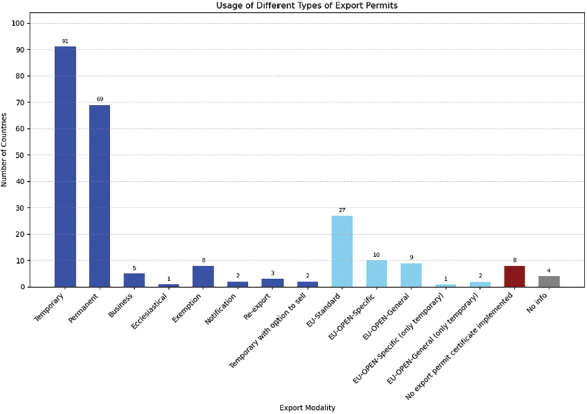
Within the European Union, pursuant to Council Regulation (EC) No 116/2009 on the export of cultural goods, three certificate types exist, of which the “Standard” certificate is mandatory, while the two “Open” certificates—intended for antiquities dealers, private collectors, and cultural institutions—are optional for Member States. European countries that actively implement “Open” certificates include France, Italy, Poland, Germany, and Belgium. Cyprus and Croatia also apply them, albeit restricted to temporary use for participation in exhibitions abroad. Additionally, the “Temporary with option to sell” certificate authorizes export for fairs and converts into a permanent export if the object is sold abroad. This permit requires either re-entry of the object or formal declaration of its sale to the Ministry of Culture. Only Spain and Portugal currently implement this certificate.
An exceptional case is Germany, which, in addition to temporary and permanent export certificates, “Business” certificates, and other EU-standard authorizations, includes the “Ecclesiastical” certificate—exclusively applicable to church property—whose removal requires prior authorization from the ecclesiastical institution.
The “Exemption” certificate encompasses a diverse nomenclature, including: “Non-Protection Certificate,” “Certificate of Free Circulation”, “Certificate of Exemption”, and “Certificate of Clearance”. Functionally, it operates almost as an authorization for permanent export, as it permits unrestricted disposal and removal from the national territory. It is applied to cultural property that does not meet the minimum statutory conditions for protection under the heritage law of the State in which it is located, yet still requires verification certifying its “non-protected” status. Belgium, Australia, and New Zealand are notable examples of jurisdictions implementing this certificate.
The “Notification” type, rather than constituting an authorization certificate, is a written notice submitted by the owner of the cultural property to the ministry or other competent authority for objects subject to this administrative mechanism under national law. It is typically used for objects enjoying lower levels of protection. Notification is not subject to examination or approval by the competent authority; it functions solely as a formal declaration of the intended removal of such property, as in the case of Argentina.
No information regarding certificate types was obtained for four countries, and eight countries or regions do not implement any certification system: Hong Kong, United States, Guyana, Suriname, Bahamas, India, Singapore, and San Marino. Among these, Hong Kong, Guyana, Suriname, Bahamas, Singapore, and San Marino lack regulation concerning movable cultural property. The United States does regulate certain categories, particularly indigenous heritage, while other objects circulate freely. India, despite applying Level 1 protection to all cultural property, does not implement an export authorization mechanism, based on the data collected.
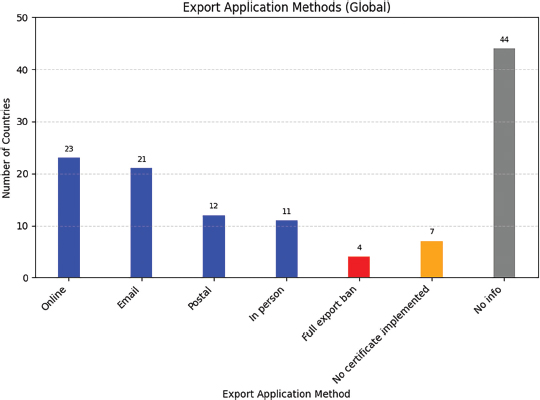
Regarding communication channels for submitting export certificate applications available to natural and legal persons, a significant number of countries—44 in total—do not publicly disclose this information. As shown in Figure 2, the most commonly implemented method is online application platforms, followed by email submission. Twelve countries still employ postal submission, and eleven allow in-person applications. Notably, several jurisdictions provide multiple submission methods; however, only three countries—Albania, Guatemala, and Cuba—restrict applications exclusively to in-person submission at the offices of the competent authority. Bolivia, Slovakia, Ukraine, Japan, and Algeria combine in-person submission with postal delivery or rely solely on postal methods, indicating the absence of digital application systems. Global data proportions mirror those observed in the European sample.
Figure 2. Export application methods
In contrast to export data, analysis of import authorization regulations reveals a marked imbalance between existing export and import frameworks: import permits are implemented in only 43.40% of the countries analyzed, compared to 92.16% for export permits. As illustrated in Figure 3, jurisdictions requiring export authorization more than double those requiring import authorization.
Figure 3. Import Implementation by Country
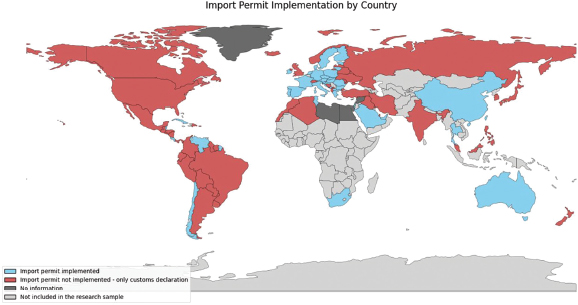
Nevertheless, import procedures are generally regulated in national legislation through a single provision implementing the obligations arising from State ratification of the UNESCO Convention 1970. This incorporation into domestic law imposes an obligation on owners or holders of cultural property to declare such objects to customs authorities upon entry into the country, accompanied by the export certificate issued by the competent authority of the State of origin, where required by its legislation. However, in most cases, no mechanism exists for prior authorization of cultural property imports before entry into the national territory.
Accordingly, the import process—similar to export—comprises two distinct administrative procedures: first, the authorization granted by the competent ministry for the entry of such goods into the country; and second, the customs declaration of the object at the moment of its physical entry into the territory. In addition to these, a third procedure exists in certain jurisdictions, such as Portugal, Montenegro, Greece, North Macedonia, Tunisia, and Spain: post-entry declaration to the competent ministry once the object has been legally imported. This declaration is generally subject to a statutory time limit following entry and is intended to confer fiscal benefits or unrestricted disposal rights within the country for a subsequent period—ten years in the case of Spain—during which the object may be re-exported without impediment by the competent authority, provided all preceding export and import procedures have been lawfully executed. In 55 of the 106 countries and regions analyzed—representing more than half—a customs declaration alone suffices for the introduction of cultural property. Nearly half of these jurisdictions are located in Europe, as detailed in Figure 4, presenting a paradox given that the European Union has regulated imports since 2019 under Regulation (EU) 2019/880 of the European Parliament and of the Council on the introduction and import of cultural goods, which entered into force in June 2025 with the implementation of the ICG (Import of Cultural Goods) system. This system obliges all EU Member States to verify the legitimacy and provenance of cultural goods imported from third countries. However, the group of jurisdictions requiring only customs declaration consists primarily of non-EU countries.
Figure 4. Import modalities of cultural goods into European countries
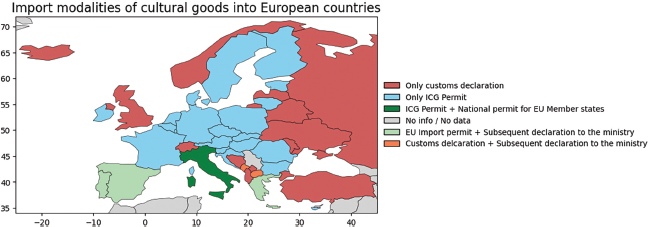
Moreover, among EU Member States, only Malta and Italy maintain national mechanisms for import authorization applicable also to intra-EU transfers. Conversely, Greece, Portugal, and Spain—while lacking a national authorization mechanism—do regulate post-import declaration to the competent authority. Noteworthy non-European jurisdictions providing prior import authorization mechanisms include: South Africa, Taiwan, United Arab Emirates, China, Israel, Saudi Arabia, Thailand, Cuba, Belize, Costa Rica, Australia, Venezuela, and Chile.
In total, the jurisdictions implementing both prior export and import authorization represent 43.40% of the countries analyzed, considering the application of the EU import permit for goods originating from third countries. Excluding the EU mechanism, the proportion drops to 22.64%, meaning that the European regulation is effectively responsible for nearly doubling the number of countries imposing pre-import controls on cultural property.
Regarding data on market security and “sales records,” these were extracted directly from the provisions of national cultural heritage legislation. Given the heterogeneity of the data, a more detailed and extensive study remains necessary; however, preliminary findings indicate that only a subset of countries regulate such matters—whether by requiring a dealer’s license, maintaining a mandatory “sales record,” identifying clients, or notifying the competent authority prior to the sale of potentially protected objects. Approximately 32.08% of jurisdictions lack any regulation in this regard, with the highest concentration of regulatory gaps observed in Europe, the Americas, and Asia, including major markets such as the United States, the United Kingdom, Singapore, and Hong Kong.
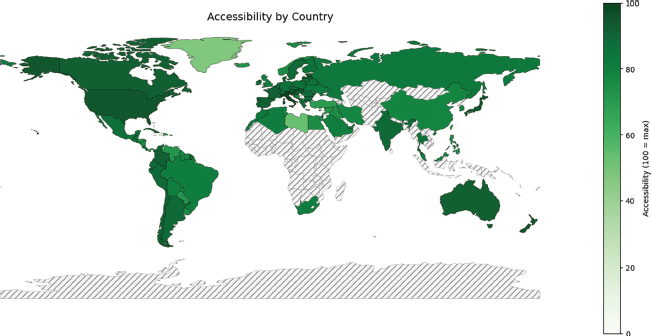
Finally, the analysis of data accessibility, as illustrated in Figure 5, reveals the significant difficulty in obtaining information necessary to complete administrative procedures—such as applying for export authorization—in a lawful and informed manner. Europe ranks as the continent with the highest accessibility, with Italy being the only country for which complete data were obtained. Overall, 17.90% of the required information proved inaccessible. Countries presenting the greatest challenges include those affected by conflict (e.g., Libya, Venezuela, Syria), small European States (e.g., Monaco, Andorra, Liechtenstein, Kosovo), several Central and South American countries, and certain regions such as Hong Kong and the Danish territories.
Figure 5. Accessibility by country
| Discussion |
The results reveal a high degree of heterogeneity in the classification and application of protection levels, as well as in administrative procedures—both in terms of certificate types and communication channels with competent authorities for export authorization. An increase in heterogeneity correlates with a heightened risk of illicit trafficking in cultural property. Given the transnational nature of such trafficking, these divergences can be exploited to launder the illicit provenance of cultural goods originating from smuggling. The success of cross-border and cross-jurisdictional trafficking is largely determined by differences, agreements, and inconsistencies among States in their legislative frameworks, ratified conventions, protection levels, and administrative processes.
Furthermore, jurisdictions with highly developed art markets tend to adopt more lenient legislation, with lower frequency of export certificate implementation. This leads to the conclusion that export certificates constitute an obstacle to the free trade of cultural goods—yet equally to the illegitimate trade thereof—by eliminating a key security mechanism within the market. Authorization certificates thus function as instruments of cultural property protection and market integrity. In most countries with high volumes of art and antiquities exports, regulatory frameworks lack provisions governing art market operations, such as mandatory “sales records,” dealer licensing, and other preventive measures previously discussed.
Within Europe, a distinctive scenario emerges wherein certain States—those belonging to the European Union—operate under a dual-layered protection system combining national and supranational regulations. This arrangement partially mitigates heterogeneity among national frameworks concerning exports to third countries. However, the presence of open borders among most EU Member States entails a significant risk of cross-border trafficking of protected heritage. Additionally, a marked imbalance persists between Member and non-Member States regarding import certificate implementation. Globally, the scarcity of import regulation represents the reverse side of cultural heritage protection: every export from one jurisdiction necessitates an import into another, and both processes should be governed by robust pre-authorization mechanisms to prevent illicit flows while promoting secure trade in cultural goods.
The research has encountered—and continues to face—numerous challenges, notably the harmonization of nomenclature and identification of functionally equivalent certificates and procedures operating under divergent designations across jurisdictions. The greatest challenge, however, lies in mitigating the risk of obsolescence. Regulatory frameworks and administrative procedures evolve over time, generating two critical issues: first, the coexistence of updated and outdated data within sources during the research phase, complicating information extraction; and second, the need for continuous maintenance of the database to ensure its utility for stakeholders and its capacity to support ongoing analyses of market security vis-à-vis illicit export. This complexity is compounded by the high degree of data fragmentation across sources, resulting in contradictions that were resolved to deliver reliable, unified information within a centralized digital environment, the Database of Regulatory Documentation of Cultural Exports and Imports. Decentralization, fragmentation, incompleteness, and obsolescence in original sources hinder informed decision-making, create inconsistencies even within a single jurisdiction, and obstruct comprehensive analysis and efficient data utilization.
Data accessibility emerged as an unexpected finding during the research, becoming evident when ministries, competent authorities, customs offices, and other entities failed to respond to information requests—even when submitted by a recognized academic institution specializing in art market and illicit trafficking research at the international level. In some cases, recourse was made to associations of antiquarians, free ports, and other market actors; however, most requests remained unanswered. This challenge is exacerbated in certain jurisdictions by political instability, raising doubts as to the effective implementation of statutory measures—for example, in Libya, Syria, or Israel.
To date, the expected outcomes have been achieved: the Database of Regulatory Documentation of Cultural Exports and Imports has been published, providing a centralized, accessible, and user-friendly environment for consulting country-specific administrative procedures for export/import authorization and customs formalities. In addition to the analysis presented herein, the research yielded unexpected yet conclusive findings regarding data accessibility. Pending tasks include the collection of detailed information on customs procedures and tariff applications; comprehensive analysis of regulatory data concerning the art market; and continuous updating of the database to maintain its functionality for market actors, collectors, institutions, customs authorities, and law enforcement agencies.
| Conclusions |
Illicit trafficking of cultural property constitutes a serious threat to historical memory, the identity of peoples, and international security. An effective response must be multilateral, integrating criminal and administrative frameworks, strengthening international cooperation mechanisms (UNESCO, INTERPOL, UNIDROIT, EU), and recognizing the constructive role of private actors within the art market. In this regard, the DECOPE project has sought to reinforce ties among the various protection stakeholders, including the art market. To this end, the project has examined the legal frameworks governing the export and import of cultural goods in jurisdictions most relevant and active in the market, with the aim of providing clarity on procedural aspects. This analysis has revealed, through the work of the project’s researchers, the existence of a global legal architecture that is often inaccessible, opaque, and inconsistent, rendering it ineffective as a tool for safeguarding cultural heritage.
Within this context, lawful, informed, and culturally committed collecting should not be perceived as an adversary but rather as a strategic ally in the fight against transnational crime. The development of public registries, certificates of origin, traceability systems, and ethical codes, combined with rigorous enforcement of the law, will enable the consolidation of a legal ecosystem in which cultural property can circulate without jeopardizing its integrity or legitimacy.
The international circulation of cultural goods within the art trade raises complex legal and ethical challenges that demand a multidisciplinary approach. The absence of an autonomous criminal classification for ITCP has led to normative fragmentation, hindering effective prosecution and allowing this form of criminality to infiltrate the legitimate market through laundering mechanisms and lack of traceability. ITCP is distinguished from other forms of organized crime by its ability to integrate into lawful market structures, complicating detection and sanction. This peculiarity calls for the reinforcement of control systems, traceability, and international cooperation, as well as a critical review of public policies that, rather than adopting indiscriminate punitive approaches, should prioritize transparency, stakeholder training, and the articulation of heritage protection network.
A comparative analysis of national legislation on the protection, export, and import of cultural goods reveals significant normative diversity. Intermediate protection models—combining levels 1 and 3—predominate in 37.7% of countries, particularly in Europe and South America, while 21.7% adopt an absolute protection regime prohibiting the definitive export of any cultural property. At the opposite end, level 4 or non-protection, present in 5.7% of cases, poses substantial risks in terms of traceability and control, underscoring the need for international normative harmonization.
Regarding export certificates, a trend toward diversification is observed, with temporary and definitive certificates prevailing, alongside specialized modalities such as “Business,” “Temporary with option to sell,” and “Ecclesiastical,” which respond to the specific needs of the art market and collecting practices. The common framework established by Regulation (EC) No. 116/2009 provides flexibility, although its implementation varies among Member States.
Finally, data accessibility emerges as a critical factor for ensuring transparency and the effectiveness of heritage control systems. Disparities in administrative procedures and import/export mechanisms highlight the urgency of advancing toward greater standardization and digitalization of processes.
In sum, the findings of the project indicate that sustainable management of cultural heritage in a global context requires coordinated action among States, cultural institutions, market operators, and collectors, grounded in best practices, international cooperation, and a firm commitment to legality and heritage preservation. While efforts are evident to balance heritage protection with the dynamism of the cultural market, significant challenges persist in terms of normative coordination, traceability, and accessibility. The consolidation of best practices, the strengthening of international cooperation mechanisms, and the promotion of ethical and transparent collecting emerge as key elements for an effective global strategy against illicit trafficking of cultural property.
| Funding |
This research, carried out by a team from Rey Juan Carlos University led by Professor Ana Vico, has been funded by the Spanish State Research Agency (Agencia Estatal de Investigación, AEI) under reference PCI2023-143383 (MCIN/AEI/10.13039/501100011033), and supported by the European Union within the research project entitled “Destructive Exploitation and Care of Cultural Objects and Professional/Public Education for Sustainable Heritage Management” (DECOPE), funded with €674,000 by the European Joint Programming Initiative on Cultural Heritage and Global Change (JPI CH). The project has been coordinated by the Norwegian Institute for Cultural Heritage Research (NIKU), Rey Juan Carlos University, and the University of Stirling. Its main objective is to advance knowledge and understanding of mobilization for the protection of cultural heritage in contexts of conflict and their aftermath.
| References |
Álvarez Jiménez, J. I. (2010). La protección del patrimonio cultural europeo frente a la exportación ilegal. Revista de Derecho UNED, 6, 13. https://doi.org/10.5944/rduned.6.2010.10997
Consolidated Versions of the Treaty on European Union (TEU) and the Treaty on the Functioning of the European Union (2016/C 202/01) (TFEU). https://eur-lex.europa.eu/legal-content/ES/TXT/?uri=celex%3A12016ME%2FTXT
Council of Europe. (2017). Convention on Offences Relating to Cultural Property.
Council Regulation (EC) No 116/2009 of 18 December 2008 on the export of cultural goods. (2009). Official Journal of the European Union, L 39, 1–7.
Directive 2014/60/EU of the European Parliament and of the Council of 15 May 2014 on the return of cultural objects unlawfully removed from the territory of a Member State, and amending Regulation (EU) No 1024/2012 (recast). (2014). Official Journal of the European Union, L 159, 1–10.
Fernández-Iriondo Gortázar, P. (2015). El coleccionista, agente protector y recuperador del patrimonio histórico. En I. González Galey (Dir.), III Encuentro Profesional sobre Lucha contra el Tráfico Ilícito de Bienes culturales: El mercado del arte como agente protector del patrimonio histórico (pp. 65–85). Ministerio de Educación, Cultura y Deporte.
Fuentes García, J. (2020). Aspectos jurídicos del tráfico internacional de obras de arte. La Albolafia: Revista de Humanidades y Cultura, 20, 219–244. https://dialnet.unirioja.es/descarga/articulo/7720603.pdf
García Calderón, J. M. (2020). La falsificación de bienes arqueológicos y su tratamiento por el derecho penal: El problema del expolio invertido. Revista d’Arqueologia de Ponent, 30, 455–468.
Julià Barceló, M. (2022). La acción exterior de la Unión Europea en la protección del patrimonio cultural: Especial referencia a la política común de seguridad y defensa. Revista de Derecho Comunitario Europeo, 26(71), 63–104. https://doi.org/10.18042/cepc/rdce.71.03
Law 16/1985, of 25 June, on Spanish Historical Heritage. (1985).
Martín Rebollo, L. (1994). El comercio del arte y la Unión Europea. Fundación Universidad-Empresa: Civitas.
Ministerio de Cultura y Deporte. (2018, 13 de julio). Restituidos a Italia bienes arqueológicos recuperados en España por la Guardia Civil. Gobierno de España. https://www.cultura.gob.es/actualidad/2018/07/20180713-arqueologia.html
Organic Law 12/1995, of 12 December, on the Suppression of Smuggling. (1995).
Regulation (EU) 2019/880 of the European Parliament and of the Council of 17 April 2019 on the introduction and import of cultural goods. (2019). Official Journal of the European Union, L 151, 1–14.
Royal Decree 111/1986, of 10 January, partially implementing Law 16/1985, of 25 June, on Spanish Historical Heritage. (1986).
Sabel del Estal, M. (2014). Circulación y tráfico ilícito de bienes culturales en la Unión Europea. Cuaderno Electrónico de Estudios Jurídicos, 3, 113–148. https://dialnet.unirioja.es/servlet/oaiart?codigo=5074927
Sánchez-Vasconcellos, A., Vico, A., & Palomo, J. (2020). Los puertos francos y su influencia en el mercado del arte. La Albolafia: Revista de Humanidades y Cultura, 19, 211–238.
UNESCO. (1954). Convention for the Protection of Cultural Property in the Event of Armed Conflict.
UNESCO. (1970). Convention on the Means of Prohibiting and Preventing the Illicit Import, Export and Transfer of Ownership of Cultural Property.
UNESCO. (2001). Convention on the Protection of the Underwater Cultural Heritage.
UNIDROIT. (1995). Convention on Stolen or Illegally Exported Cultural Objects.
Vico Belmonte, A. (2015). El mercado del arte, formación de una profesión para proteger el patrimonio histórico. En I. González Galey (Dir.), III Encuentro Profesional sobre Lucha contra el Tráfico Ilícito de Bienes culturales: El mercado del arte como agente protector del patrimonio histórico (pp. 45–54). Ministerio de Educación, Cultura y Deporte.
Vico, A., Palomo, J., & Laguna, M. P. (2015). La rentabilidad de las obras de arte: Estudio de los entornos propicios para la venta de bienes artísticos y de colección. Dyckinson.
Yáñez, A., & Rodríguez Temiño, I. (2021). ¿Cuánto valen los platos rotos? JAS Arqueología.
| Biographical notes |
Ph.D. Ana Vico Belmonte is a Senior Lecturer «Profesora Titular» at the Rey Juan Carlos University (URJC) in the Department of Business Economics. She has an extensive academic background, holding a Bachelor’s degree in History with a specialisation in Archaeology from the Autonomous University of Madrid UAM, a PhD in Business Economics (2010) and a PhD in History (2015) from the URJC, and is a Corresponding Member of the Royal Academy of History. Her research focuses on the field of Cultural Economics (the art market, cultural industries and the management of historical heritage). She is currently the director of the Master’s Degree in Art Market Management at the URJC. She has worked at auction houses in New York, Zurich, London and Madrid. She has participated in several competitive international projects focused on combating money laundering and the financing of organised crime and terrorism, funded by the European Commission, NATO and other institutions. She is currently the Principal Investigator (PI) of the European project “Destructive Exploitation of Cultural Objects and Professional/Public Education for Sustainable Heritage Management. JPI CH CHSE Cultural Heritage Society and Ethics 2022”, whilst also participating in other national projects. She has published 22 articles in indexed journals and a further 60 in journals across various fields, as well as 9 books and 43 book chapters. He is a member of the Organising Committee for the Feriarte and Almoneda art fairs, and is a Corresponding Member of the Federal Institute of Numismatic Researchers of the Republic of Argentina.
Katharina Nothnagel Vivas is a pre-doctoral researcher employed by URJC on the DECOPE (JPI CH CHSE) project, “Destructive Exploitation of Cultural Objects and Professional/Public Education for Sustainable Heritage Management”, funded by the Spanish National Research Council and supported by the European Commission. She holds a Bachelor’s degree in Art History (2021) from the University of Zaragoza, a Master’s degree in Art Market Management (2022) from Rey Juan Carlos University, and is a PhD student in the Humanities at the university’s International Doctoral School, where she is working on her thesis on the art market and the illicit trafficking of cultural property.
Paula de la Fuente Polo is a State Museum Curator. Since 2024, she has been working in the Sponsorship and Business Development Department at the Reina Sofía National Art Museum. She holds a double degree in History and Tourism from the URJC, and a Master’s degree in the Art Market from the Distance Learning University of Madrid (UDIMA), where she was awarded the Master’s Degree Special Prize. She has participated as a researcher in the European DECOPE project, which aims to combat the illicit trafficking of cultural property, and has helped organise exhibitions and academic events, including ‘25th Anniversary: From Tradition to Innovation’ (URJC, 2022). Her academic output includes publications on collecting and the art market, such as Identity and Historical and Artistic Heritage before and during the Spanish Civil War (2024), Collecting and the Art Market in the 19th and 20th Centuries: The Little-Known Case of the Harris Family (2017), as well as articles in specialist journals. She contributes to the Master’s in Art Market Management (URJC), addressing issues related to collecting, museology and the protection of cultural heritage. She is currently pursuing her PhD at Rey Juan Carlos University.
Ph.D. Jesús Palomo Martínez been a Professor in the Department of Business Administration at Rey Juan Carlos University since 2006. He holds a PhD in Computer Science and Mathematical Modelling, as well as a Master’s degree in Business Administration and a Master’s degree in Management Computer Science. He is currently co-director of the Research Group on Good Governance of Public and Private Institutions at the URJC and president of the Observatory of Defence Economy and Industry at the Madrid Association of Economists. Previously, he was a visiting researcher at the University of Surrey (UK), the NATO Defence College (Rome), and the Platform of Asset Recovery Offices (DG Home Affairs, EC), the National Research Council (Italy), Duke University (USA), the University of California, Santa Cruz (USA), the National Institute of Environmental Health Sciences (USA), and the Danish Institute for Social Research (Denmark). He is currently the Principal Investigator for the project “The challenge of managing the EU’s next-generation plan: threats and weaknesses in the Spanish institutional framework”, and “Further follow-up actions in the EU”. He has published over 60 research articles, books and book chapters, and has led more than 20 international projects on Security and Defence, including serving as Research Director of the ISEC Project Centre of Excellence on Asset Recovery and Training; Principal Investigator in the ISEC Project Portfolio on Organised Crime; and the ISEC Project on Combating.
_______________________________
Received / Recibido: 24/11/2025
Accepted / Aceptado: 07/05/2026
1 Soft law encompasses normative instruments—such as declarations, guidelines, and codes of conduct—that, while not legally binding, shape the behavior of States. In contrast, hard law consists of legally binding norms, typically embodied in treaties or legislation, which create enforceable rights and obligations.
2 Article 167 of TFEU, includes treaty-level exceptions for the circulation of goods pertaining to cultural Heritage, keeping Member States competence in cultural matters.
3 This refers to the public administration’s statutory right of pre-emption in the context of export control. Under certain national heritage laws, as it happens in Spain, an application for an export licence is deemed, by operation of law, to constitute an irrevocable offer to sell the object to the State at the value declared by the owner. If the export authorisation is subsequently refused on grounds of cultural interest, the administration may exercise its preferential acquisition right and purchase the object at the declared price. This mechanism reconciles the restriction on export with the protection of the owner’s economic interests, while ensuring the retention of culturally significant property within the national territory.
4 Such standards have explicitly been adopted through various codes of conduct in the art market: the Code of Ethics of the Art Dealers Association of America (ADAA); the British Art Market Federation (BAMF) Code of Conduct; the European Fine Art Foundation (TEFAF) Guidelines; the UNESCO International Code of Ethics for Dealers in Cultural Property; and the Confédération Internationale des Négociants En Oeuvres D’art (CINOA) Code of Ethics and Charter.
5 According to Article 29.1 of the Spanish Historical Heritage Act (LPHE), restitution is not applicable in circumstances where objects forming part of the Spanish cultural heritage have been illicitly exported and thereby become the property of the State from the moment of export without the requisite authorisation.
6 This sub-level is primarily found in the most protective regulatory frameworks for cultural heritage. It typically applies in cases where States provide only the highest level of protection (Level 1) as the sole category. In such instances, all cultural property defined by law is deemed non-exportable, regardless of whether it is registered. Generally, these jurisdictions require mandatory registration of all such assets, making this sub-level relatively rare. A potential, albeit unintended, analytical use of this level would be to classify cultural property for which permanent export applications have been denied; once denied, these objects are registered and thus fall under Level 1.
7 Level 4 could theoretically apply to contemporary art; however, given that contemporary works are generally subject to exceptional protection through national registries, this category does not encompass them. Level 4—the lowest level of protection—applies to objects falling within the statutory definition of cultural property for which no specific protective measures are prescribed. These objects are typically of some antiquity, remain unregistered, and do not require an export certificate.
8 This section does not include any of the export procedures that must be carried out at the time of declaring the goods at customs. These are specified under the category “Transit and Customs.”
9 The ATA Carnet facilitates the temporary movement of goods between countries participating in the agreement, without the obligation to pay customs duties or other taxes related to temporary importation and re-export to another destination. This provision is of particular interest for cultural property participating in trade fairs or temporary exhibitions abroad.
10 In the case of the European Union, the list of customs offices authorised to carry out the export procedures for cultural goods is published in the Official Journal of the European Union (2018/C 230/13), in accordance with the provisions of Article 5(2) of Council Regulation (EC) No 116/2009.
11 https://cicecurjc.es/cicec (Accessed: 30/5/2025).