
The deadly virus: the impact of yellow fever on the French expeditionary force in Saint Domingue, 1802
Abstract
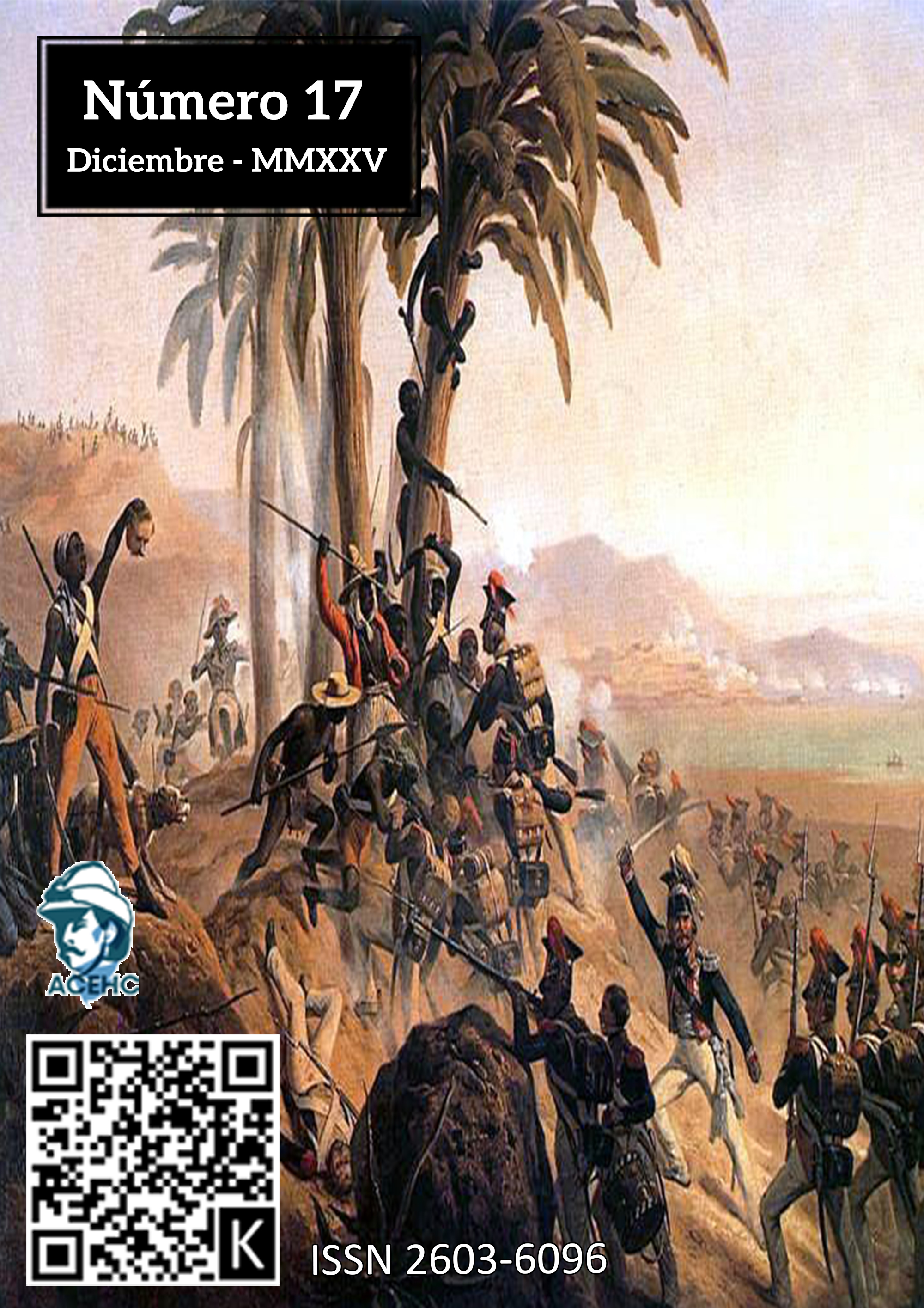
Taking advantage of the preliminary peace agreements of Amiens, signed in London with his traditional enemy Great Britain between October and December 1801, Napoleon Bonaparte, consul of the French Republic, organised and deployed a formidable expeditionary force consisting of 35 ships of the line and 21 frigates, which secured Spanish and Dutch participation and which mobilised, in its first phase, 24,500 soldiers from elite European regiments, veterans of the campaigns of the Rhine, the Alps, and the Nile, and 4,500 sailors. The operation sought to regain control of the island of Hispaniola, as the metropolis, cut off from the Antilles theatre by the English naval blockade since 1793, controlled it through Toussaint Louverture. The island lay under French sovereignty and remained divided into two separate colonies, Saint Domingue and Santo Domingo, but in December 1800, the black general took the former Spanish part and unified them into a single political entity, giving it a constitution without the consent of Paris. The reconquest campaign was Napoleon's response to the insolence of Toussaint de Breda, who had been elevated to governor for life. The French landing took place in February 1802, and by the end of March, the reconquest troops had defeated the indigenous army. In May, the rebel leader was captured and sent to France in June. However, the pacification campaign was halted in April by the appearance of a silent and deadly virus that ravaged the troops during the summer, leading to military defeat and the failure of the enterprise.References
ANOM - Archives Nationales d’Outre Mer, Aix en Provence, legajos CC9A – 32 - CC9B.
Arnold, David. Warm Climates and Western Medicine, 1500–1900. Amsterdan, Edition Rodopi, 1996. DOI: https://doi.org/10.1163/9789004418448
Arnold, David. La naturaleza como problema histórico. El medio, la cultura y la expansión de Europa. México: Fondo de Cultura Económica. 2000.
Benot, Yves. La Révolution française et la fin des colonies 1789-1794. Paris: Éditions La Découverte, 1987.
Blancpain, François. Histoire de Saint Domingue – Haïti. Matoury Guyane, Ibis Rouge Éditions, 2016.
Bloch, Marc. Introducción a la historia. México, Fondo de Cultura Económica, 1952
Branda, Pierre y Lentz, Thierry. Napoleon, l’esclavage et les colonies. Paris, Le Grand Livre du Mois, 2006,
De Cauna, Jacques. Haïti l’éternelle révolution. Histoire de la décolonisation (1789-1804). Paris, Éditions des Régionalismes, 2009.
Chanlatte, Juste. Histoire de la catastrophe de Saint Domingue. Paris, Librairie Peytieux, 1824.
Desportes, Pouppé. Traité ou abrège des plantes usuelles de Saint Domingue. Paris, Chez Lejay, 1770.
Dubois, Laurent. Avengers of the New World. The Story of the Haitian Revolution. Cambridge, Harvard University, 2004. DOI: https://doi.org/10.2307/j.ctv322v50g
Gaffarel, Paul. La Politique coloniale en France de 1789 à 1830. Paris, Félix Alcan Éditeur, 1908.
Gillet, Jean-Claude. La Marine Impériale. Le grand rêve de Napoléon. Paris, Bernard Giovanengeli Éditeur, 2010. DOI: https://doi.org/10.14375/NP.9782758700623
Girard, Philippe. “Black Talleyrand: Toussaint Louverture´s Diplomacy”, The William and Mary Quarterly, 66(1), 87–124.
Girard, Philippe. The Slaves who defeated Napoléon. Tuscaloosa, University of Alabama Press, 2011. DOI: https://doi.org/10.2307/jj.30346986
Héctor, Michel y Moïse, Claude. Colonisation et esclavage en Haïtí. Le régime colonial français à Saint Domingue, 1625-1789. Montréal, Deschamps – CIDIHCA, 1990.
Kernéis, Jean Pierre. “En lisant l’histoire des médecins et des pharmaciens de la marine et les colonies, de Pierre Pluchon et ses coauteurs”, Revue Historique, vol. 257, n.2, 1986, 445-465.
Kotar, S.L. y Gessler, J.E. Yellow Fever. A Worldwide Perspective. Jefferson, McFarland and Company, 2017.
Leclerc, Charles Emmanuel. Lettres du général Leclerc, commandant en chef de l’Armée de Saint Domingue en 1802. Paris, Société de l’histoire des colonies françaises, 1937.
Lepkowski, Tadeusz. La agricultura y la cuestión agraria, Haití. La Habana, Casa de las Américas, 1964.
McClellan III, James. Colonialism and Science. Saint Domingue in the Old Regime. Chicago, University of Chicago Press, 1992.
Métral, Antoine. Histoire de l’expédition française à Saint Domingue, sous le consulat de Napoléon Bonaparte. Paris, chez Manget et Cherbuliez, 1818.
Mézière, Henri. Le General Leclerc (1772 – 1802) et l’expédition de Saint Domingue. Paris, Tallandier, 1990.
Ortega y Medina, Juan. Teoría y crítica de la historiografía científico-idealista alemana (Guillermo de Humboldt-Leopoldo Ranke). México, UNAM, 2019.
Tarrade, Jean. Le commerce colonial de la France à la fin de l’ancien régime. Paris, Université de Paris, 1972.
Trouillot, Michel Rolph. Silencing the Past. Power and Production of History. Boston, Beacon Press, 1995.
Wallerstein, Immanuel. El moderno sistema mundial III. La segunda era de gran expansión de la economía mundo capitalista, 1730-1850. México, Siglo XXI Editores, 2006.
License
Copyright (c) 2025 Carlos Alberto Murgueitio Manrique

This work is licensed under a Creative Commons Attribution-NonCommercial 4.0 International License.
##plugins.themes.default.displayStats.downloads##
Similar Articles
- Jonathan Jacobo Bar Shuali, Carlos Alberto Murgueitio Manrique, General Leclerc’s Expedition on Saint-Domingue (1802): Historiography, Military Units and Collective Accounts , Guerra Colonial. Colonialismo, procesos postcoloniales y relaciones internacionales: No. 17 (2025)
- Johanna Von Grafenstein, Español An Unsuccessful Enterprise. Victor Emmanuell Leclerc ´s Expedition in Anglosaxon, French and Haitian Sources , Guerra Colonial. Colonialismo, procesos postcoloniales y relaciones internacionales: No. 17 (2025)
- José de Jesús Rodríguez Monreal, Permanent Army and Recruitment in Mexico at the Time of the North American Invasion, 1846-1847 , Guerra Colonial. Colonialismo, procesos postcoloniales y relaciones internacionales: No. 4 (2019): June- MMXIX
- Loles González-Ripoll, Leclerc or the brief ‘time of illusion’: emotions about Saint Domingue from the printed word , Guerra Colonial. Colonialismo, procesos postcoloniales y relaciones internacionales: No. 17 (2025)
- Guadalupe de la Fuente Salido, Maximilian Imperial Army during the second french invasión of Mexico , Guerra Colonial. Colonialismo, procesos postcoloniales y relaciones internacionales: No. 5 (2019): December - MMXIX
- Antonio Jesús Pinto Tortosa, “I did not come to Santo Domingo as an enemy”: Santo Domingo’s invasion by Toussaint Louverture (1801-1802), prelude to Leclerc’s expedition to Saint-Domingue , Guerra Colonial. Colonialismo, procesos postcoloniales y relaciones internacionales: No. 17 (2025)
- Marisa Margarita Pérez Domínguez, Gonzalo Aurelio Esteva y Landero: A Figure of Mexican Diplomacy in Italy , Guerra Colonial. Colonialismo, procesos postcoloniales y relaciones internacionales: No. 16 (2025)
You may also start an advanced similarity search for this article.
Most read articles by the same author(s)
- Jonathan Jacobo Bar Shuali, Carlos Alberto Murgueitio Manrique, General Leclerc’s Expedition on Saint-Domingue (1802): Historiography, Military Units and Collective Accounts , Guerra Colonial. Colonialismo, procesos postcoloniales y relaciones internacionales: No. 17 (2025)